Cobb angle and curve type predict progression in adolescent idiopathic scoliosis patients
Curve type, flexibility, correction, and rotation are predictors of curve progression in patients with adolescent idiopathic scoliosis undergoing conservative treatment : a systematic review
Systematic reviewMixed results
What morphological factors predict curve progression in adolescent idiopathic scoliosis undergoing conservative treatment?
Who
Patients with adolescent idiopathic scoliosis
Compared
Unbraced patients: Cobb angle > 25° and thoracic curves were predictive
Braced patients: flexibility < 28% and limited in-brace correction were predictive
Main outcome
Curve progression in adolescent idiopathic scoliosis
Bottom line: Cobb angle, curve type, flexibility, and correction rate are strong predictors of curve progression.
Limitation: Some predictors like apical vertebral rotation and pelvic tilt have low evidence.
Bone Joint J · 2022-04-01Download image
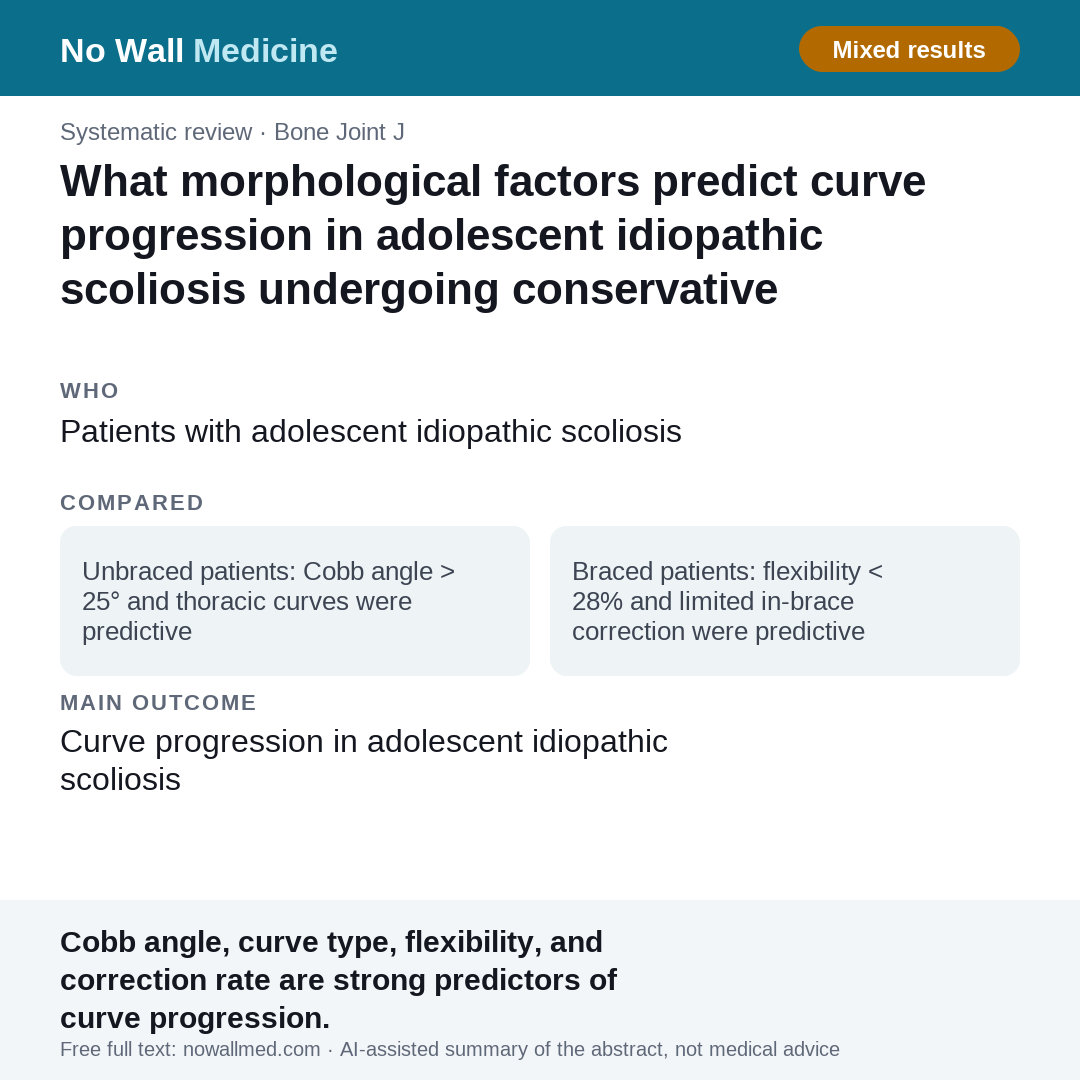
Clinical question: What morphological factors predict curve progression in adolescent idiopathic scoliosis undergoing conservative treatment?
Why it matters: It is unclear which specific spinal curve characteristics and morphological features best predict the risk of progression in adolescents receiving conservative treatment.
Key points
- Researchers reviewed 26 publications containing 25 datasets to identify morphological predictors of spinal curve progression in adolescent idiopathic scoliosis.
- For unbraced patients, an initial Cobb angle greater than 25° and thoracic curves were predictive of progression.
- In braced patients, flexibility less than 28% and limited in-brace correction were predictive of curve progression.
Headline and key points written with AI from the paper’s abstract, with every number checked against it. Read the paper before relying on them.
Was this summary helpful?
Subject terms
Cite this article
Wong LPK, Cheung PWH, Cheung JPY. Curve type, flexibility, correction, and rotation are predictors of curve progression in patients with adolescent idiopathic scoliosis undergoing conservative treatment : a systematic review. Bone Joint J. 2022. doi:10.1302/0301-620X.104B4.BJJ-2021-1677.R1
Spotted a mistake? Suggest a correction
Top studies every Monday
The week’s key trials and guidelines in your specialties, plus any topics you follow. By email, free.
Get the weekly digest