Anatomical mapping and ink-based perfusion assessment provided a framework for sheep perforator flap research
Cutaneous perforator mapping and ink-based perfusion assessment in an ovine model: An anatomical study and systematic review
Anatomical study and systematic reviewBenefit found
What are the perforator anatomy and cutaneous perfusion characteristics in an ovine model?
Who
7
Seven adult ewes
Compared
Deep circumflex iliac: 650 ± 84 cm²
Cranial tibial: 188 ± 36 cm²
Main outcome
Perforator coordinates, pedicle length, vessel diameter, and perfused cutaneous area
Bottom line: The study provides a reproducible framework for anatomical and functional characterization of cutaneous perforators in sheep.
JPRAS Open · 2026-06-25Download image
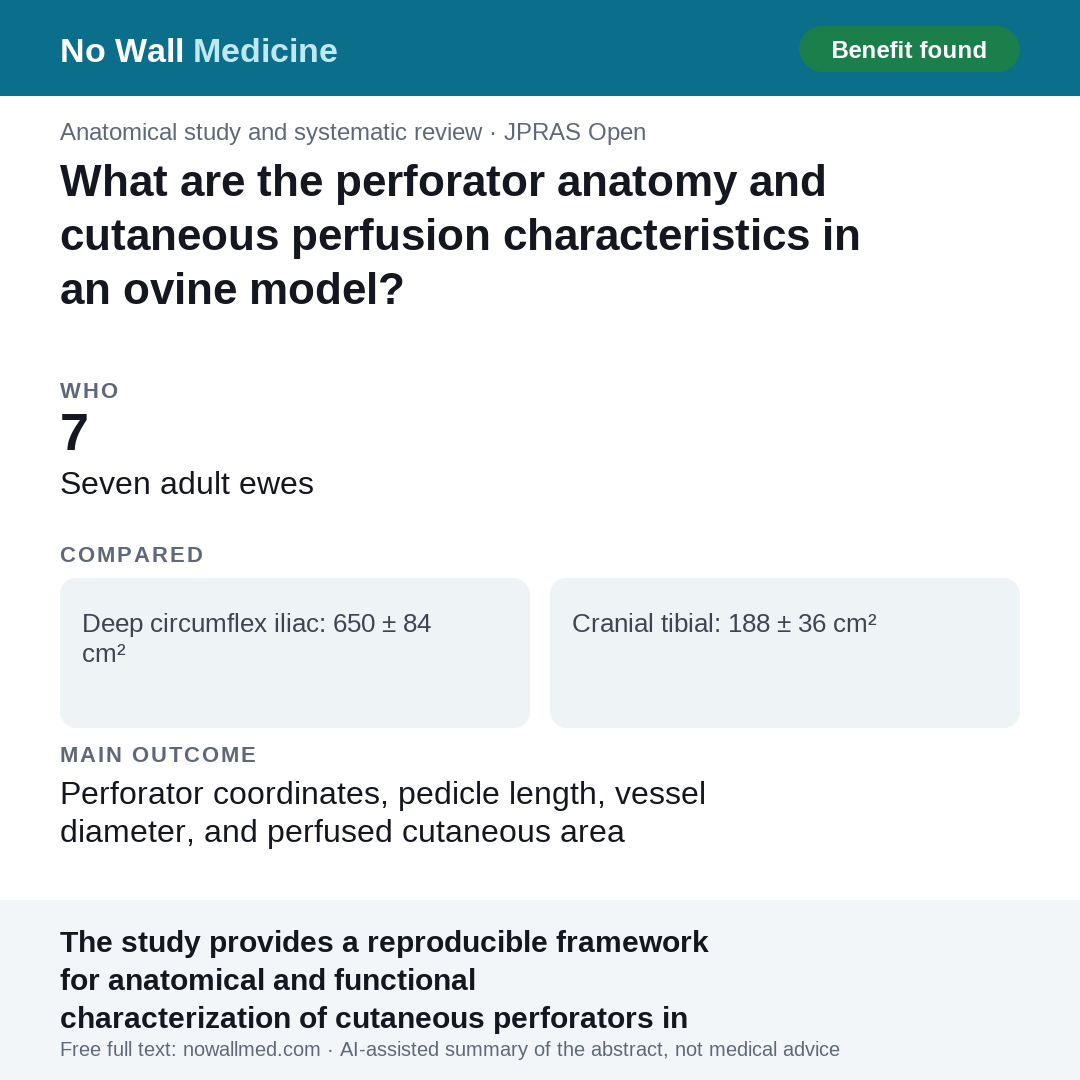
Clinical question: What are the perforator anatomy and cutaneous perfusion characteristics in an ovine model?
Why it matters: Data integrating systematic anatomical mapping with functional perfusion assessment in sheep models are scarce for designing reconstructive surgery flaps.
Key points
- Researchers conducted a systematic review of eight studies and an anatomical study on seven adult ewes involving 70 total perforators.
- The study identified five dominant pedicles with mean lengths ranging from 7.25 ± 1.57 cm to 17.43 ± 2.23 cm.
- Mean perfused skin areas measured between 188 ± 36 cm² for the cranial tibial vessel and 650 ± 84 cm² for the deep circumflex iliac vessel.
Headline and key points written with AI from the paper’s abstract, with every number checked against it. Read the paper before relying on them.
Cite this article
Lancien U, Passemard L, Thuau F, Lahmar T, Gauthier O, Charbonnier B. Cutaneous perforator mapping and ink-based perfusion assessment in an ovine model: An anatomical study and systematic review. JPRAS Open. 2026. doi:10.1016/j.jpra.2026.06.014
Spotted a mistake? Suggest a correction