Cutaneous Perforators and Their Clinical Implications on Intrinsic Hand Flaps: A Systematic Review
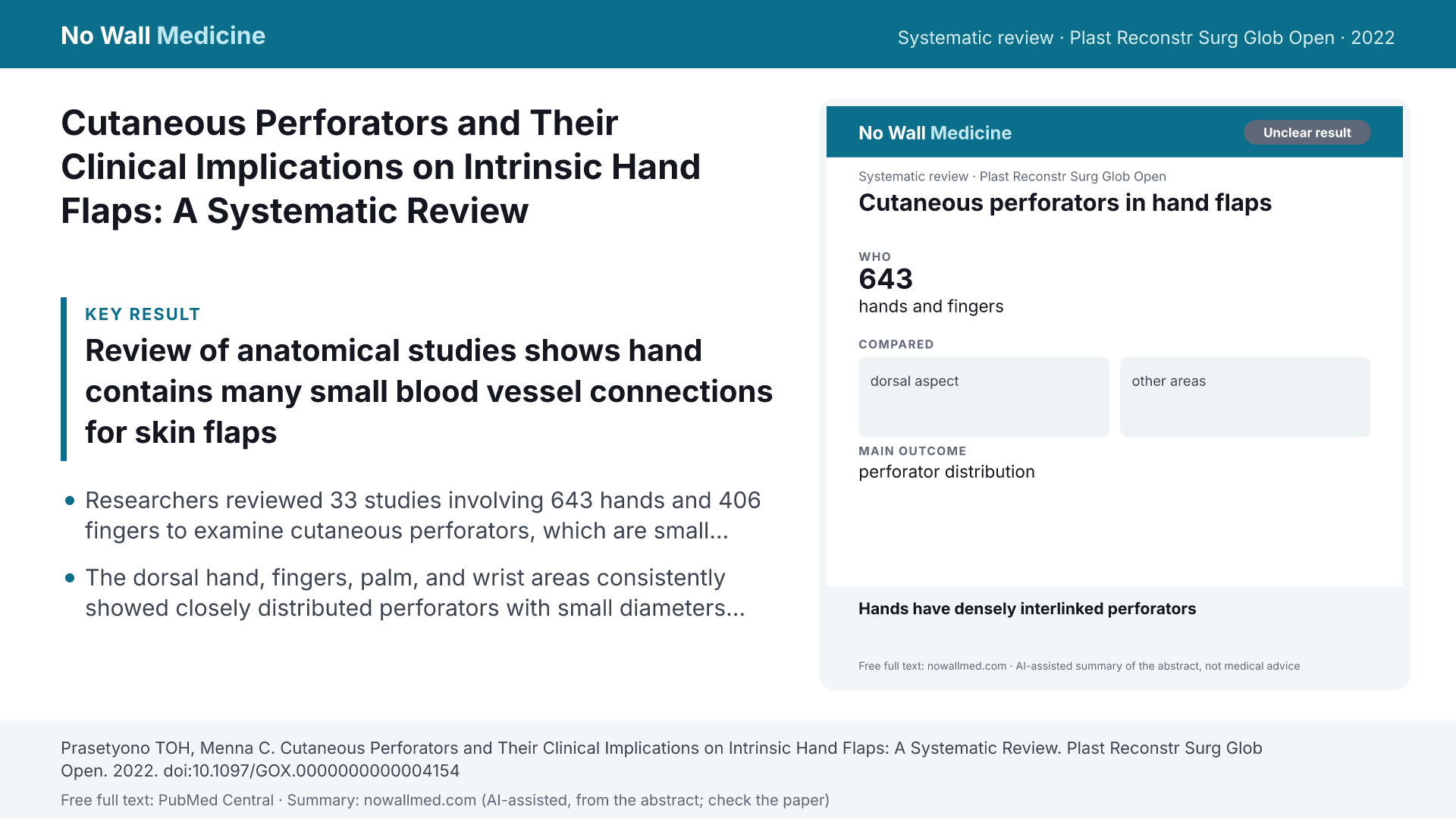
Key result: Review of anatomical studies shows hand contains many small blood vessel connections for skin flaps
Systematic reviewUnclear result
Cutaneous perforators in hand flaps
Who
643
hands and fingers
Compared
dorsal aspect
other areas
Main outcome
perforator distribution
Bottom line: Hands have densely interlinked perforators
Plast Reconstr Surg Glob Open · 2022-04-22Download image
Key points
- Researchers reviewed 33 studies involving 643 hands and 406 fingers to examine cutaneous perforators, which are small blood vessels that penetrate the skin.
- The dorsal hand, fingers, palm, and wrist areas consistently showed closely distributed perforators with small diameters and short pedicle lengths.
- Clinical studies showed that elevating local perforator flaps in these various hand areas was successful.
Why it matters: The specific anatomical data regarding the distribution and characteristics of cutaneous perforators for designing intrinsic hand flaps was not fully synthesized.
Discussion prompts
- Would these patients look like yours? Who was left out?
- Is the main outcome one that matters to patients?
- Is the difference large enough to change what you do?
Cite: Prasetyono TOH, Menna C. Cutaneous Perforators and Their Clinical Implications on Intrinsic Hand Flaps: A Systematic Review. Plast Reconstr Surg Glob Open. 2022. doi:10.1097/GOX.0000000000004154
Free full text: PubMed Central · Summary and visual abstract: nowallmed.com/a/cutaneous-perforators-and-their-clinical-implications-on-intrinsic-klya2y/ (AI-assisted from the abstract; check the paper before relying on it).