Cytisinicline was associated with higher smoking abstinence rates in smokers with and without COPD
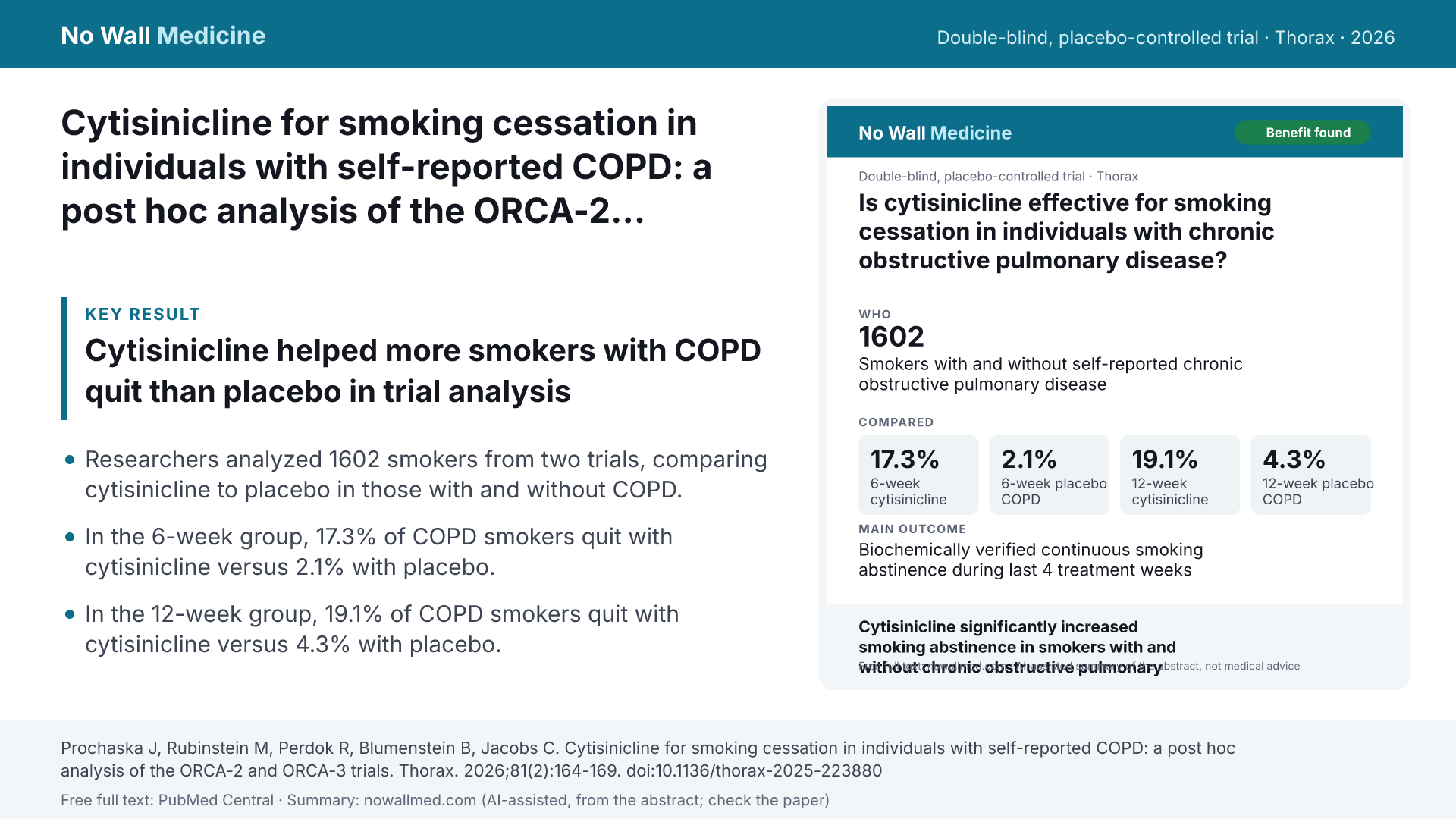
Cytisinicline for smoking cessation in individuals with self-reported COPD: a post hoc analysis of the ORCA-2 and ORCA-3 trials
Double-blind, placebo-controlled trialBenefit found
Is cytisinicline effective for smoking cessation in individuals with chronic obstructive pulmonary disease?
Who
1602
Smokers with and without self-reported chronic obstructive pulmonary disease
Compared
17.3%6-week cytisinicline COPD
2.1%6-week placebo COPD
19.1%12-week cytisinicline COPD
4.3%12-week placebo COPD
Main outcome
Biochemically verified continuous smoking abstinence during last 4 treatment weeks
Bottom line: Cytisinicline significantly increased smoking abstinence in smokers with and without chronic obstructive pulmonary disease.
Thorax · 2026-01-15Download image
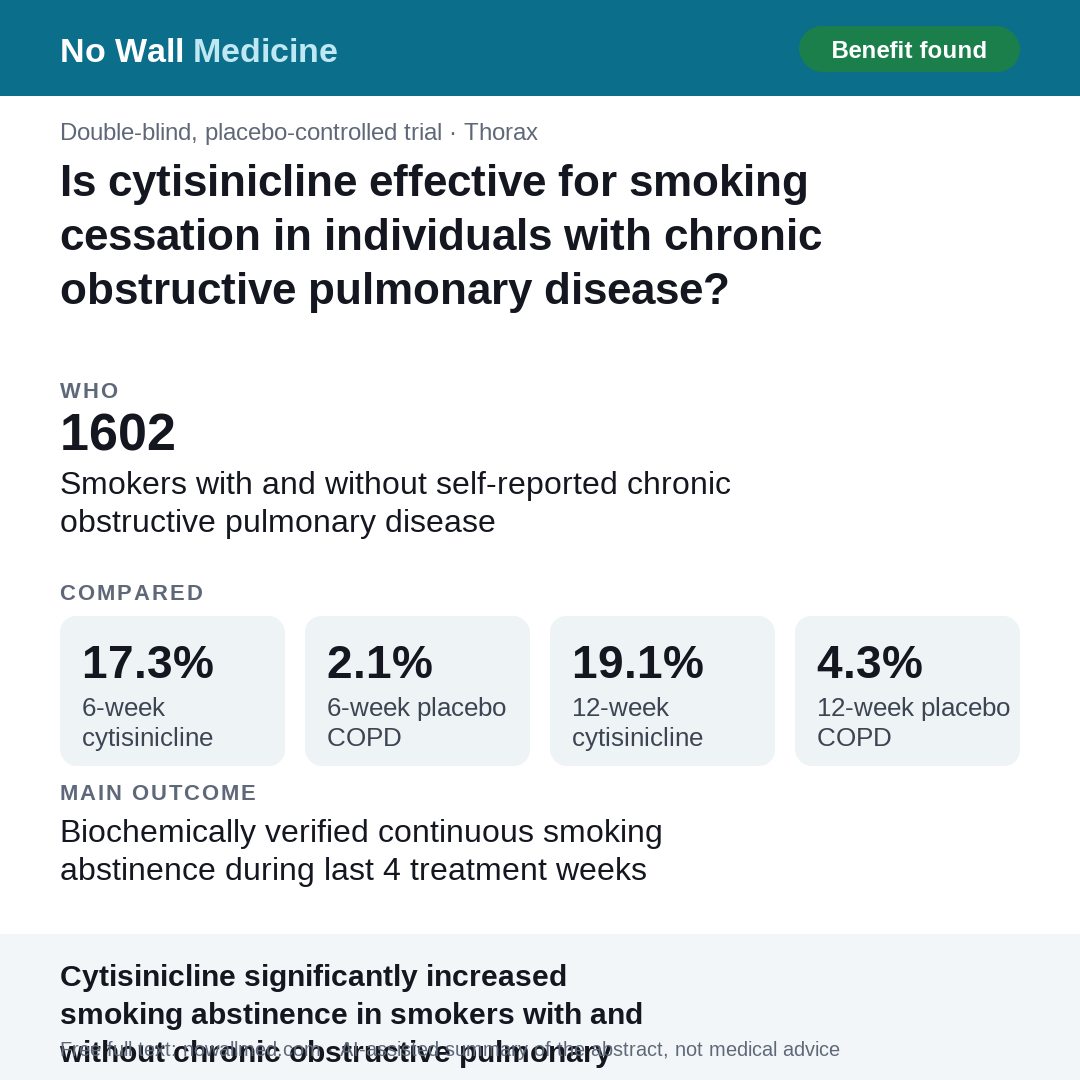
Clinical question: Is cytisinicline effective for smoking cessation in individuals with chronic obstructive pulmonary disease?
Why it matters: It is important to evaluate if cytisinicline is effective for smoking cessation specifically among individuals with chronic obstructive pulmonary disease.
Key points
- Researchers analyzed 1602 participants from two phase 3 trials, including 145 individuals who self-reported chronic obstructive pulmonary disease (COPD).
- In the 6-week treatment group, smoking abstinence was 17.3% for COPD patients using cytisinicline compared to 2.1% for those using a placebo.
- In the 12-week treatment group, smoking abstinence was 19.1% for COPD patients using cytisinicline compared to 4.3% for those using a placebo.
Headline and key points written with AI from the paper’s abstract, with every number checked against it. Read the paper before relying on them.
Was this summary helpful?
Abstract
Importance
Quitting smoking is essential for stabilising and improving respiratory function in people with chronic obstructive pulmonary disease (COPD). Objective
To evaluate the efficacy and safety of cytisinicline versus placebo for cessation among smokers with and without COPD. Methods
This post hoc analysis used combined data from the phase 3 ORCA-2 (Ongoing Research of Cytisinicline for Addiction) and ORCA-3 double-blind, placebo-controlled trials. Participants received 6 or 12 weeks of cytisinicline or placebo. Of 1602 participants, 145 (9.3%) self-reported COPD. Interventions
Participants received 3 mg of cytisinicline three times daily (6 weeks: n=532; 12 weeks: n=534) or placebo (12 weeks: n=536), plus behavioural support. Outcome
Biochemically verified continuous smoking abstinence during the last 4 treatment weeks. Results
COPD participants were older, smoked longer and had greater nicotine dependence. Cytisinicline was associated with significantly higher smoking abstinence compared with placebo in both COPD and non-COPD subgroups. There was no statistical evidence of heterogeneity in treatment effect between arms. In the 6-week arm, quit estimates were 17.3% versus 2.1% (OR 9.7, p=0.03) for COPD and 19.3% versus 5.5% (OR 4.1, p<0.0001) for non-COPD. In the 12-week arm, quit estimates were 19.1% versus 4.3% (OR 5.3, p=0.04) for COPD and 32.6% versus 8.6% (OR 5.2, p<0.0001) for non-COPD. Cytisinicline was well tolerated with no serious treatment-related events. Conclusion
Cytisinicline significantly increased quitting for smokers with and without COPD and was well tolerated. The findings support cytisinicline as a viable treatment for smokers with COPD who want to quit. Trial registration number
ORCA-2 (NCT04576949) and ORCA-3 (NCT05206370).
Abstract reproduced under the article’s CC BY NC licence.
Subject terms
Cite this article
Prochaska J, Rubinstein M, Perdok R, Blumenstein B, Jacobs C. Cytisinicline for smoking cessation in individuals with self-reported COPD: a post hoc analysis of the ORCA-2 and ORCA-3 trials. Thorax. 2026. doi:10.1136/thorax-2025-223880
Spotted a mistake? Suggest a correction