Oxiris membrane hemoadsorption showed no difference in microcirculation or adverse outcomes after cardiac surgery
Cytokine Hemoadsorption versus Standard Care in Cardiac Surgery Using the Oxiris Membrane: The OXICARD Single-center Randomized Trial
Randomized single-center trialNo clear difference
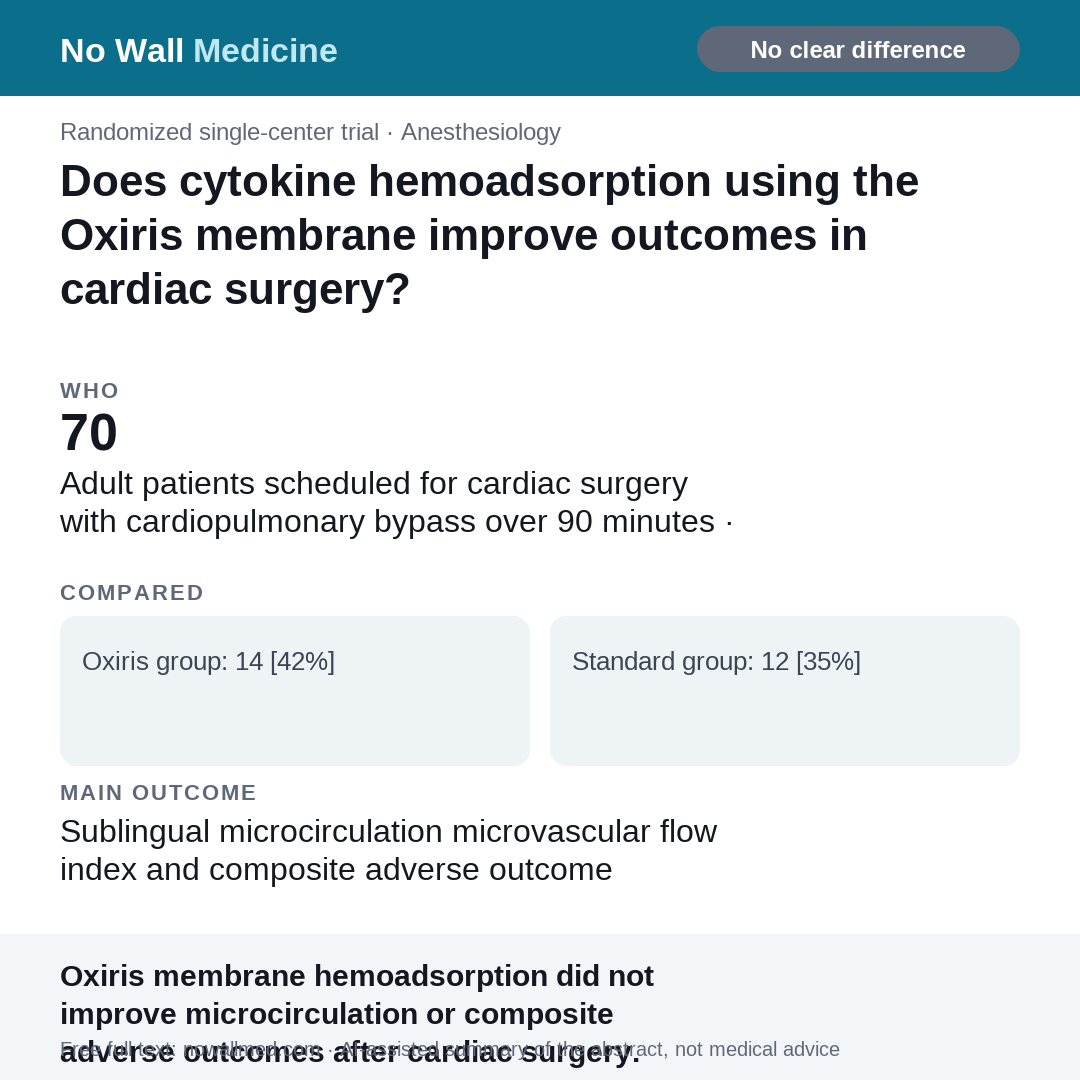
Does cytokine hemoadsorption using the Oxiris membrane improve outcomes in cardiac surgery?
Who
70
Adult patients scheduled for cardiac surgery with cardiopulmonary bypass over 90 minutes · Amiens University Hospital, France
Compared
Oxiris group: 14 [42%]
Standard group: 12 [35%]
Main outcome
Sublingual microcirculation microvascular flow index and composite adverse outcome
Result: -0.17 (95% CI -0.44 to 0.10)
Bottom line: Oxiris membrane hemoadsorption did not improve microcirculation or composite adverse outcomes after cardiac surgery.
Anesthesiology · 2025-01-21Download image
Clinical question: Does cytokine hemoadsorption using the Oxiris membrane improve outcomes in cardiac surgery?
Why it matters: It was unknown if using the Oxiris membrane to remove inflammatory proteins could preserve small vessel blood flow and improve outcomes after prolonged heart-lung machine use.
Key points
- Researchers studied 70 adult patients undergoing scheduled cardiac surgery with expected cardiopulmonary bypass time greater than 90 min, comparing standard care to the Oxiris membrane.
- The microvascular flow index, which measures blood flow in small vessels, did not differ between groups on day 1 (difference -0.17; 95% CI -0.44 to 0.10; P = 0.2).
- Composite adverse outcomes within 30 days were not significantly different between the Oxiris group (14 [42%]) and the standard group (12 [35%]; P = 0.7).
Limitation the authors note: The study was a single-center randomized trial.
Headline and key points written with AI from the paper’s abstract, with every number checked against it. Read the paper before relying on them.
Topics
Cite this article
Abou-Arab O, Huette P, Ibrahima A, Beyls C, Bayart G, Guilbart M. Cytokine Hemoadsorption versus Standard Care in Cardiac Surgery Using the Oxiris Membrane: The OXICARD Single-center Randomized Trial. Anesthesiology. 2025. doi:10.1097/ALN.0000000000005376
Spotted a mistake? Suggest a correction