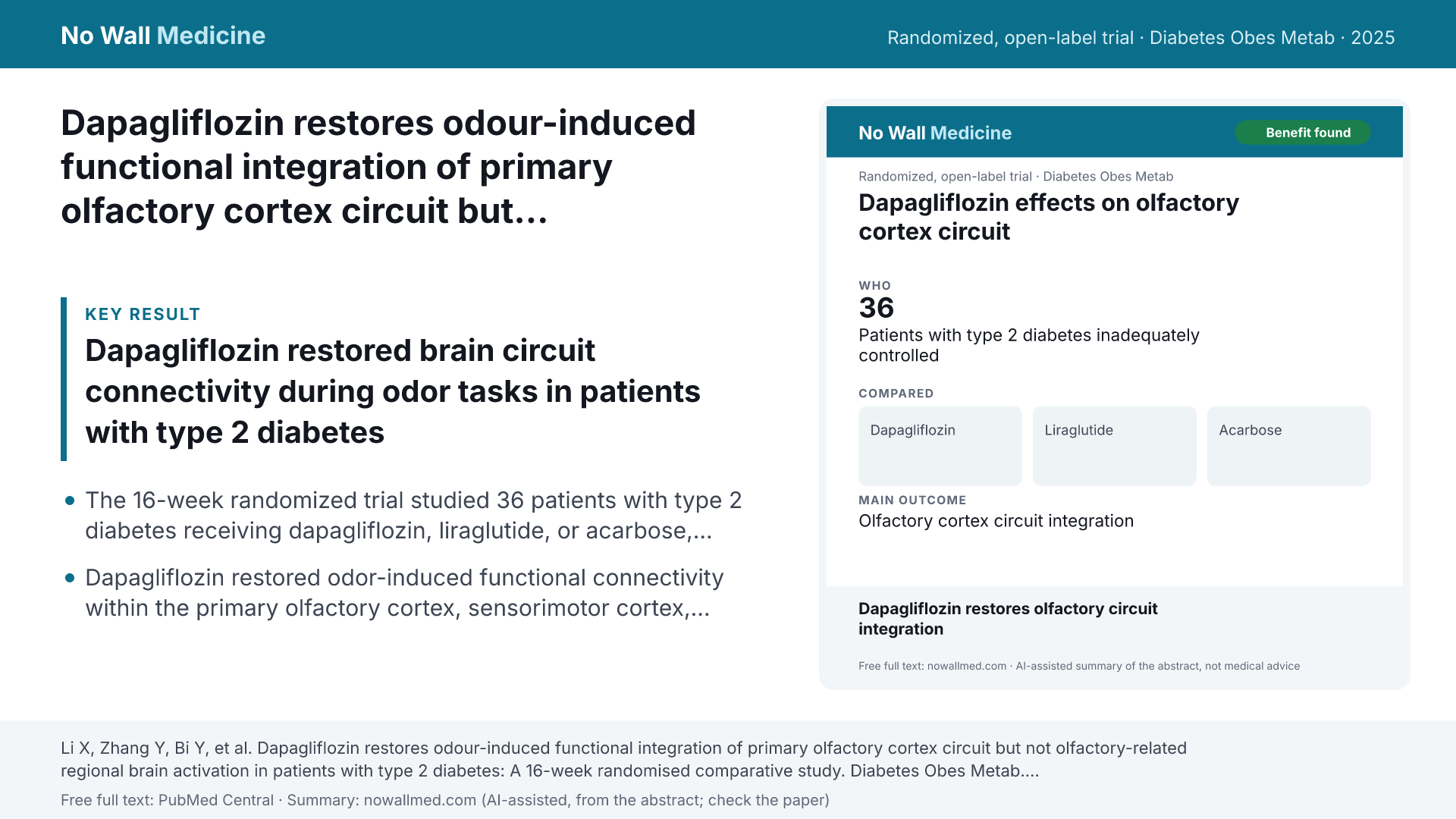
Dapagliflozin restored brain circuit connectivity during odor tasks in patients with type 2 diabetes
Dapagliflozin restores odour-induced functional integration of primary olfactory cortex circuit but not olfactory-related regional brain activation in patients with type 2 diabetes: A 16-week randomised comparative study
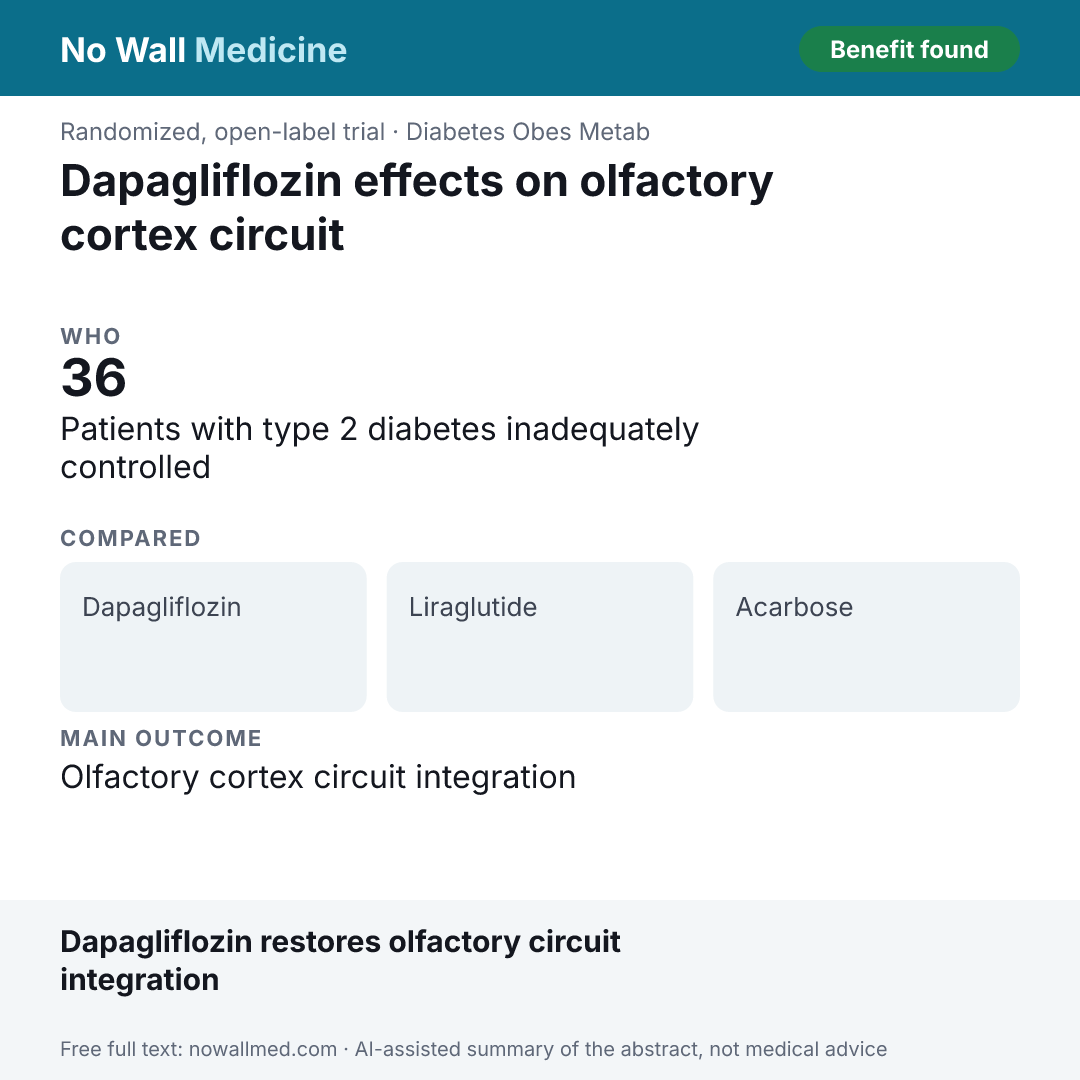
Randomized, open-label trialBenefit found
Dapagliflozin effects on olfactory cortex circuit
Who
36
Patients with type 2 diabetes inadequately controlled
Compared
Dapagliflozin
Liraglutide
Acarbose
Main outcome
Olfactory cortex circuit integration
Bottom line: Dapagliflozin restores olfactory circuit integration
Diabetes Obes Metab · 2025-09-15 · Save PNG
Why it matters: The mechanisms and efficacy of hypoglycemic agents regarding neuroprotective effects in patients with type 2 diabetes remain controversial.
Key points
- The 16-week randomized trial studied 36 patients with type 2 diabetes receiving dapagliflozin, liraglutide, or acarbose, and 36 healthy controls.
- Dapagliflozin restored odor-induced functional connectivity within the primary olfactory cortex, sensorimotor cortex, and middle temporal cortex circuit, but liraglutide and acarbose did not.
- Liraglutide enhanced odor-induced activation in the left hippocampus, a result not observed with dapagliflozin or acarbose.
Headline and key points written with AI from the paper’s abstract, with every number checked against it. Read the paper before relying on them.
Was this summary helpful?
Subject terms
Headline, design, result, key points, caveat and citation as plain text.
Cite this article
Li X, Zhang Y, Bi Y, et al. Dapagliflozin restores odour-induced functional integration of primary olfactory cortex circuit but not olfactory-related regional brain activation in patients with type 2 diabetes: A 16-week randomised comparative study. Diabetes Obes Metab. 2025;27(12):7309-7322. doi:10.1111/dom.70132
Spotted a mistake? Suggest a correction