Adding daratumumab to standard therapy improved survival in patients with newly diagnosed AL amyloidosis
Daratumumab-bortezomib-cyclophosphamide-dexamethasone for newly diagnosed amyloidosis: ANDROMEDA final survival analysis
Phase 3 randomized trialBenefit found
Does adding subcutaneous daratumumab to bortezomib, cyclophosphamide, and dexamethasone improve outcomes in newly diagnosed AL amyloidosis?
Who
388
Patients with newly diagnosed light-chain amyloidosis
Compared
59.5%Daratumumab, bortezomib, cyclophosphamide, and dexamethasone
19.2%Bortezomib, cyclophosphamide, and dexamethasone
Main outcome
hematologic complete response rate
Result: hazard ratio 0.62 (95% CI 0.42-0.90)
Bottom line: Adding daratumumab to bortezomib, cyclophosphamide, and dexamethasone improves hematologic response, organ function, and overall survival.
Blood · 2026-05-12Download image
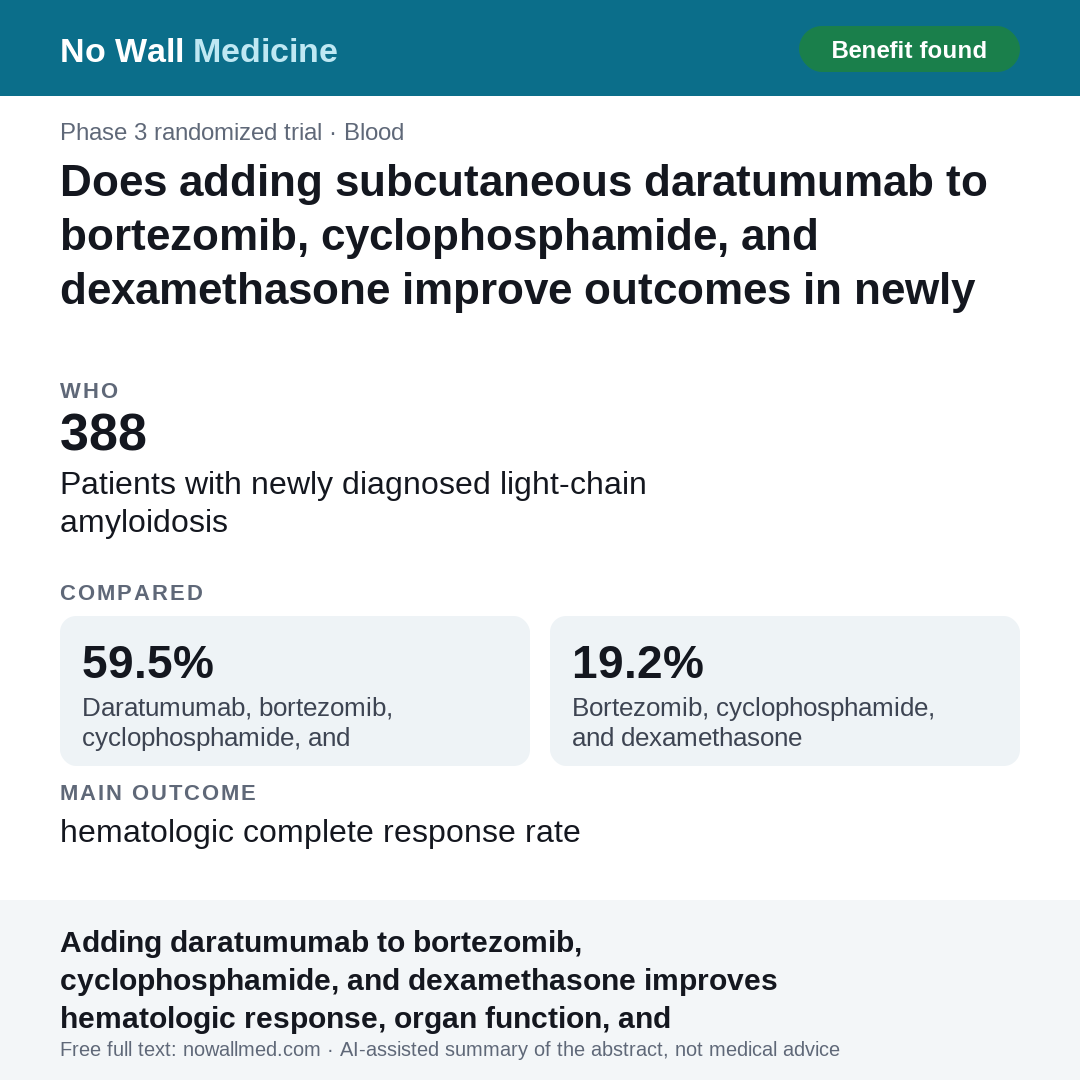
Clinical question: Does adding subcutaneous daratumumab to bortezomib, cyclophosphamide, and dexamethasone improve outcomes in newly diagnosed AL amyloidosis?
Why it matters: Doctors needed to determine if adding daratumumab to standard chemotherapy improves survival and organ response in patients with newly diagnosed light-chain amyloidosis.
Key points
- Researchers studied 388 patients with newly diagnosed light-chain amyloidosis, comparing six cycles of bortezomib, cyclophosphamide, and dexamethasone alone to the same drugs plus subcutaneous daratumumab.
- The hematologic complete response rate was 59.5% for the daratumumab group versus 19.2% for the control group, with a shorter median time to response of 67.5 days versus 85.0 days.
- With a median follow-up of 61.4 months, the daratumumab group showed improved major organ deterioration-progression-free survival and overall survival compared to the control group.
Headline and key points written with AI from the paper’s abstract, with every number checked against it. Read the paper before relying on them.
Abstract
In the primary analysis of ANDROMEDA, addition of subcutaneous daratumumab to VCd (bortezomib, cyclophosphamide, and dexamethasone; D-VCd) significantly improved hematologic complete response (CR) rate vs VCd, establishing D-VCd as the only approved therapy for light-chain (AL) amyloidosis. We present results from the preplanned final analysis. In this phase 3 trial, we randomly assigned 388 patients with newly diagnosed AL amyloidosis to 6 cycles of VCd alone (control group) or with subcutaneous daratumumab (D-VCd) followed by single-agent daratumumab every 4 weeks for up to 24 total cycles. The primary end point was hematologic CR. The updated hematologic CR rate was 59.5% for D-VCd vs 19.2% for VCd (odds ratio, 6.03; 95% confidence interval [CI], 3.80-9.58; P< .0001). Median time to hematologic CR was shorter with D-VCd (67.5 days [range, 8.0-879.0]) vs VCd (85.0 days [range, 14.0-617.0]). With a median follow-up of 61.4 months, significant improvement was observed with D-VCd vs VCd in major organ deterioration-progression-free survival (hazard ratio, 0.44; 95% CI, 0.31-0.63; P< .0001) and overall survival (hazard ratio, 0.62; 95% CI, 0.42-0.90; P = .0121). Cardiac and renal response rates were 2 to 3 times higher with D-VCd vs VCd. Achieving hematologic or cardiac CR was associated with improved major organ deterioration-progression-free survival and overall survival. Adverse events were consistent with the known safety profiles for VCd and daratumumab. Adding daratumumab to VCd resulted in deeper and more rapid hematologic responses and organ function recovery, translating to statistically significant improvement in both overall survival and major organ deterioration-progression-free survival in newly diagnosed AL amyloidosis. This trial was registered at www.clinicaltrials.gov as #NCT03201965.
Abstract reproduced under the article’s CC BY NC ND licence.
Topics
Spotted a mistake? Suggest a correction