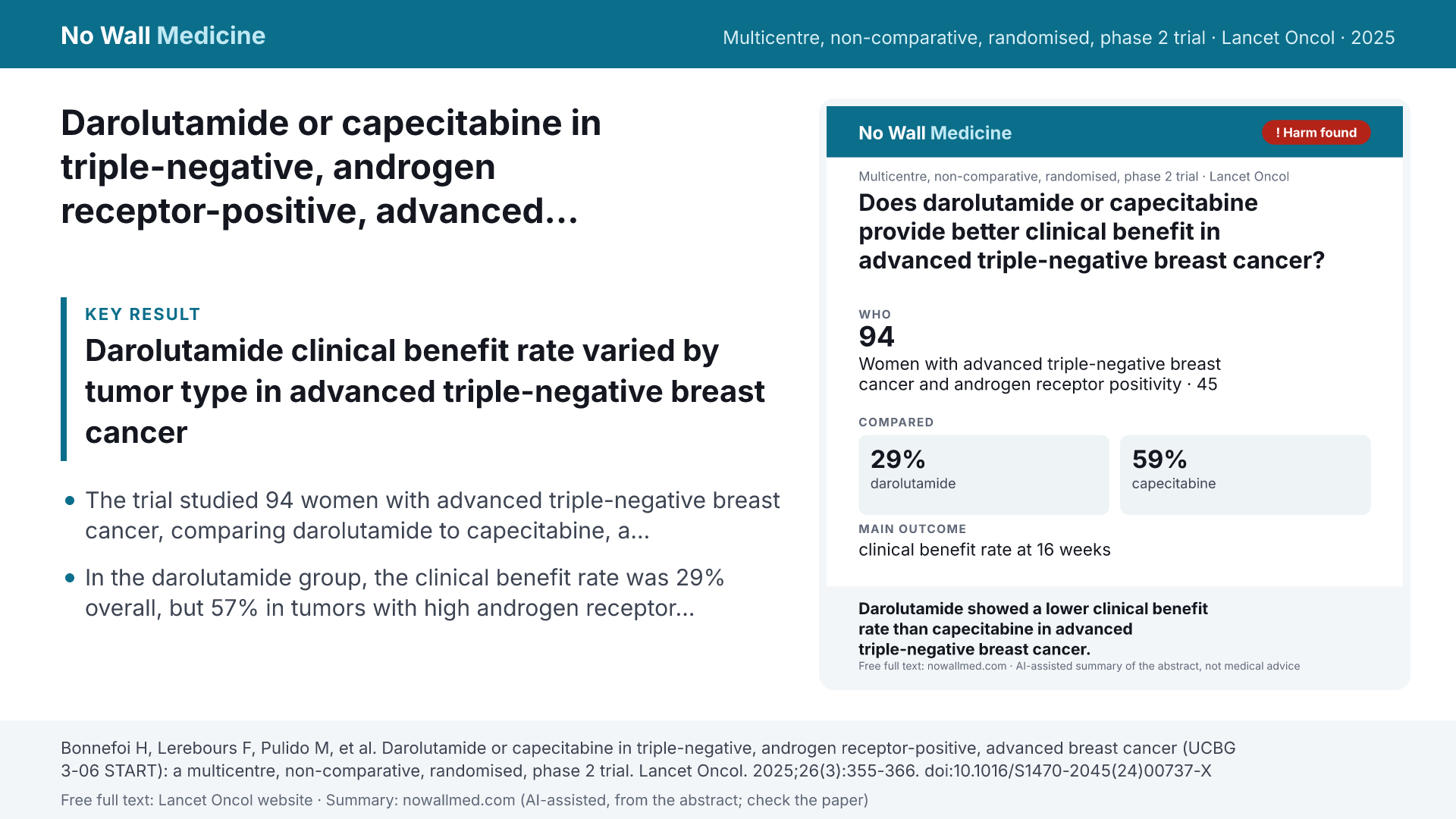
Darolutamide clinical benefit rate varied by tumor type in advanced triple-negative breast cancer
Darolutamide or capecitabine in triple-negative, androgen receptor-positive, advanced breast cancer (UCBG 3-06 START): a multicentre, non-comparative, randomised, phase 2 trial
Multicentre, non-comparative, randomised, phase 2 trialHarm found
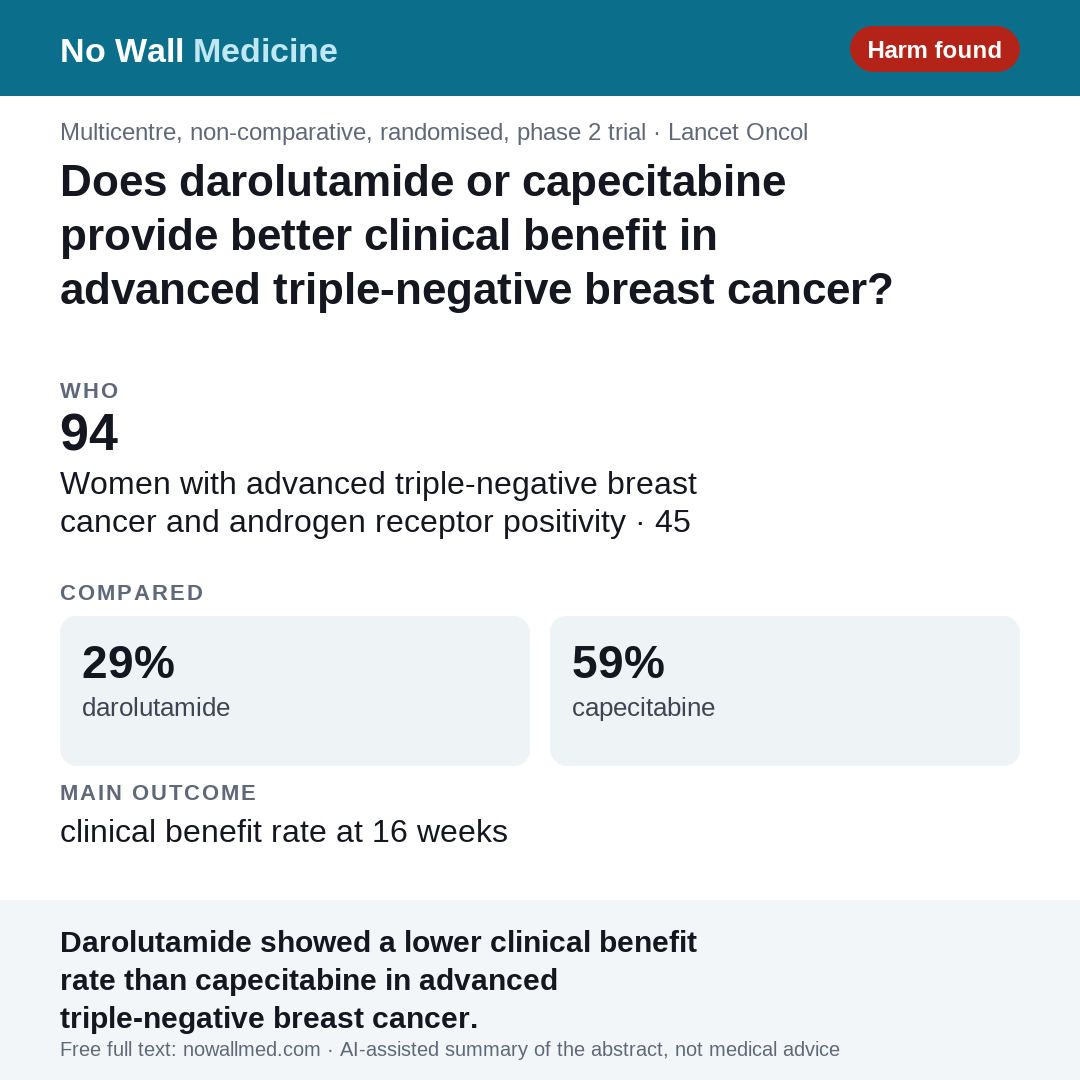
Does darolutamide or capecitabine provide better clinical benefit in advanced triple-negative breast cancer?
Who
94
Women with advanced triple-negative breast cancer and androgen receptor positivity · 45 hospitals in France
Compared
29%darolutamide (17 of 58; 90% CI 19-39)
59%capecitabine (19 of 32; 90% CI 45-74)
Main outcome
clinical benefit rate at 16 weeks
Bottom line: Darolutamide showed a lower clinical benefit rate than capecitabine in advanced triple-negative breast cancer.
Funded by: Bayer and Fondation Bergonié
Lancet Oncol · 2025-02-17Download image
Clinical question: Does darolutamide or capecitabine provide better clinical benefit in advanced triple-negative breast cancer?
Key points
- The trial studied 94 women with advanced triple-negative breast cancer, comparing darolutamide to capecitabine, a chemotherapy drug.
- In the darolutamide group, the clinical benefit rate was 29% overall, but 57% in tumors with high androgen receptor activity compared to 16% in other tumors.
- The clinical benefit rate for capecitabine was 59% and the most common grade 3 adverse event was palmar-plantar erythrodysaesthesia syndrome in 6% of those patients.
Headline and key points written with AI from the paper’s abstract, with every number checked against it. Read the paper before relying on them.
Was this summary helpful?
Abstract
Background
We proposed in 2005 that androgens replace oestrogens as the driver steroids in a subgroup of triple-negative breast cancer (TNBC) with androgen receptor (AR) expression called molecular apocrine (MA) or luminal androgen receptor (LAR). Here, we report the analysis of a clinical trial evaluating the antitumour activity of the anti-androgen darolutamide in MA breast cancer. Our aim was to assess the clinical benefit in patients with AR-positive TNBCs defined by immunohistochemistry and by RNA profiling. Methods
In this multicentre, non-comparative, randomised, phase 2 trial, women aged 18 years or older with an Eastern Cooperative Oncology Group performance status of 0-1 and with advanced TNBC that was previously treated with a maximum of one line of chemotherapy were recruited from 45 hospitals in France. After central confirmation of TNBC status and AR positivity (≥10%; SP107 antibody), participants were randomly assigned (2:1) to receive darolutamide 600 mg orally twice daily or capecitabine minimum 1000 mg/m2 twice daily for 2 weeks on and 1 week off, until disease progression, unacceptable toxicity, lost to follow-up, or withdrawal of consent. Randomisation was done centrally using the minimisation procedure and was stratified according to the number of previous lines of chemotherapy. Transcriptomic analysis was used to classify tumours into groups with high and low AR activity (MAhigh and MAlow). The primary clinical endpoint was clinical benefit rate at 16 weeks (confirmed complete response, partial response, or stable disease). The primary translational endpoint was clinical benefit rate in the darolutamide group in MAhigh tumours versus all other tumours. Analyses were done per protocol. This trial is registered with ClinicalTrials.gov (NCT03383679), and is closed to recruitment. Findings
Between April 9, 2018, and July 20, 2021, 254 women were screened and 94 were randomly assigned to darolutamide (n=61) or capecitabine (n=33), of whom 90 were evaluable for efficacy analyses. Median follow-up at the data cutoff on July 20, 2022, was 22·5 months (IQR 16·5-30·5). The clinical benefit rate was 29% (17 of 58; 90% CI 19-39) with darolutamide and 59% (19 of 32; 90% CI 45-74) with capecitabine. In patients treated with darolutamide, the clinical benefit rate was 57% (12 of 21; 95% CI 36-78) in MAhigh tumours, and 16% (five of 31; 95% CI 3-29; p=0·0020) in other tumours. The most common grade 3 adverse events were palmar-plantar erythrodysaesthesia syndrome (none of 60 in the darolutamide group vs two [6%] of 33 in the capecitabine group), and headache (three [5%] vs none). No grade 4 or 5 adverse events were observed. Drug-related serious adverse events occurred in three (5%) patients in the darolutamide group and three (9%) in the capecitabine group, which were toxicoderma (n=1) and headache (n=2) in the darolutamide group, and diarrhoea, general physical deterioration, and hepatic cytolysis in the capecitabine group (n=1 each). Interpretation
This study did not reach its prespecified endpoint for darolutamide activity in patients with triple-negative breast cancer selected on the basis of immunohistochemistry for AR. Further studies selecting patients based on RNA profiling might allow better identification of tumours sensitive to anti-androgens. Funding
Bayer and Fondation Bergonié.
Abstract reproduced under the article’s CC BY NC ND licence.
Subject terms
Headline, design, result, key points, caveat and citation as plain text.
Cite this article
Bonnefoi H, Lerebours F, Pulido M, et al. Darolutamide or capecitabine in triple-negative, androgen receptor-positive, advanced breast cancer (UCBG 3-06 START): a multicentre, non-comparative, randomised, phase 2 trial. Lancet Oncol. 2025. doi:10.1016/S1470-2045(24)00737-X
Spotted a mistake? Suggest a correction