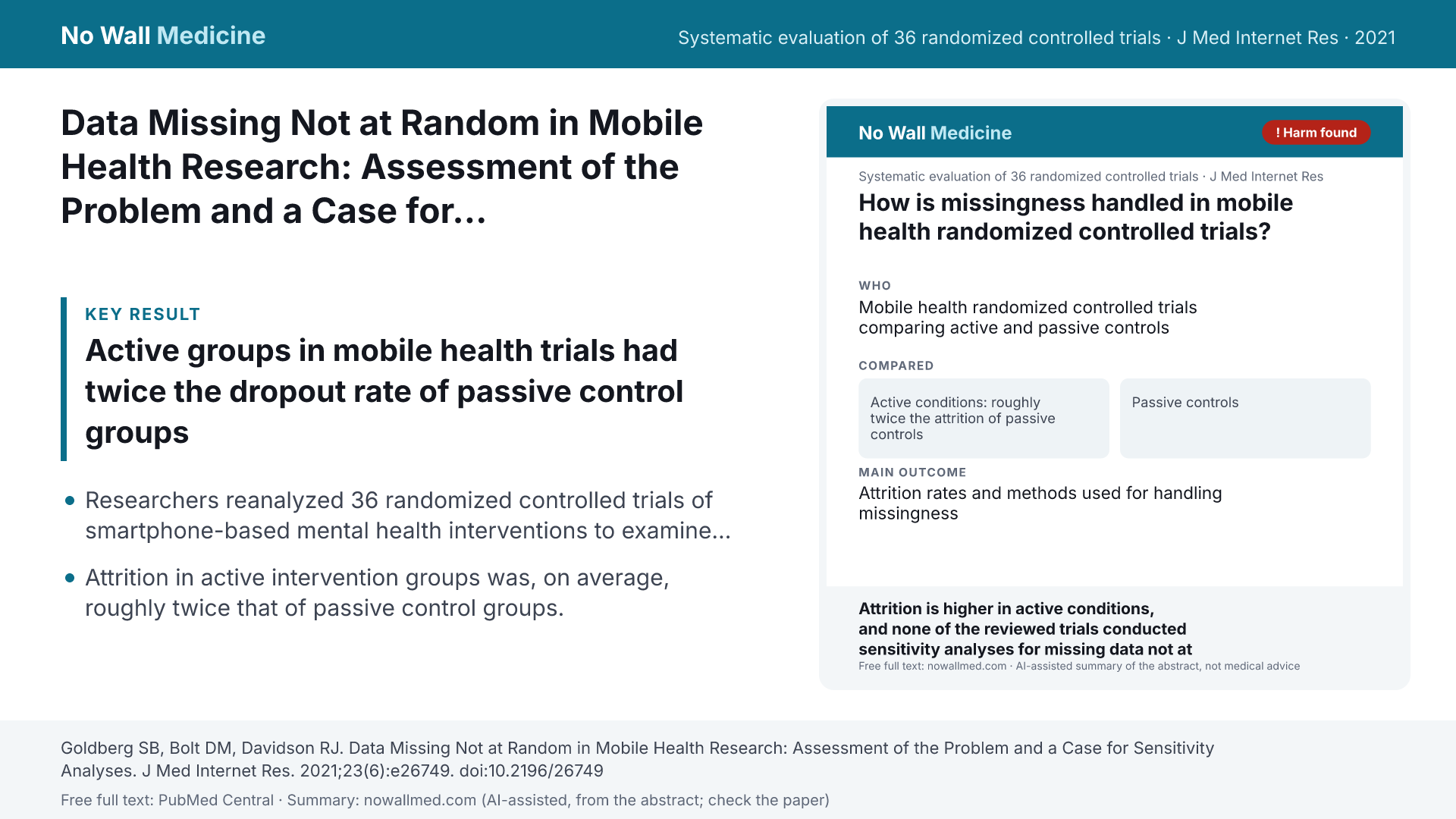
Data Missing Not at Random in Mobile Health Research: Assessment of the Problem and a Case for Sensitivity Analyses
Key result: Active groups in mobile health trials had twice the dropout rate of passive control groups
Systematic evaluation of 36 randomized controlled trialsHarm found
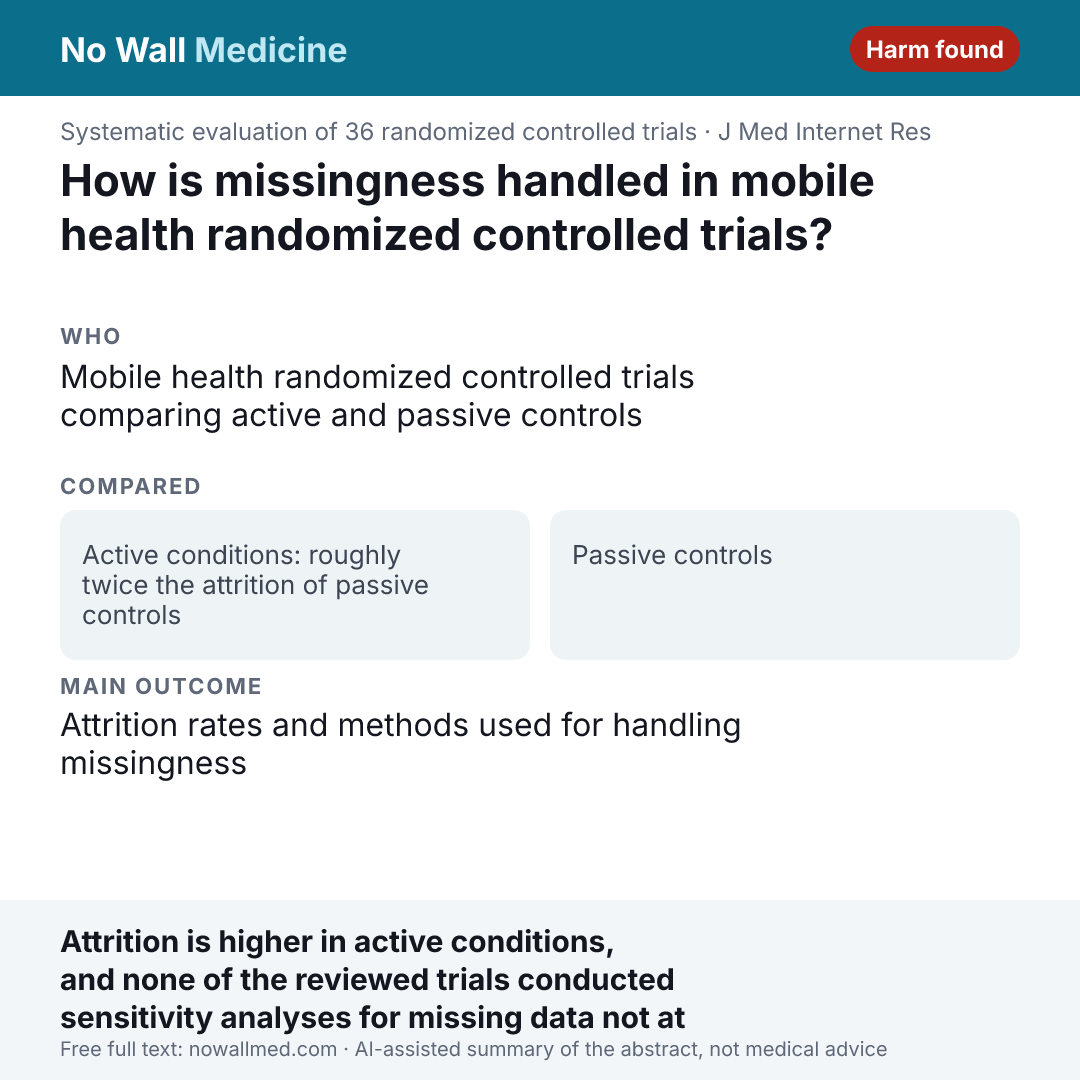
How is missingness handled in mobile health randomized controlled trials?
Who
Mobile health randomized controlled trials comparing active and passive controls
Compared
Active conditions: roughly twice the attrition of passive controls
Passive controls
Main outcome
Attrition rates and methods used for handling missingness
Bottom line: Attrition is higher in active conditions, and none of the reviewed trials conducted sensitivity analyses for missing data not at random.
Limitation: The study reanalyzed a sample of 36 trials from a recent meta-analysis.
J Med Internet Res · 2021-06-15 · Save PNG
Key points
- Researchers reanalyzed 36 randomized controlled trials of smartphone-based mental health interventions to examine how missing data is handled.
- Attrition in active intervention groups was, on average, roughly twice that of passive control groups.
- None of the 36 mobile health trials reviewed conducted a sensitivity analysis to evaluate the consequences of data missing not at random.
Discussion prompts
- Would these patients look like yours? Who was left out?
- Is the main outcome one that matters to patients?
- Is the difference large enough to change what you do?
Cite: Goldberg SB, Bolt DM, Davidson RJ. Data Missing Not at Random in Mobile Health Research: Assessment of the Problem and a Case for Sensitivity Analyses. J Med Internet Res. 2021;23(6):e26749. doi:10.2196/26749
Free full text: PubMed Central · Summary and visual abstract: nowallmed.com/a/data-missing-not-at-random-in-mobile-health-research-assessment-of-1prnbrx/ (AI-assisted from the abstract; check the paper before relying on it).