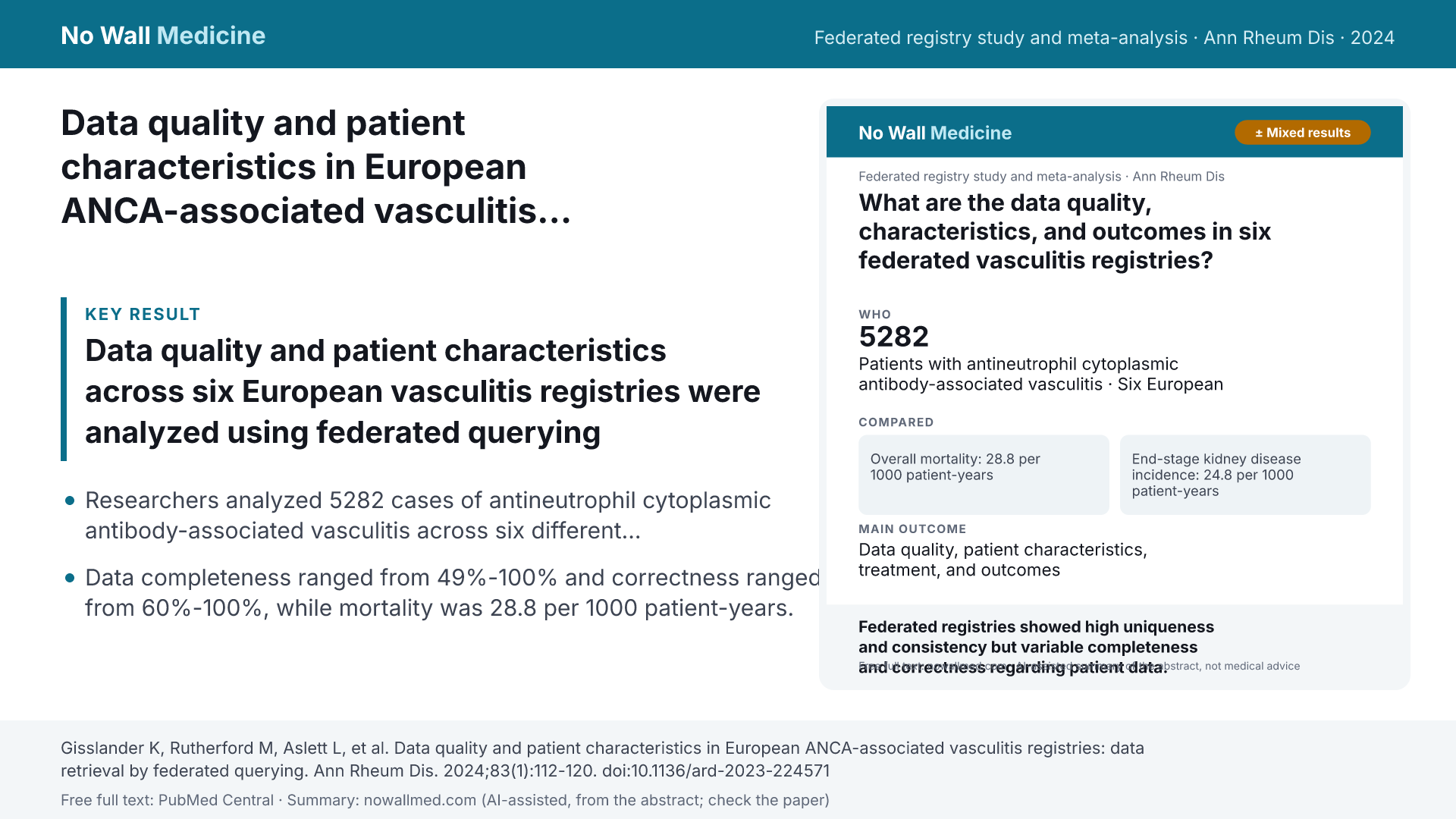
Data quality and patient characteristics across six European vasculitis registries were analyzed using federated querying
Data quality and patient characteristics in European ANCA-associated vasculitis registries: data retrieval by federated querying
Federated registry study and meta-analysisMixed results
What are the data quality, characteristics, and outcomes in six federated vasculitis registries?
Who
5282
Patients with antineutrophil cytoplasmic antibody-associated vasculitis · Six European registries
Compared
Overall mortality: 28.8 per 1000 patient-years
End-stage kidney disease incidence: 24.8 per 1000 patient-years
Main outcome
Data quality, patient characteristics, treatment, and outcomes
Result: mortality 28.8 (95% CI 19.7 to 42.2); end-stage kidney disease 24.8 (95% CI 19.7 to 31.1)
Bottom line: Federated registries showed high uniqueness and consistency but variable completeness and correctness regarding patient data.
Ann Rheum Dis · 2024-01-02 · Save PNG
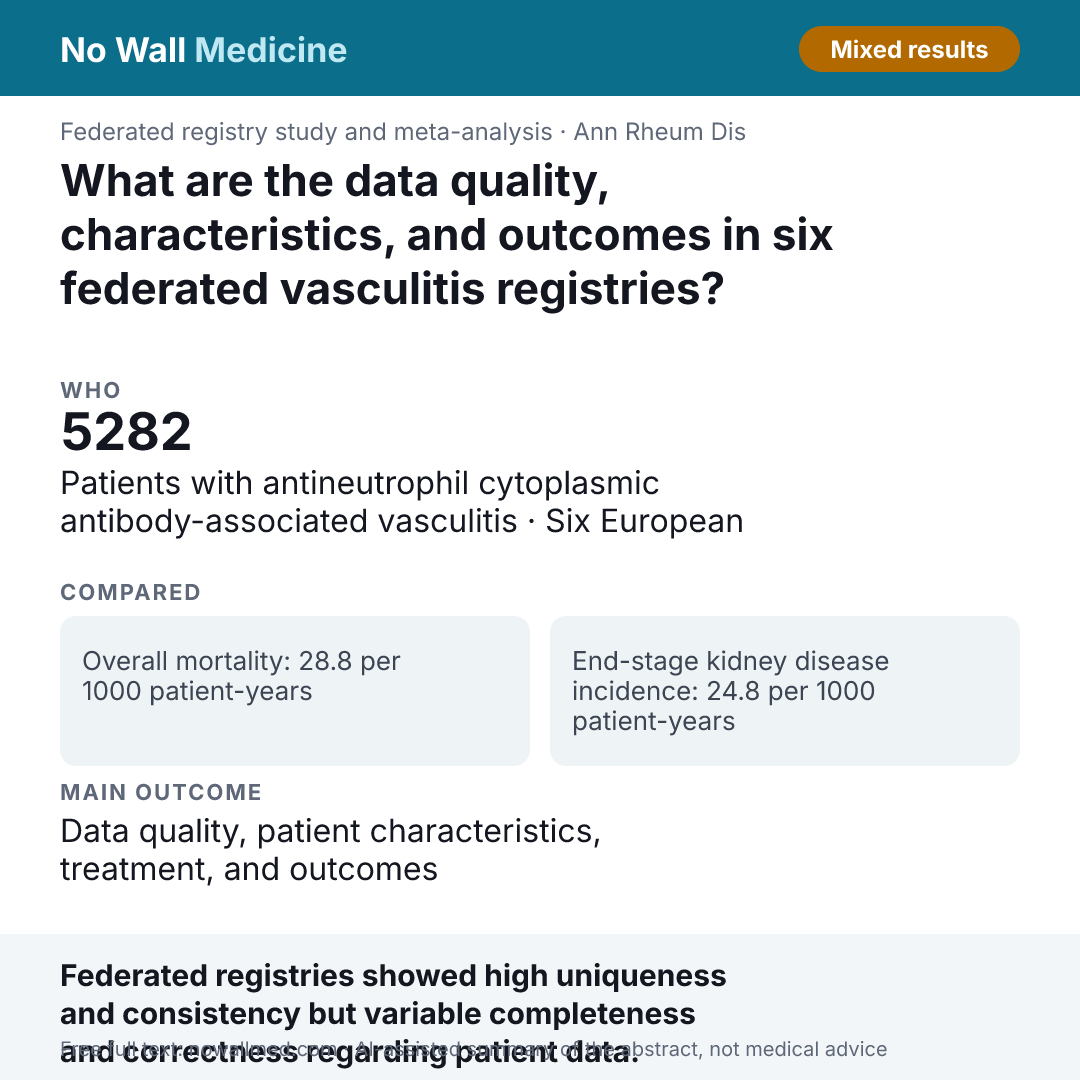
Clinical question: What are the data quality, characteristics, and outcomes in six federated vasculitis registries?
Key points
- Researchers analyzed 5282 cases of antineutrophil cytoplasmic antibody-associated vasculitis across six different registries using a new data harmonization process.
- Data completeness ranged from 49%-100% and correctness ranged from 60%-100%, while mortality was 28.8 per 1000 patient-years.
- The most common organ involvement was the lung in 65.1% of cases, followed by ear-nose-throat at 56.7% and kidney at 50.2%.
Headline and key points written with AI from the paper’s abstract, with every number checked against it. Read the paper before relying on them.
Was this summary helpful?
Abstract
Objectives
This study aims to describe the data structure and harmonisation process, explore data quality and define characteristics, treatment, and outcomes of patients across six federated antineutrophil cytoplasmic antibody-associated vasculitis (AAV) registries. Methods
Through creation of the vasculitis-specific Findable, Accessible, Interoperable, Reusable, VASCulitis ontology, we harmonised the registries and enabled semantic interoperability. We assessed data quality across the domains of uniqueness, consistency, completeness and correctness. Aggregated data were retrieved using the semantic query language SPARQL Protocol and Resource Description Framework Query Language (SPARQL) and outcome rates were assessed through random effects meta-analysis. Results
A total of 5282 cases of AAV were identified. Uniqueness and data-type consistency were 100% across all assessed variables. Completeness and correctness varied from 49%-100% to 60%-100%, respectively. There were 2754 (52.1%) cases classified as granulomatosis with polyangiitis (GPA), 1580 (29.9%) as microscopic polyangiitis and 937 (17.7%) as eosinophilic GPA. The pattern of organ involvement included: lung in 3281 (65.1%), ear-nose-throat in 2860 (56.7%) and kidney in 2534 (50.2%). Intravenous cyclophosphamide was used as remission induction therapy in 982 (50.7%), rituximab in 505 (17.7%) and pulsed intravenous glucocorticoid use was highly variable (11%-91%). Overall mortality and incidence rates of end-stage kidney disease were 28.8 (95% CI 19.7 to 42.2) and 24.8 (95% CI 19.7 to 31.1) per 1000 patient-years, respectively. Conclusions
In the largest reported AAV cohort-study, we federated patient registries using semantic web technologies and highlighted concerns about data quality. The comparison of patient characteristics, treatment and outcomes was hampered by heterogeneous recruitment settings.
Abstract reproduced under the article’s CC BY licence.
Subject terms
Headline, design, result, key points, caveat and citation as plain text.
Cite this article
Gisslander K, Rutherford M, Aslett L, et al. Data quality and patient characteristics in European ANCA-associated vasculitis registries: data retrieval by federated querying. Ann Rheum Dis. 2024;83(1):112-120. doi:10.1136/ard-2023-224571
Spotted a mistake? Suggest a correction