Desmopressin response varies significantly between different types of bleeding disorders
DDAVP response and its determinants in bleeding disorders: a systematic review and meta-analysis
Meta-analysis of 71 articlesMixed results
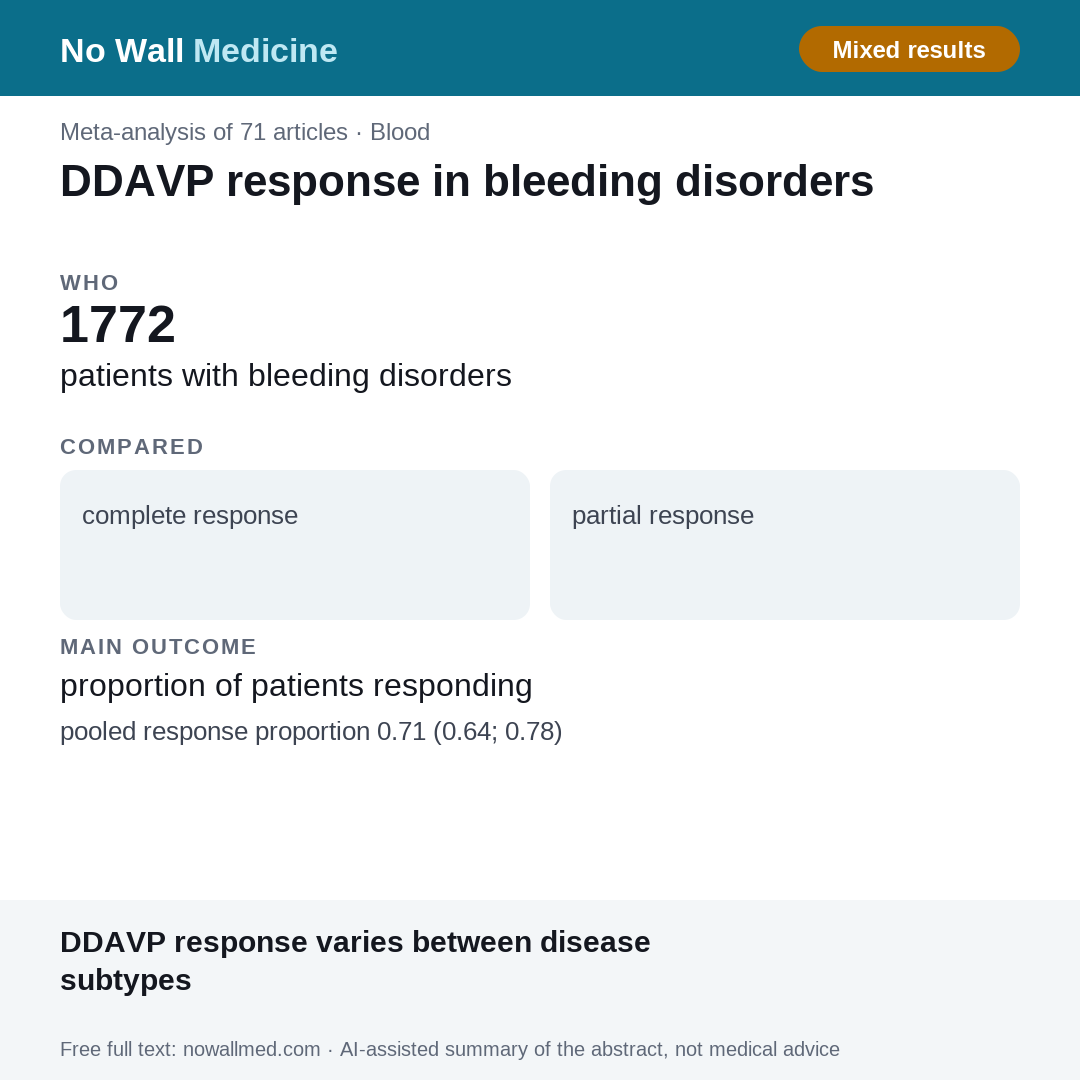
DDAVP response in bleeding disorders
Who
1772
patients with bleeding disorders
Compared
complete response
partial response
Main outcome
proportion of patients responding
Result: pooled response proportion 0.71 (0.64; 0.78)
Bottom line: DDAVP response varies between disease subtypes
Blood · 2025-01-24Download image
Why it matters: The specific factors that determine how individual patients respond to desmopressin are largely unknown due to large variations between people.
Key points
- Researchers analyzed 71 articles involving 1772 patients to determine how people respond to desmopressin, a medication used to stop or prevent bleeding.
- The pooled proportion of patients showing a response was 0.71 (0.64; 0.78), with significant differences found between disease subtypes.
- In von Willebrand disease type 1, von Willebrand factor antigen, von Willebrand factor activity, and factor VIII activity were significant determinants of response.
Headline and key points written with AI from the paper’s abstract, with every number checked against it. Read the paper before relying on them.
Abstract
Desmopressin (1-desamino-8-d-arginine vasopressin [DDAVP]) can be used to prevent or stop bleeding. However, large interindividual variability is observed in DDAVP response and determinants are largely unknown. In this systematic review and meta-analysis, we aimed to identify the response to DDAVP and the factors that determine DDAVP response in patients. We included studies with patients with any bleeding disorder receiving DDAVP. First and second screening round and risk of bias assessment were performed by independent reviewers. The main outcome was proportion of patients with complete (factor level >50 U/dL) or partial (30-50 U/dL) response to DDAVP. Determinants of response including disease type, age, sex, von Willebrand factor (VWF) and factor VIII (FVIII) mutations, and baseline factor levels were investigated. In total, 591 articles were found and 103 were included. Of these, 71 articles (1772 patients) were suitable for the study's definition of response. Meta-analysis showed a pooled response proportion of 0.71 (0.64; 0.78) and a significant difference in response between disease subtypes. For hemophilia A, baseline FVIII activity (FVIII:C) was a borderline significant determinant of response. In patients with von Willebrand disease (VWD) type 1, VWF antigen (VWF:Ag), VWF activity, and FVIII:C were significant determinants. A large variation in response was observed for specific mutations in VWF and FVIII. Response to DDAVP varied between disease subtypes and was largely determined by the baseline levels of FVIII:C for hemophilia A and VWF:Ag for VWD. Our findings highlight the significant differences in response and emphasize the need for a standardized response definition and further research into response mechanisms.
Abstract reproduced under the article’s CC BY NC ND licence.
Topics
Cite this article
Laan S, Del Castillo Alferez J, Cannegieter S, Fijnvandraat K, Kruip M, le Cessie S. DDAVP response and its determinants in bleeding disorders: a systematic review and meta-analysis. Blood. 2025. doi:10.1182/blood.2024026804
Spotted a mistake? Suggest a correction
Top studies every Monday
The week’s key trials and guidelines in your specialties, plus any topics you follow. By email, free.
Get the weekly digest