Deciphering radiological stable disease to immune checkpoint inhibitors
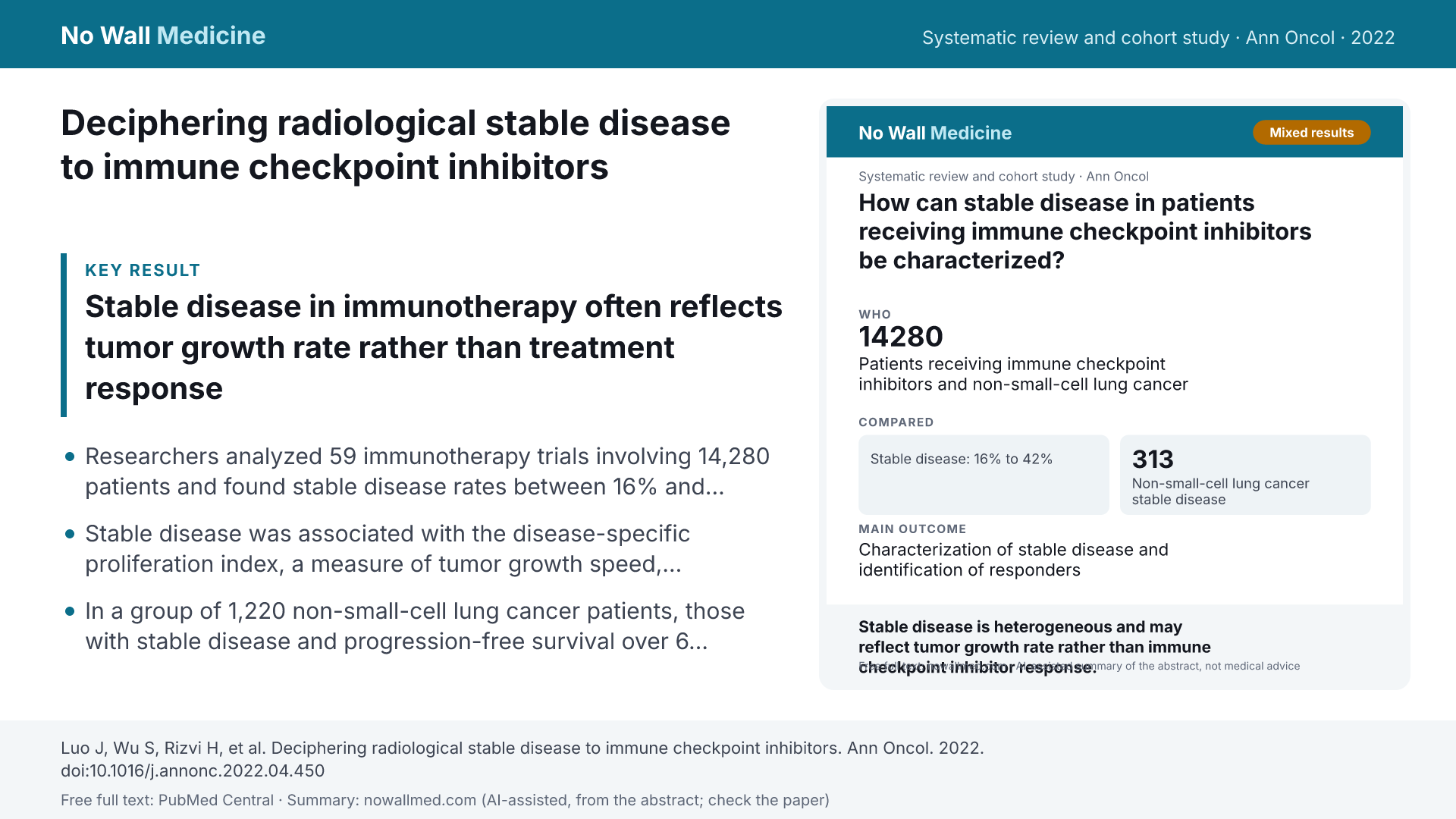
Key result: Stable disease in immunotherapy often reflects tumor growth rate rather than treatment response
Systematic review and cohort studyMixed results
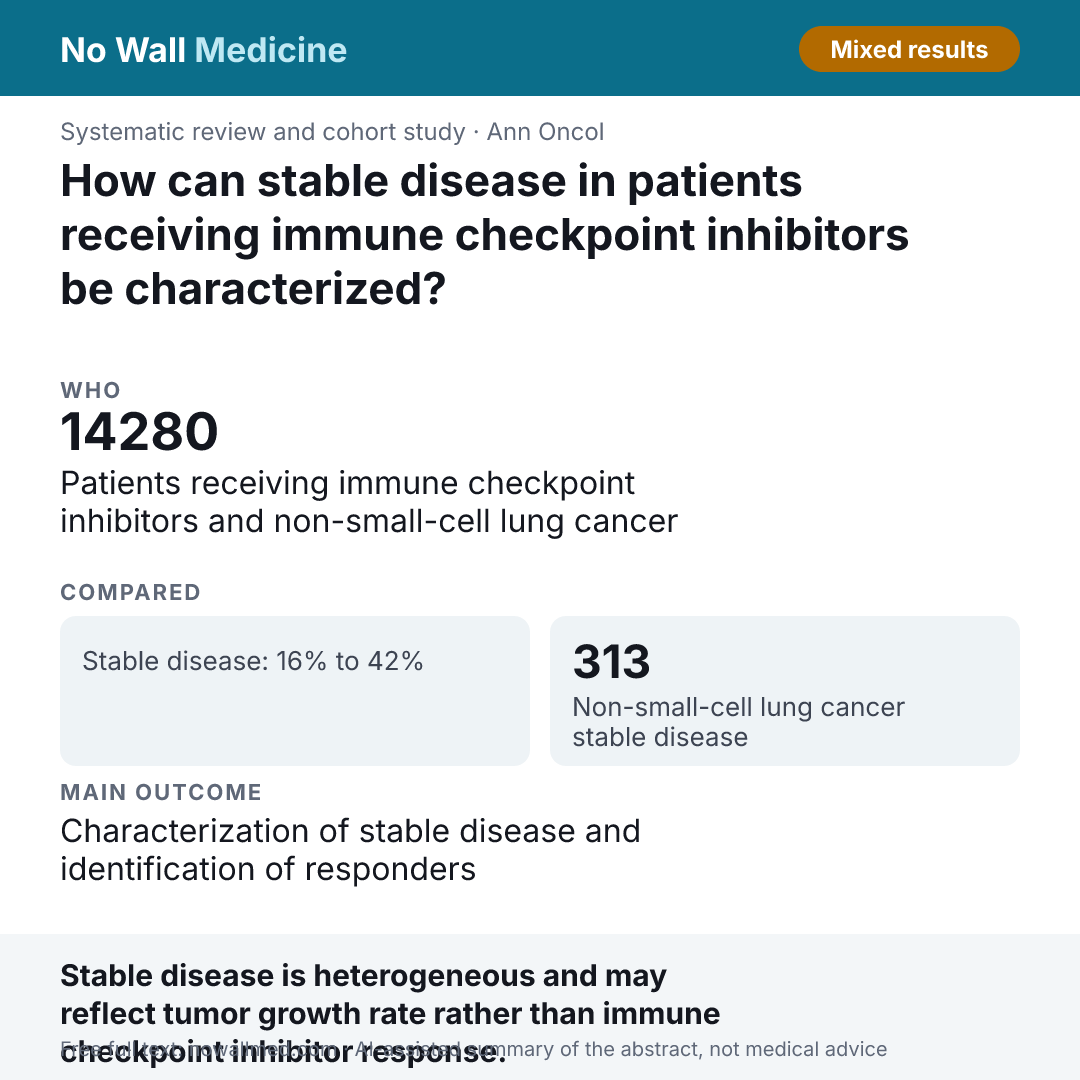
How can stable disease in patients receiving immune checkpoint inhibitors be characterized?
Who
14280
Patients receiving immune checkpoint inhibitors and non-small-cell lung cancer patients
Compared
Stable disease: 16% to 42%
313Non-small-cell lung cancer stable disease (26%)
Main outcome
Characterization of stable disease and identification of responders
Result: overall survival hazard ratio 1.0
Bottom line: Stable disease is heterogeneous and may reflect tumor growth rate rather than immune checkpoint inhibitor response.
Ann Oncol · 2022-05-06 · Save PNG
Key points
- Researchers analyzed 59 immunotherapy trials involving 14,280 patients and found stable disease rates between 16% and 42% across different tumor types.
- Stable disease was associated with the disease-specific proliferation index, a measure of tumor growth speed, rather than the relative response to immunotherapy.
- In a group of 1,220 non-small-cell lung cancer patients, those with stable disease and progression-free survival over 6 months had survival outcomes similar to responders.
Why it matters: The term stable disease is often ambiguous and it is unclear which patients within this group are actually benefiting from immune checkpoint inhibitors.
Discussion prompts
- Would these patients look like yours? Who was left out?
- Is the main outcome one that matters to patients?
- Is the difference large enough to change what you do?
Cite: Luo J, Wu S, Rizvi H, et al. Deciphering radiological stable disease to immune checkpoint inhibitors. Ann Oncol. 2022. doi:10.1016/j.annonc.2022.04.450
Free full text: PubMed Central · Summary and visual abstract: nowallmed.com/a/deciphering-radiological-stable-disease-to-immune-checkpoint-j33u4r/ (AI-assisted from the abstract; check the paper before relying on it).