Most studies find community health worker programs cost-effective despite methodological limitations in economic models
Decision-analytic models in the economic evaluation of community health worker programmes globally: a systematic review
Systematic reviewMixed results
How rigorously are decision-analytic models applied in community health worker economic evaluations?
Who
37
Community health worker-led or integrated interventions · Global, mostly low- and middle-income countries
Compared
84%Studies concluding cost-effectiveness
67%Mean quality score
Main outcome
Methodological quality and cost-effectiveness of community health worker programmes
Bottom line: Community health worker interventions are generally cost-effective, but existing economic models have methodological limitations and validation gaps.
Limitation: Substantial gaps in model validation and limited exploration of structural uncertainty.
BMJ Glob Health · 2026-06-22Download image
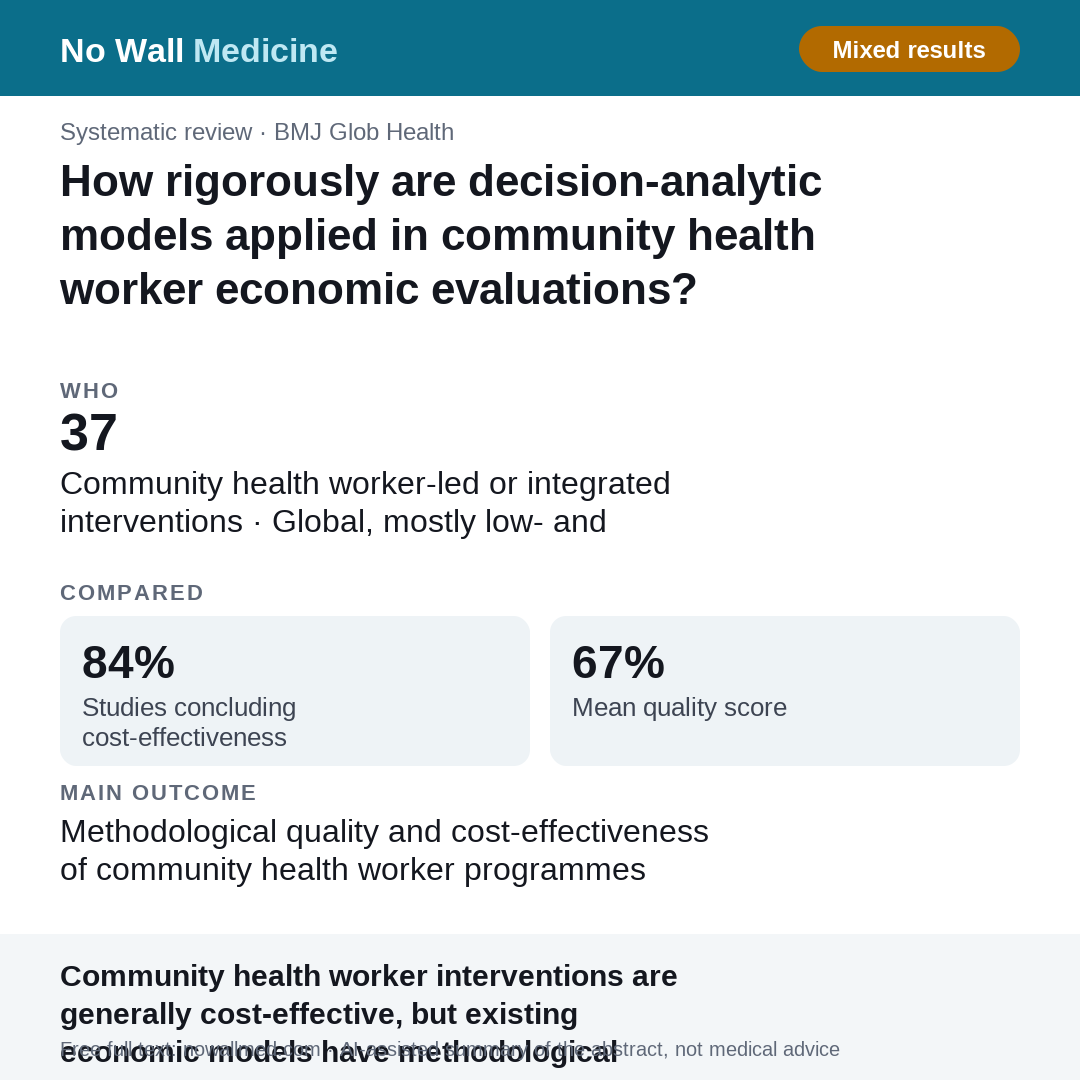
Clinical question: How rigorously are decision-analytic models applied in community health worker economic evaluations?
Why it matters: It is unclear how rigorously mathematical models are applied to community health worker evaluations, which may affect the reliability of cost-effectiveness estimates used for policy decisions.
Key points
- Researchers reviewed 37 studies that used decision-analytic models, which are mathematical tools used to project long-term value, to evaluate community health worker programs.
- While 84% of the studies concluded that these programs were cost-effective, the average quality score for the models was 67%.
- The review found significant gaps in how models were validated and a limited exploration of structural uncertainty in the existing evidence.
Limitation the authors note: The authors state that the strength of the evidence is constrained by methodological limitations in existing models, including gaps in model validation.
Headline and key points written with AI from the paper’s abstract, with every number checked against it. Read the paper before relying on them.
Abstract
Introduction
Economic evidence on community health worker (CHW) programmes is crucial for scaling these initiatives. Although decision-analytic models (DAMs) are essential for projecting long-term value, it is unclear how rigorously they have been applied to CHW evaluations, potentially compromising the reliability and comparability of cost-effectiveness estimates used for policy decisions. Methods
A systematic review was conducted to identify full economic evaluations of CHW-led or CHW-integrated interventions that employed a DAM. Following Preferred Reporting Items for Systematic Reviews and Meta-Analyses (PRISMA) guidelines, six databases (Medline, Embase, Global Health, CINAHL, Web of Science and Scopus) were searched from inception to June 2025. Eligible studies were full economic evaluations assessing CHW-led or CHW-integrated interventions using DAMs. Study selection and data extraction were conducted independently by two reviewers. Methodological quality was appraised using the Philips checklist, and data were extracted on model type, data sources and validation practices. Findings were synthesised narratively across model structures, income groups and quality domains. Results
37 studies met the inclusion criteria. Decision trees were used in 32% of studies and Markov models in 30% with the remainder applying microsimulation, dynamic transmission or hybrid approaches. Most evaluations were undertaken in low- and middle-income countries, with few from low-income or high-income settings. Data constraints in low-income settings limited model complexity, whereas models in high-income settings tended to adopt more sophisticated structures but narrower intervention scopes. The mean quality score was 67%, with substantial gaps in model validation and limited exploration of structural uncertainty. Overall, 84% of studies concluded that CHW-led interventions were cost-effective, with incremental cost-effectiveness ratios generally favourable across settings. Conclusions
Although CHW interventions are generally cost-effective, the strength of this evidence is constrained by methodological limitations in existing models. Future modelling should prioritise rigorous validation, localisation of input data and explicit valuation of CHW and societal contributions to enhance the credibility of economic evidence for policy use. Prospero registration number
CRD420251066586.
Abstract reproduced under the article’s CC BY licence.
Topics
Cite this article
Chen S, Banstola A, Junghans Minton C, Harris M, Anokye N. Decision-analytic models in the economic evaluation of community health worker programmes globally: a systematic review. BMJ Glob Health. 2026. doi:10.1136/bmjgh-2025-023076
Spotted a mistake? Suggest a correction