Decision-Making Scoring System for the Repetition of Conventional Transarterial Chemoembolization in Patients With Inoperable Hepatocellular Carcinoma
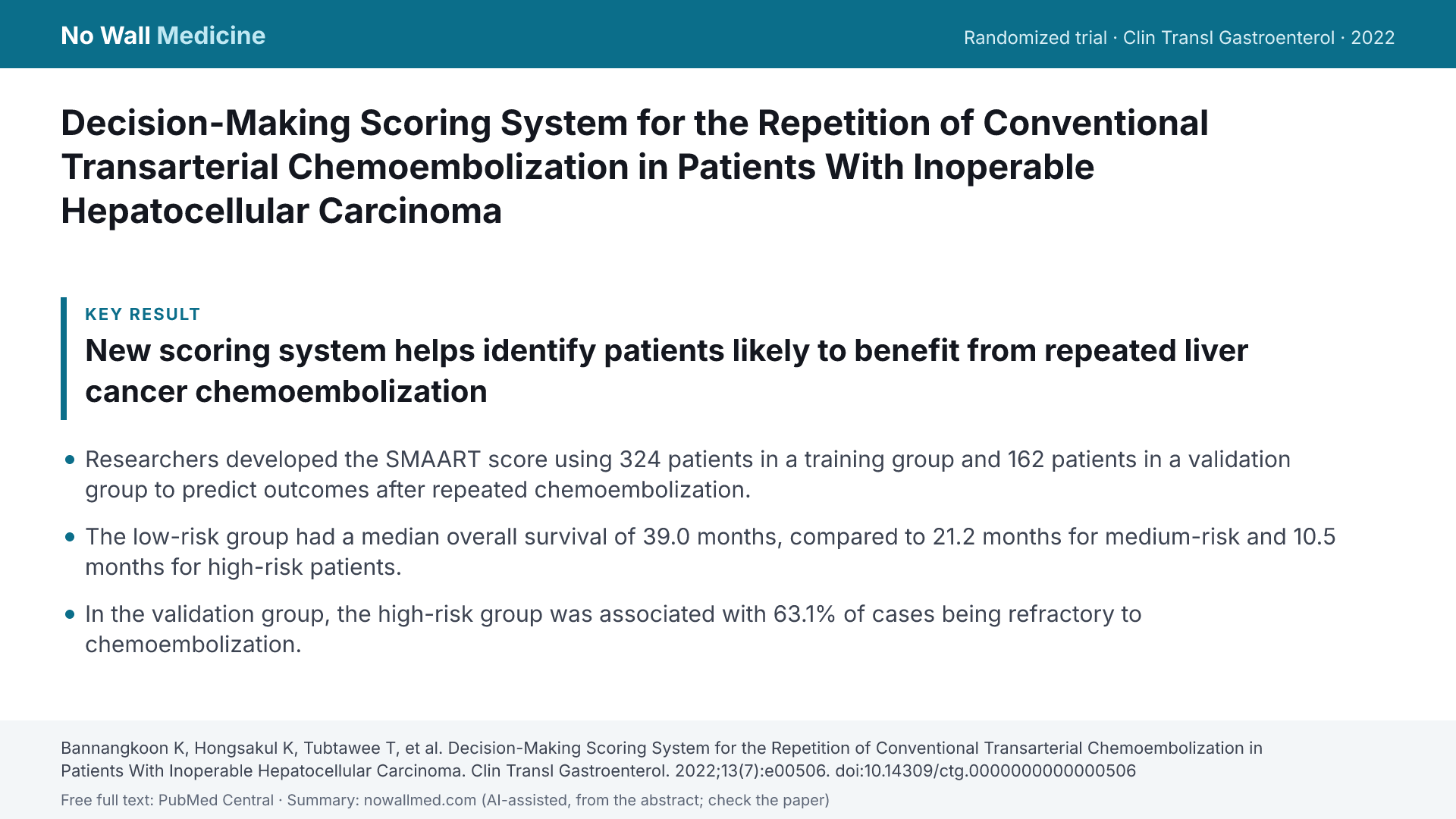
Key result: New scoring system helps identify patients likely to benefit from repeated liver cancer chemoembolization
Key points
- Researchers developed the SMAART score using 324 patients in a training group and 162 patients in a validation group to predict outcomes after repeated chemoembolization.
- The low-risk group had a median overall survival of 39.0 months, compared to 21.2 months for medium-risk and 10.5 months for high-risk patients.
- In the validation group, the high-risk group was associated with 63.1% of cases being refractory to chemoembolization.
Discussion prompts
- Would these patients look like yours? Who was left out?
- Is the main outcome one that matters to patients?
- Is the difference large enough to change what you do?
Cite: Bannangkoon K, Hongsakul K, Tubtawee T, et al. Decision-Making Scoring System for the Repetition of Conventional Transarterial Chemoembolization in Patients With Inoperable Hepatocellular Carcinoma. Clin Transl Gastroenterol. 2022;13(7):e00506. doi:10.14309/ctg.0000000000000506
Free full text: PubMed Central · Summary and visual abstract: nowallmed.com/a/decision-making-scoring-system-for-the-repetition-of-conventional-7zixyj/ (AI-assisted from the abstract; check the paper before relying on it).