Meta-analysis estimates mpox incubation period and case fatality rates during the 2022-2023 global outbreak
Decoding mpox: a systematic review and meta-analysis of the transmission and severity parameters of the 2022-2023 global outbreak
Systematic review and meta-analysisMixed results
What are the transmission and severity parameters of the 2022-2023 mpox outbreak?
Who
Observational studies on the 2022-2023 mpox outbreak · Global
Compared
Americas: 0.19% (95% CI 0.09% to 0.37%) case fatality rate
Europe: 0.33% (95% CI 0.15% to 0.7%) case fatality rate
Africa clade I: 17-64% case fatality rate
Africa clade IIb: 0-6% case fatality rate
Main outcome
Incubation period, serial interval, reproductive number, and case fatality rate
Bottom line: Mpox transmission parameters vary, with case fatality rates being significantly higher in African countries associated with clade I.
BMJ Glob Health · 2025-01-31Download image
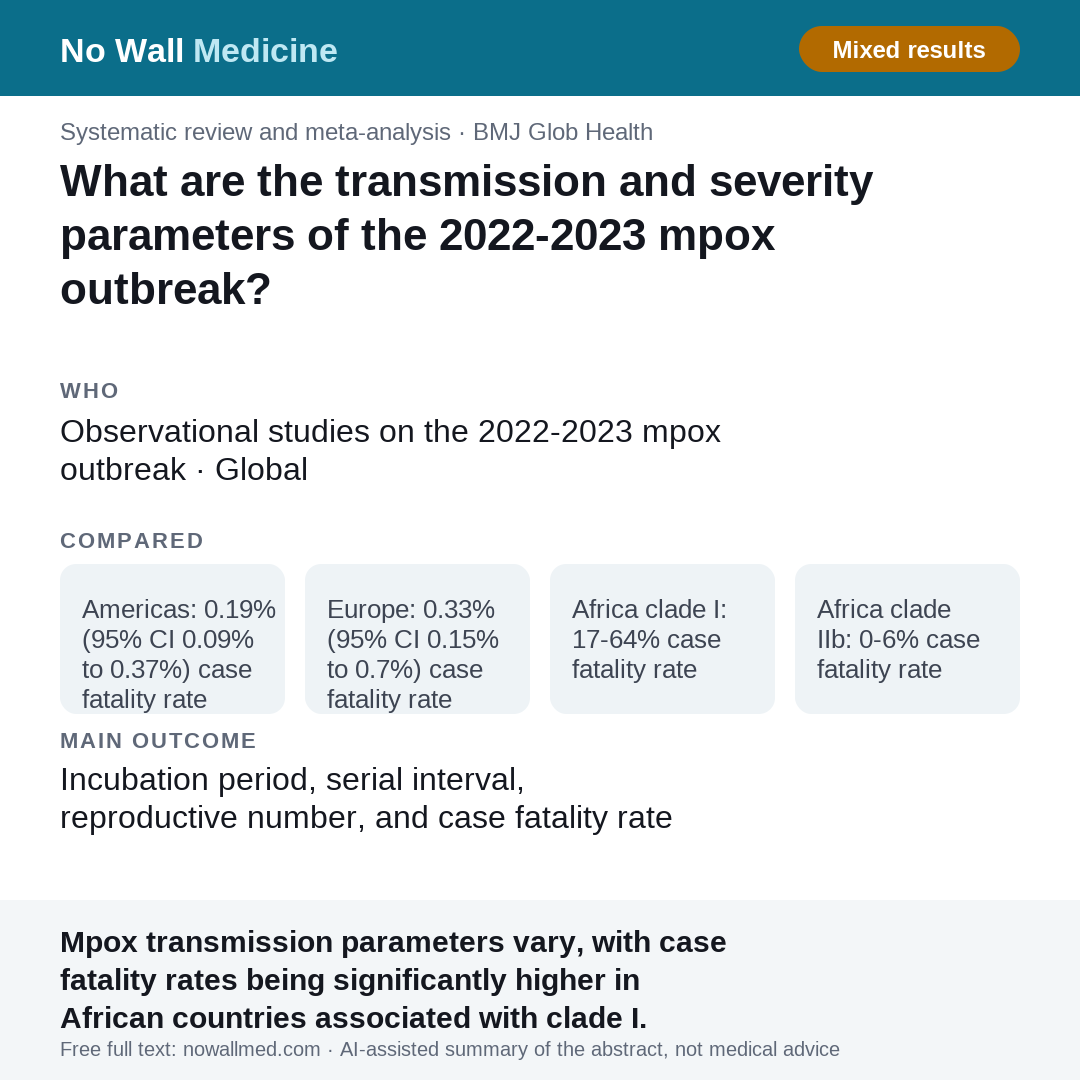
Clinical question: What are the transmission and severity parameters of the 2022-2023 mpox outbreak?
Why it matters: The specific transmission dynamics and severity parameters of the 2022-2023 mpox outbreak were not fully synthesized to inform mathematical models.
Key points
- Researchers performed a systematic review and meta-analysis of observational studies to measure mpox transmission and severity parameters.
- The pooled incubation period was 7.60 days and the pooled serial interval, the time between symptom onset in successive cases, was 8.30 days.
- Case fatality rates were estimated at 0.19% for the Americas and 0.33% for Europe, while African countries with clade I showed rates between 17-64%.
Headline and key points written with AI from the paper’s abstract, with every number checked against it. Read the paper before relying on them.
Was this summary helpful?
Abstract
Introduction
The 2022-2023 mpox outbreak has been the largest in history. We aim to synthesise the key epidemiological parameters related to the dynamics, transmission, and severity of mpox (incubation period, serial interval, generation time, infectious period, basic (R0) and effective (R(t)) reproductive number, and case fatality rate (CFR)). Methods
Systematic review of observational studies in MEDLINE, EMBASE and other sources up to September 2023 (PROSPERO: CRD42023404503). Quality assessment using the Joanna Briggs Institute Critical Appraisal for case series, cross-sectional and cohort studies, and a designed quality assessment questionnaire for mathematical models. Meta-analysis was performed using a random effects model. Results
For transmissibility parameters, we estimated a pooled incubation period of 7.60 (95% CI 7.14 to 8.10) days and a pooled serial interval of 8.30 (95% CI 6.74 to 10.23) days. One study reported a generation time of 12.5 days (95% CI 7.5 to 17.3). Three studies reported presymptomatic transmission in 27-50% of paired cases investigated. R(t) varied between 1.16 and 3.74 and R0 varied between 0.006 and 7.84. The epidemic peaked between August and September 2022 in Europe and the Americas whereas transmission has continued in African countries. For severity parameters, we estimated a pooled CFR by continent: 0.19% (95% CI 0.09% to 0.37%) for the Americas and 0.33% (95% CI 0.15% to 0.7%) for Europe. For Africa, we found that the CFRs of countries associated with group I were higher (range 17-64%) than those associated with group IIb (range 0-6%). Conclusion
Pooled mpox serial interval was slightly larger than pooled incubation period, suggesting transmission occurs mostly postsymptom onset, although presymptomatic transmission can occur in an important proportion of cases. CFR estimates varied by geographical region and were higher in Africa, in countries linked with clade I. Our results contribute to a better understanding of mpox dynamics, and the development of mathematical models to assess the impact of current and future interventions.
Abstract reproduced under the article’s CC BY NC licence.
Subject terms
Cite this article
Diaz Brochero C, Nocua-Báez LC, Cortes JA, Charniga K, Buitrago-Lopez A, Cucunubá ZM. Decoding mpox: a systematic review and meta-analysis of the transmission and severity parameters of the 2022-2023 global outbreak. BMJ Glob Health. 2025. doi:10.1136/bmjgh-2024-016906
Spotted a mistake? Suggest a correction
Top studies every Monday
The week’s key trials and guidelines in your specialties, plus any topics you follow. By email, free.
Get the weekly digest