Universal decolonization in nursing homes was associated with fewer hospital transfers due to infection
Decolonization in Nursing Homes to Prevent Infection and Hospitalization
Cluster-randomized trialBenefit found
Does universal decolonization prevent infection and hospitalization in nursing homes?
Who
28,956
Nursing home residents · 28 nursing homes
Compared
62.6%Routine-care bathing
52.2%Universal decolonization
Main outcome
Transfer to a hospital due to infection
Result: risk ratio 0.83 (95% CI 0.79 to 0.88)
Bottom line: Universal decolonization with chlorhexidine and nasal povidone-iodine significantly reduced hospital transfers due to infection.
Funded by: Agency for Healthcare Research and Quality
NEJM · 2023-10-10Download image
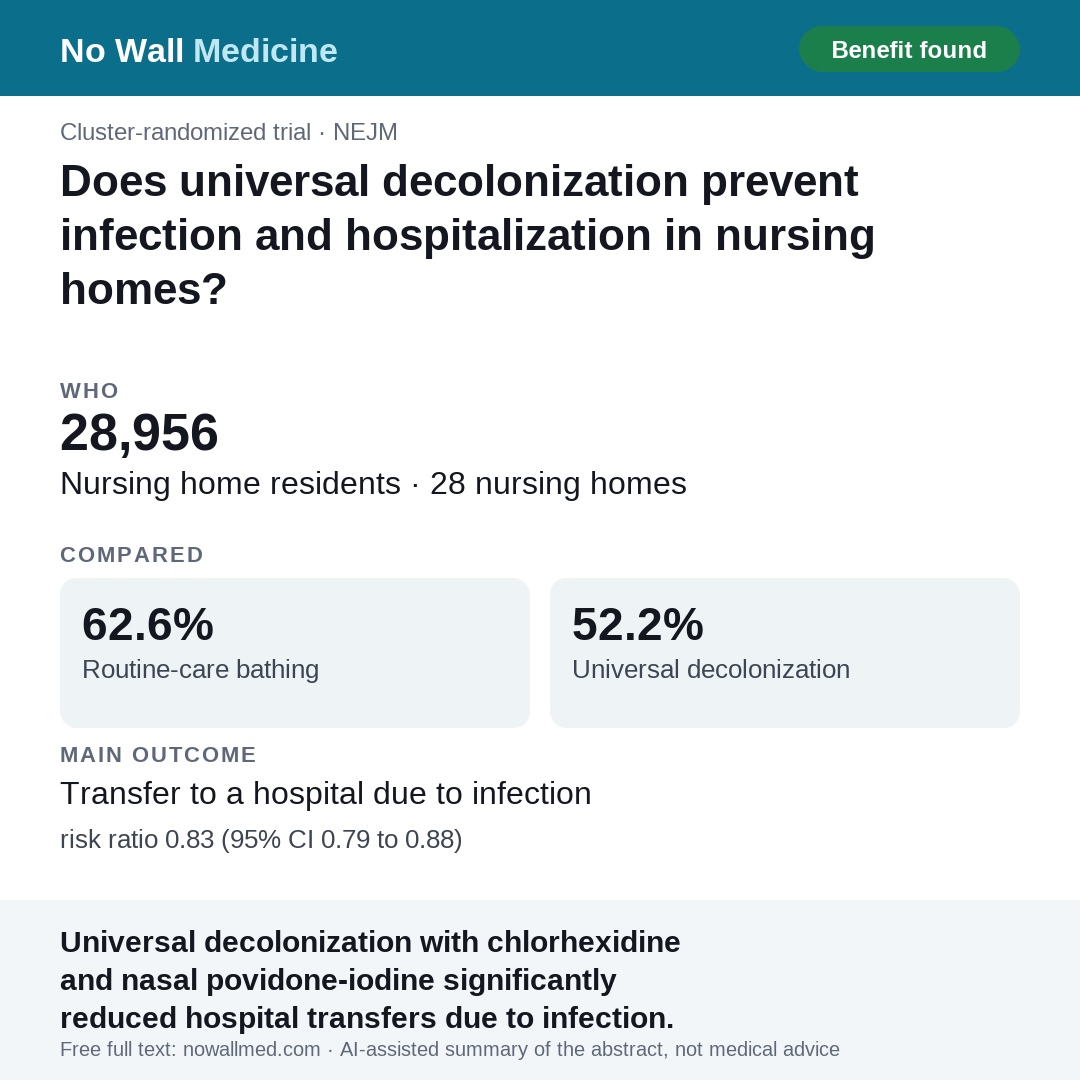
Clinical question: Does universal decolonization prevent infection and hospitalization in nursing homes?
Why it matters: Nursing home residents face a high risk of infection, hospitalization, and colonization with multidrug-resistant organisms.
Key points
- Researchers conducted a cluster-randomized trial involving 28,956 residents across 28 nursing homes comparing universal decolonization to routine-care bathing.
- The decolonization group showed a 16.6% difference in risk ratio for hospital transfers due to infection compared to the routine-care group.
- Hospital transfers for any reason also showed a 14.6% difference in risk ratio compared to routine care in the decolonization group.
Headline and key points written with AI from the paper’s abstract, with every number checked against it. Read the paper before relying on them.
Topics
Cite this article
Miller LG, McKinnell JA, Singh RD, Gussin GM, Kleinman K, Saavedra R. Decolonization in Nursing Homes to Prevent Infection and Hospitalization. NEJM. 2023. doi:10.1056/NEJMoa2215254
Spotted a mistake? Suggest a correction