Dedicated devices show lower mortality and higher success in transcatheter aortic valve replacement
Dedicated Versus Conventional Devices in Patients With Pure Native Aortic Regurgitation: A Systematic Review and Meta-Analysis
Meta-analysis of 19 observational studiesBenefit found
Is transcatheter aortic valve replacement efficacy different with dedicated versus conventional devices?
Who
Patients with pure native aortic regurgitation
Compared
16.9%First generation devices (95% CI, 13.2%-18.9%)
7.2%Second generation devices (95% CI, 6.1%-9.2%)
4.7%Dedicated devices (95% CI, 1.8%-8.9%)
Main outcome
30-day all-cause mortality
Result: 8.7% (95% CI, 5.8%-10.7%)
Bottom line: Transcatheter aortic valve replacement using dedicated devices may be a safe and effective option for high-risk patients.
Limitation: Observational design, lack of patient-level data, device heterogeneity, and potential publication bias.
J Am Heart Assoc · 2025-10-28Download image
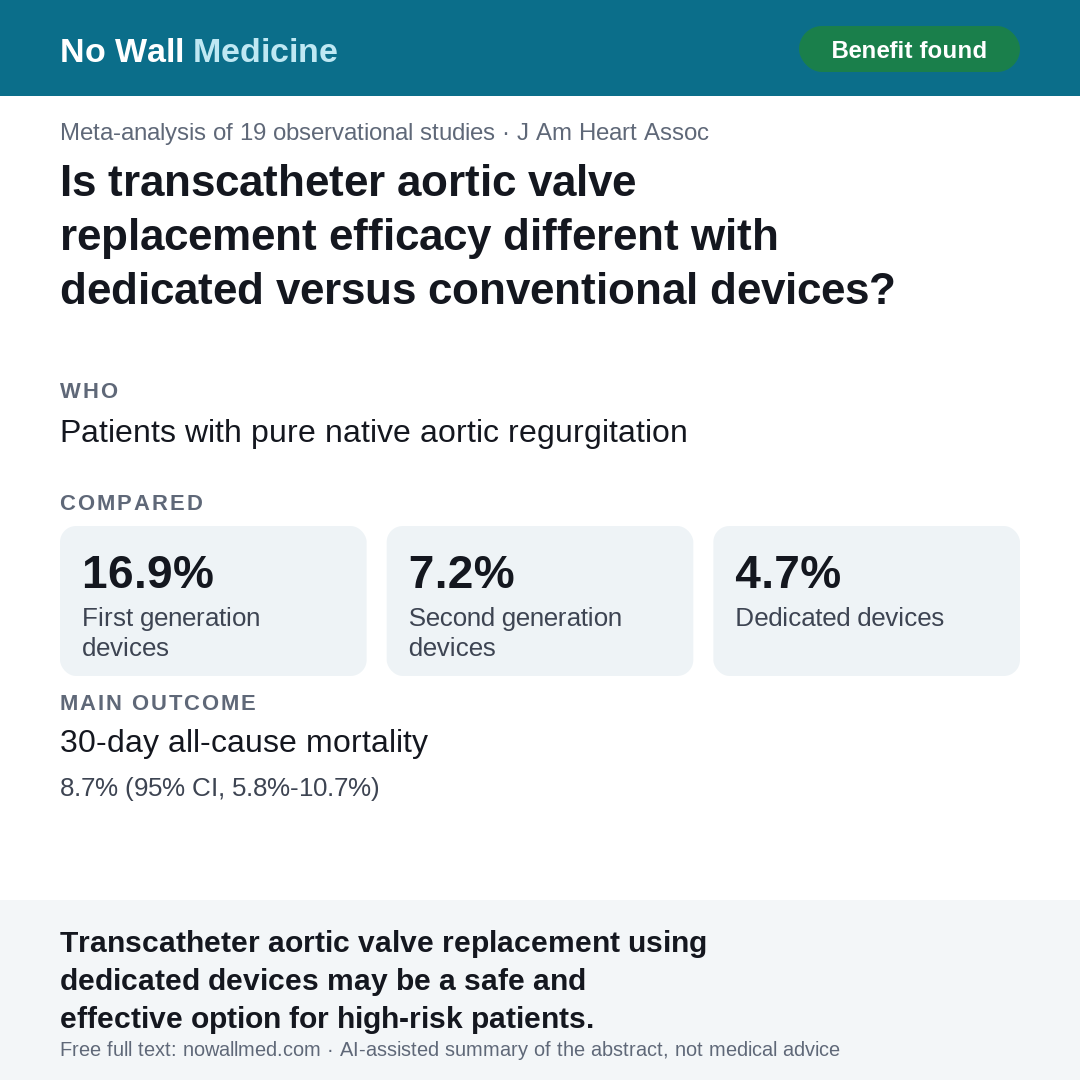
Clinical question: Is transcatheter aortic valve replacement efficacy different with dedicated versus conventional devices?
Why it matters: Many patients with pure native aortic regurgitation have unacceptable surgical risk, making transcatheter aortic valve replacement a potential alternative.
Key points
- Researchers analyzed 19 observational studies involving at least 20 patients each with pure native aortic regurgitation undergoing transcatheter aortic valve replacement.
- The pooled 30-day mortality was 8.7%, with dedicated devices showing 4.7% mortality compared to 16.9% for first generation devices.
- Overall device success was 84.1%, while valve migration, where the replacement valve moves from its position, occurred in 7.8% of cases.
Limitation the authors note: The authors state that the observational design, lack of patient-level data, device heterogeneity, and potential publication bias limit definitive conclusions.
Headline and key points written with AI from the paper’s abstract, with every number checked against it. Read the paper before relying on them.
Topics
Cite this article
Bacigalupi E, Scorpiglione L, Prendergast BD, Radico F, Gallinoro E, Bartorelli AL. Dedicated Versus Conventional Devices in Patients With Pure Native Aortic Regurgitation: A Systematic Review and Meta-Analysis. J Am Heart Assoc. 2025. doi:10.1161/JAHA.124.038659
Spotted a mistake? Suggest a correction