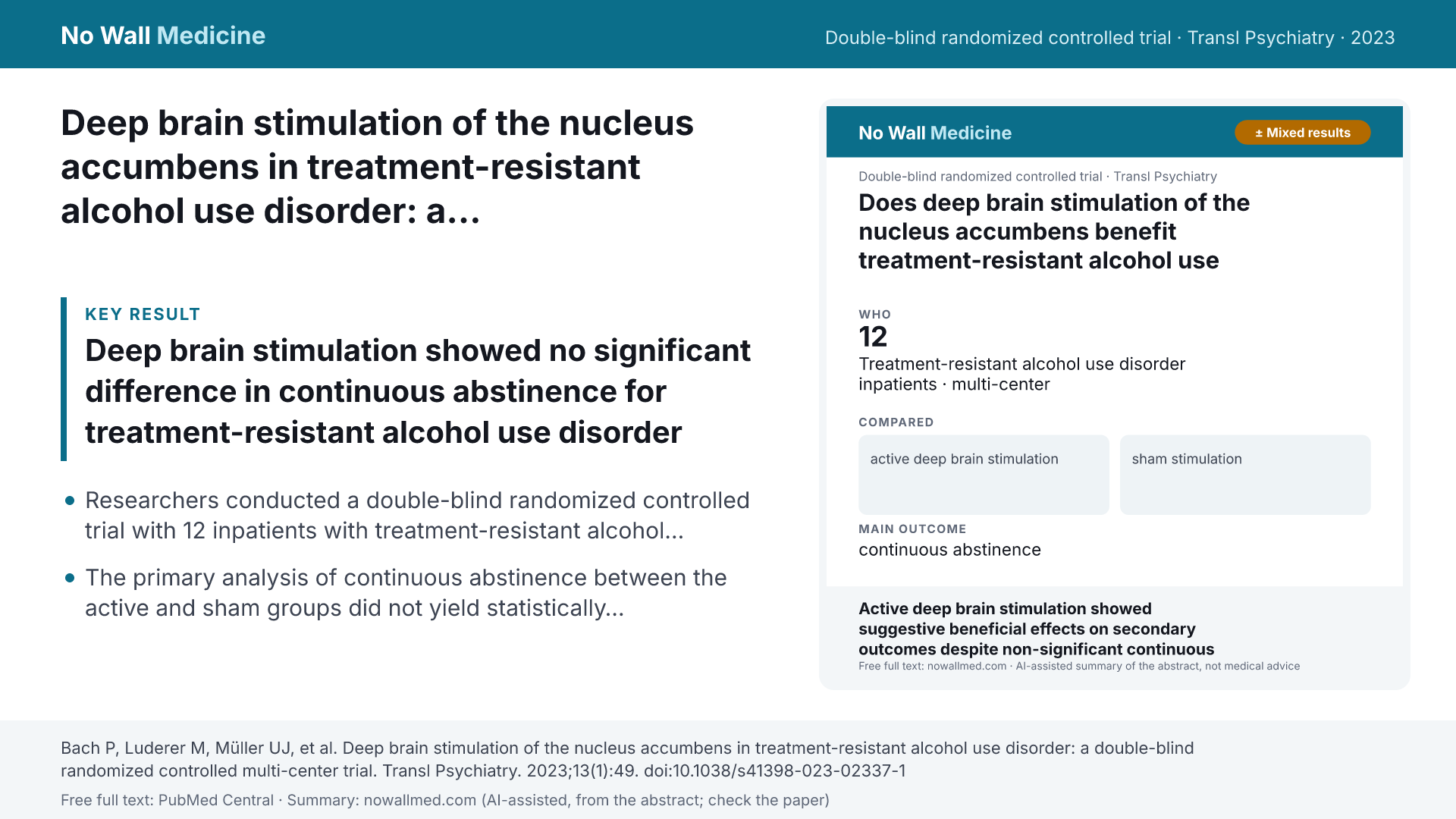
Deep brain stimulation showed no significant difference in continuous abstinence for treatment-resistant alcohol use disorder
Deep brain stimulation of the nucleus accumbens in treatment-resistant alcohol use disorder: a double-blind randomized controlled multi-center trial
Double-blind randomized controlled trialMixed results
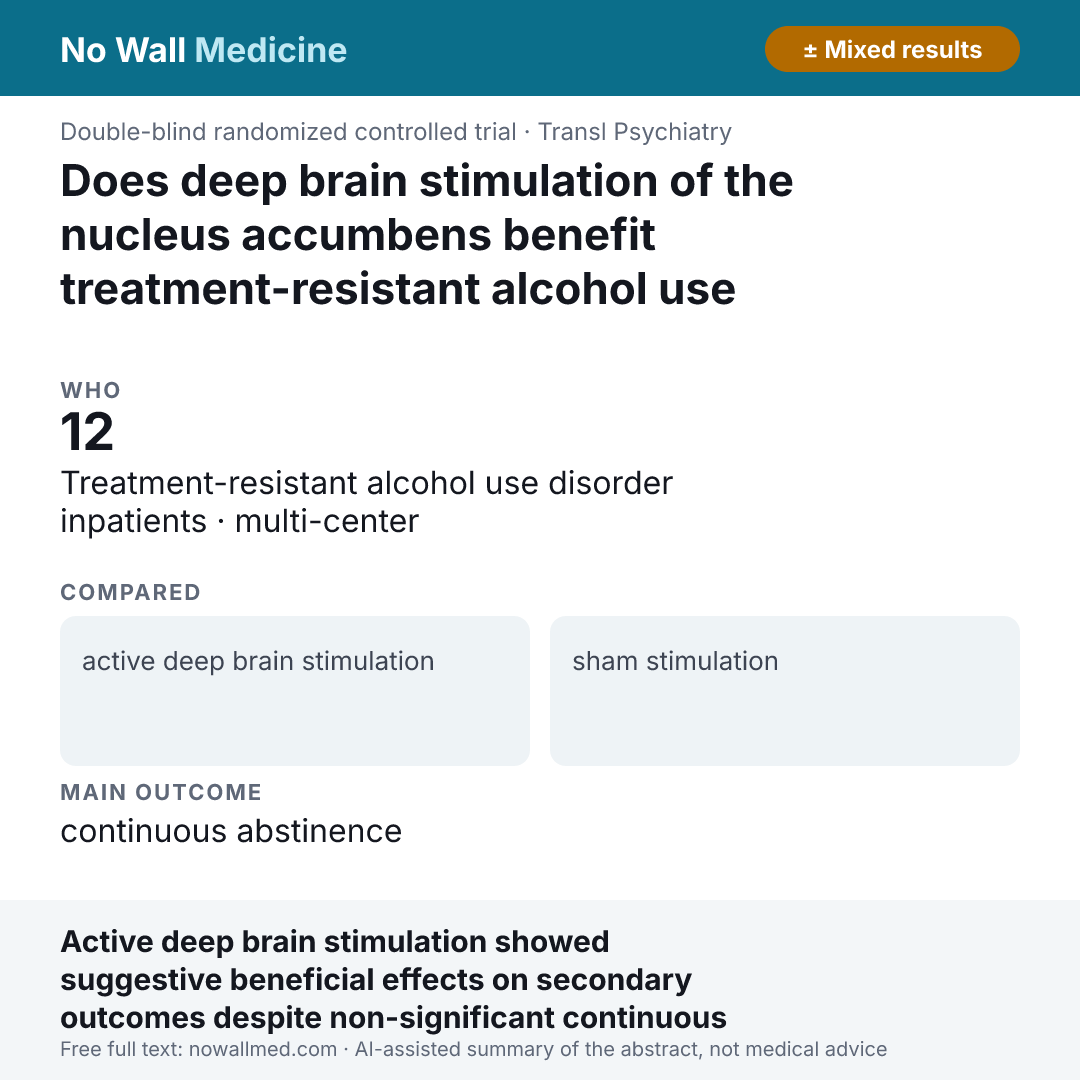
Does deep brain stimulation of the nucleus accumbens benefit treatment-resistant alcohol use disorder?
Who
12
Treatment-resistant alcohol use disorder inpatients · multi-center
Compared
active deep brain stimulation
sham stimulation
Main outcome
continuous abstinence
Bottom line: Active deep brain stimulation showed suggestive beneficial effects on secondary outcomes despite non-significant continuous abstinence results.
Limitation: restricted number of participants and limited statistical power
Transl Psychiatry · 2023-02-08 · Save PNG
Clinical question: Does deep brain stimulation of the nucleus accumbens benefit treatment-resistant alcohol use disorder?
Key points
- Researchers conducted a double-blind randomized controlled trial with 12 inpatients with treatment-resistant alcohol use disorder comparing active deep brain stimulation to sham stimulation.
- The primary analysis of continuous abstinence between the active and sham groups did not yield statistically significant results.
- In the active group, secondary outcomes after 6 months included a significantly higher proportion of abstinent days, lower alcohol craving, and lower anhedonia, which is the inability to feel pleasure.
Limitation the authors note: The lack of statistically significant results for the primary outcome was most likely due to the restricted number of participants.
Headline and key points written with AI from the paper’s abstract, with every number checked against it. Read the paper before relying on them.
Was this summary helpful?
Subject terms
Headline, design, result, key points, caveat and citation as plain text.
Cite this article
Bach P, Luderer M, Müller UJ, et al. Deep brain stimulation of the nucleus accumbens in treatment-resistant alcohol use disorder: a double-blind randomized controlled multi-center trial. Transl Psychiatry. 2023;13(1):49. doi:10.1038/s41398-023-02337-1
Spotted a mistake? Suggest a correction