Deep learning algorithms showed higher diagnostic accuracy than dermatologists for basal cell carcinoma detection
Deep Learning Algorithms in the Diagnosis of Basal Cell Carcinoma Using Dermatoscopy: Systematic Review and Meta-Analysis
Systematic review and meta-analysisBenefit found
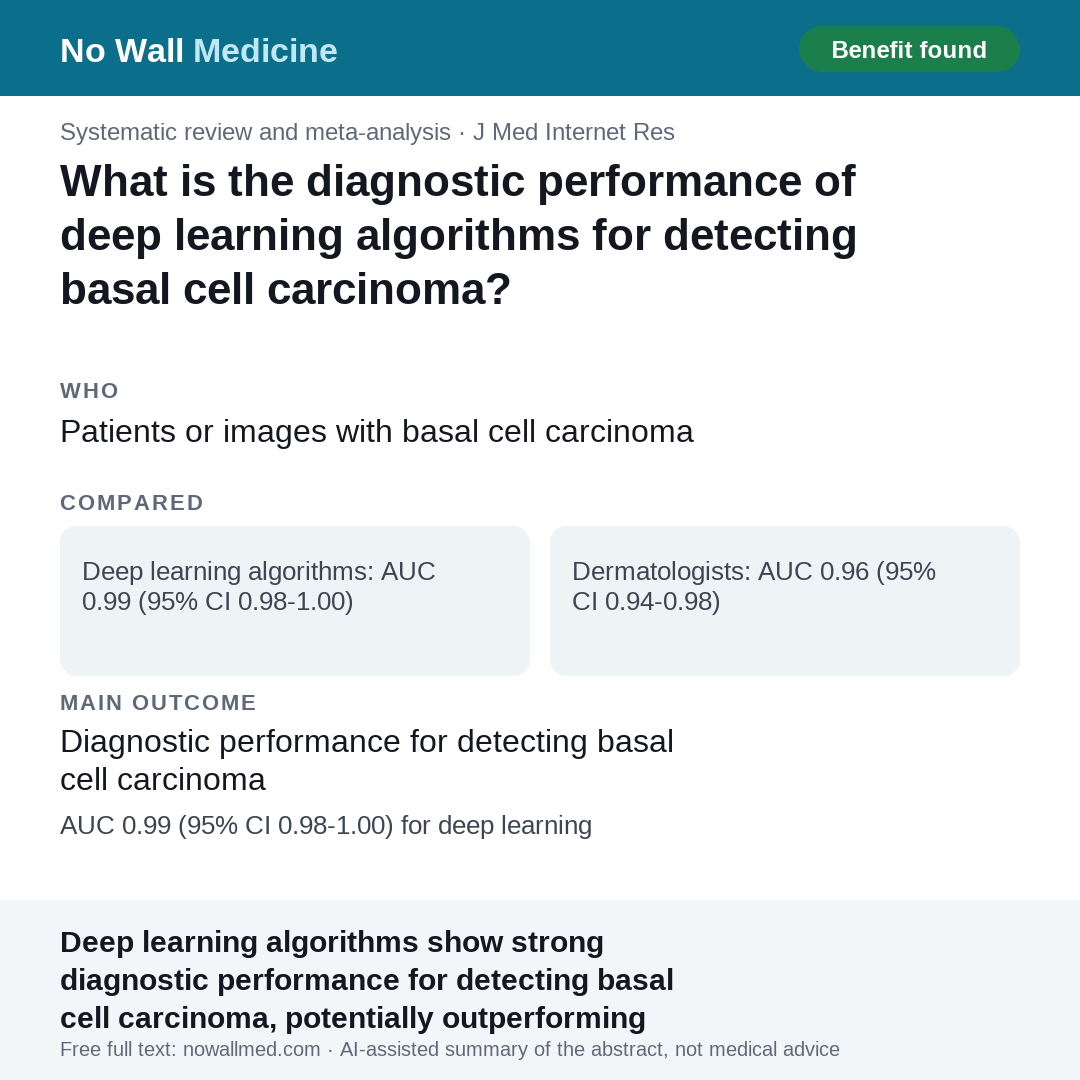
What is the diagnostic performance of deep learning algorithms for detecting basal cell carcinoma?
Who
Patients or images with basal cell carcinoma
Compared
Deep learning algorithms: AUC 0.99 (95% CI 0.98-1.00)
Dermatologists: AUC 0.96 (95% CI 0.94-0.98)
Main outcome
Diagnostic performance for detecting basal cell carcinoma
Result: AUC 0.99 (95% CI 0.98-1.00) for deep learning
Bottom line: Deep learning algorithms show strong diagnostic performance for detecting basal cell carcinoma, potentially outperforming dermatologists in internal validation datasets.
Limitation: Retrospective design of many studies and variations in reference standards may restrict generalizability.
J Med Internet Res · 2025-10-03Download image
Clinical question: What is the diagnostic performance of deep learning algorithms for detecting basal cell carcinoma?
Why it matters: The diagnostic performance of deep learning algorithms using dermatoscopy, which is a technique for examining skin lesions with a handheld magnifier, remains controversial.
Key points
- Researchers analyzed 15 studies involving 32,069 internal validation images and 200 external validation images to evaluate deep learning algorithms for basal cell carcinoma.
- Deep learning algorithms had a pooled sensitivity of 0.96, specificity of 0.98, and area under the curve of 0.99 compared to 0.75, 0.97, and 0.96 for dermatologists.
- The area under the curve for deep learning algorithms was higher than for dermatologists when using internal validation datasets.
Limitation the authors note: The retrospective design of many included studies and variations in reference standards may restrict the generalizability of these findings.
Headline and key points written with AI from the paper’s abstract, with every number checked against it. Read the paper before relying on them.
Was this summary helpful?
Subject terms
Cite this article
Liu H, Shang G, Shan Q. Deep Learning Algorithms in the Diagnosis of Basal Cell Carcinoma Using Dermatoscopy: Systematic Review and Meta-Analysis. J Med Internet Res. 2025. doi:10.2196/73541
Spotted a mistake? Suggest a correction
Top studies every Monday
The week’s key trials and guidelines in your specialties, plus any topics you follow. By email, free.
Get the weekly digest