Deep learning applications in stroke imaging focus primarily on stroke lesion segmentation
Deep Learning Applications in Imaging of Acute Ischemic Stroke: A Systematic Review and Narrative Summary
Systematic literature reviewMixed results
What are the current deep learning applications for imaging in acute ischemic stroke?
Who
Adult patients with acute ischemic stroke
Compared
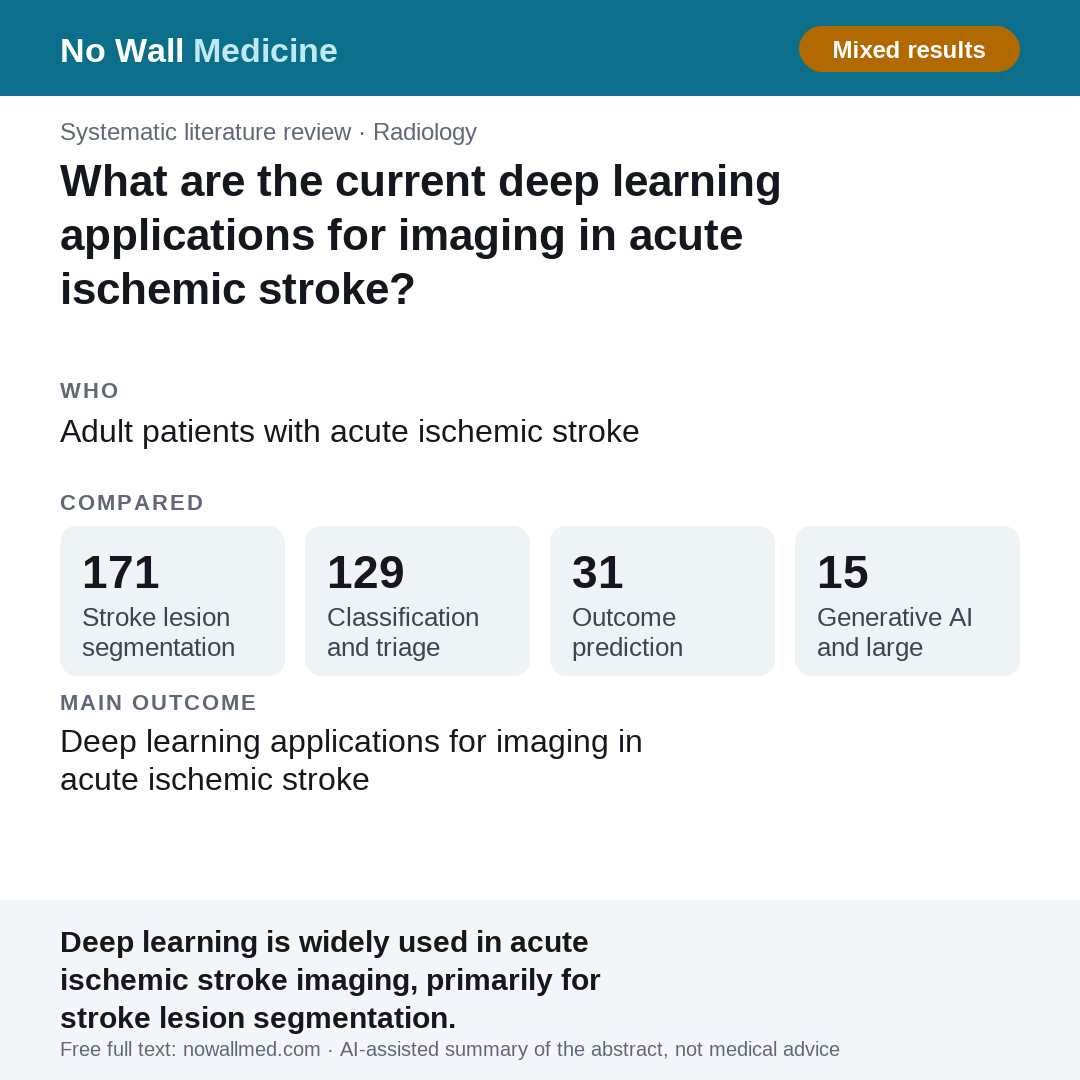
171Stroke lesion segmentation (45.0%)
129Classification and triage (33.9%)
31Outcome prediction (8.2%)
15Generative AI and large language models (3.9%)
Main outcome
Deep learning applications for imaging in acute ischemic stroke
Bottom line: Deep learning is widely used in acute ischemic stroke imaging, primarily for stroke lesion segmentation.
Limitation: Need for standardized protocols, test sets, larger datasets, and real-world validation.
Radiology · 2025-04-08Download image
Clinical question: What are the current deep learning applications for imaging in acute ischemic stroke?
Key points
- Researchers conducted a systematic review of 380 studies published between January 2016 and January 2024 regarding deep learning for acute ischemic stroke imaging.
- Of the included studies, 171 (45.0%) focused on stroke lesion segmentation and 129 (33.9%) focused on classification and triage.
- Other research areas included outcome prediction in 31 (8.2%) studies, generative artificial intelligence in 15 (3.9%) studies, and rapid imaging in 11 (2.9%) studies.
Headline and key points written with AI from the paper’s abstract, with every number checked against it. Read the paper before relying on them.
Topics
Cite this article
Jiang B, Pham N, van Staalduinen EK, Liu Y, Nazari-Farsani S, Sanaat A. Deep Learning Applications in Imaging of Acute Ischemic Stroke: A Systematic Review and Narrative Summary. Radiology. 2025. doi:10.1148/radiol.240775
Spotted a mistake? Suggest a correction
Top studies every Monday
The week’s key trials and guidelines in your specialties, plus any topics you follow. By email, free.
Get the weekly digest