Artificial intelligence assistance increased diagnostic accuracy for detecting acute intracranial hemorrhage on brain scans
Deep learning based automatic detection algorithm for acute intracranial haemorrhage: a pivotal randomized clinical trial
Retrospective, multi-reader, pivotal, crossover, randomised studyBenefit found
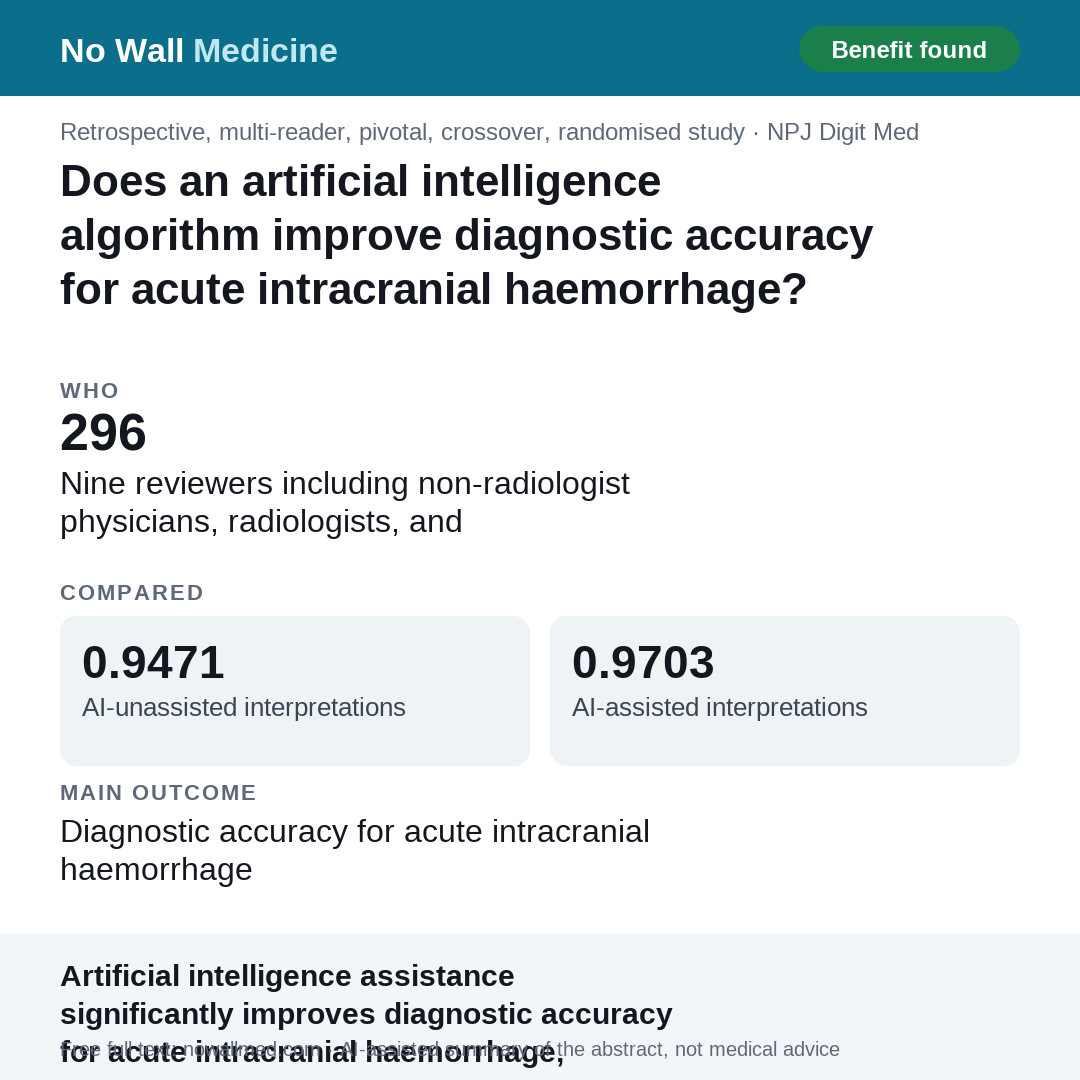
Does an artificial intelligence algorithm improve diagnostic accuracy for acute intracranial haemorrhage?
Who
296
Nine reviewers including non-radiologist physicians, radiologists, and neuroradiologists
Compared
0.9471AI-unassisted interpretations
0.9703AI-assisted interpretations
Main outcome
Diagnostic accuracy for acute intracranial haemorrhage
Bottom line: Artificial intelligence assistance significantly improves diagnostic accuracy for acute intracranial haemorrhage, especially for non-radiologist physicians.
NPJ Digit Med · 2023-04-07Download image
Clinical question: Does an artificial intelligence algorithm improve diagnostic accuracy for acute intracranial haemorrhage?
Why it matters: It is unknown if artificial intelligence algorithms can improve the accuracy of different types of physicians when diagnosing acute intracranial hemorrhage on brain computed tomography scans.
Key points
- Researchers compared nine reviewers, including non-radiologist physicians, board-certified radiologists, and neuroradiologists, using 12,663 brain computed tomography slices from 296 patients.
- The use of the artificial intelligence algorithm was associated with higher diagnostic accuracy compared to no assistance (0.9703 vs 0.9471, p < 0.0001).
- Non-radiologist physicians showed the greatest improvement in accuracy when using the artificial intelligence tool to interpret brain scans.
Headline and key points written with AI from the paper’s abstract, with every number checked against it. Read the paper before relying on them.
Cite this article
Yun TJ, Choi JW, Han M, Jung WS, Choi SH, Yoo RE. Deep learning based automatic detection algorithm for acute intracranial haemorrhage: a pivotal randomized clinical trial. NPJ Digit Med. 2023. doi:10.1038/s41746-023-00798-8
Spotted a mistake? Suggest a correction
Top studies every Monday
The week’s key trials and guidelines in your specialties, plus any topics you follow. By email, free.
Get the weekly digest