Deep learning system increased accuracy of detecting fetal brain malformations in ultrasound images
Deep learning system improved detection efficacy of fetal intracranial malformations in a randomized controlled trial
Three-way crossover, randomized controlled trialBenefit found
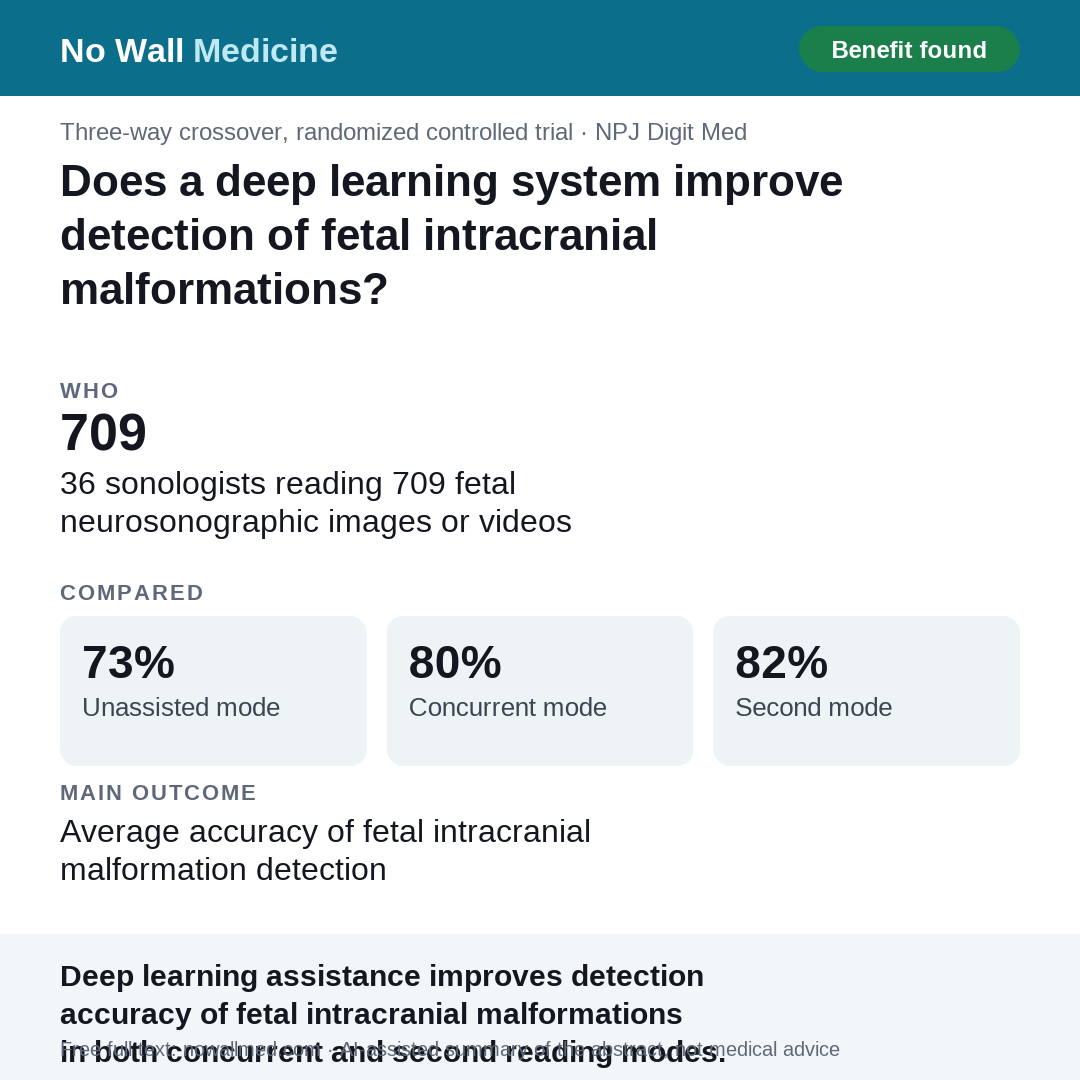
Does a deep learning system improve detection of fetal intracranial malformations?
Who
709
36 sonologists reading 709 fetal neurosonographic images or videos
Compared
73%Unassisted mode
80%Concurrent mode
82%Second mode
Main outcome
Average accuracy of fetal intracranial malformation detection
Result: AUC increased from 0.85 to 0.89 and to 0.90
Bottom line: Deep learning assistance improves detection accuracy of fetal intracranial malformations in both concurrent and second reading modes.
NPJ Digit Med · 2023-10-13Download image
Clinical question: Does a deep learning system improve detection of fetal intracranial malformations?
Why it matters: The impact of deep learning-assisted detection of congenital intracranial malformations from fetal neurosonographic images has not been evaluated.
Key points
- Researchers conducted a three-way crossover randomized controlled trial involving 36 sonologists reading 709 fetal neurosonographic images or videos.
- The average accuracy increased from 73% in unassisted mode to 80% in concurrent mode and 82% in second mode.
- Median reading time per data increased from 6 s to 7 s in concurrent mode and to 11 s in second mode.
Headline and key points written with AI from the paper’s abstract, with every number checked against it. Read the paper before relying on them.
Cite this article
Lin M, Zhou Q, Lei T, Shang N, Zheng Q, He X. Deep learning system improved detection efficacy of fetal intracranial malformations in a randomized controlled trial. NPJ Digit Med. 2023. doi:10.1038/s41746-023-00932-6
Spotted a mistake? Suggest a correction
Top studies every Monday
The week’s key trials and guidelines in your specialties, plus any topics you follow. By email, free.
Get the weekly digest