Deep Lipidomics in Human Plasma: Cardiometabolic Disease Risk and Effect of Dietary Fat Modulation
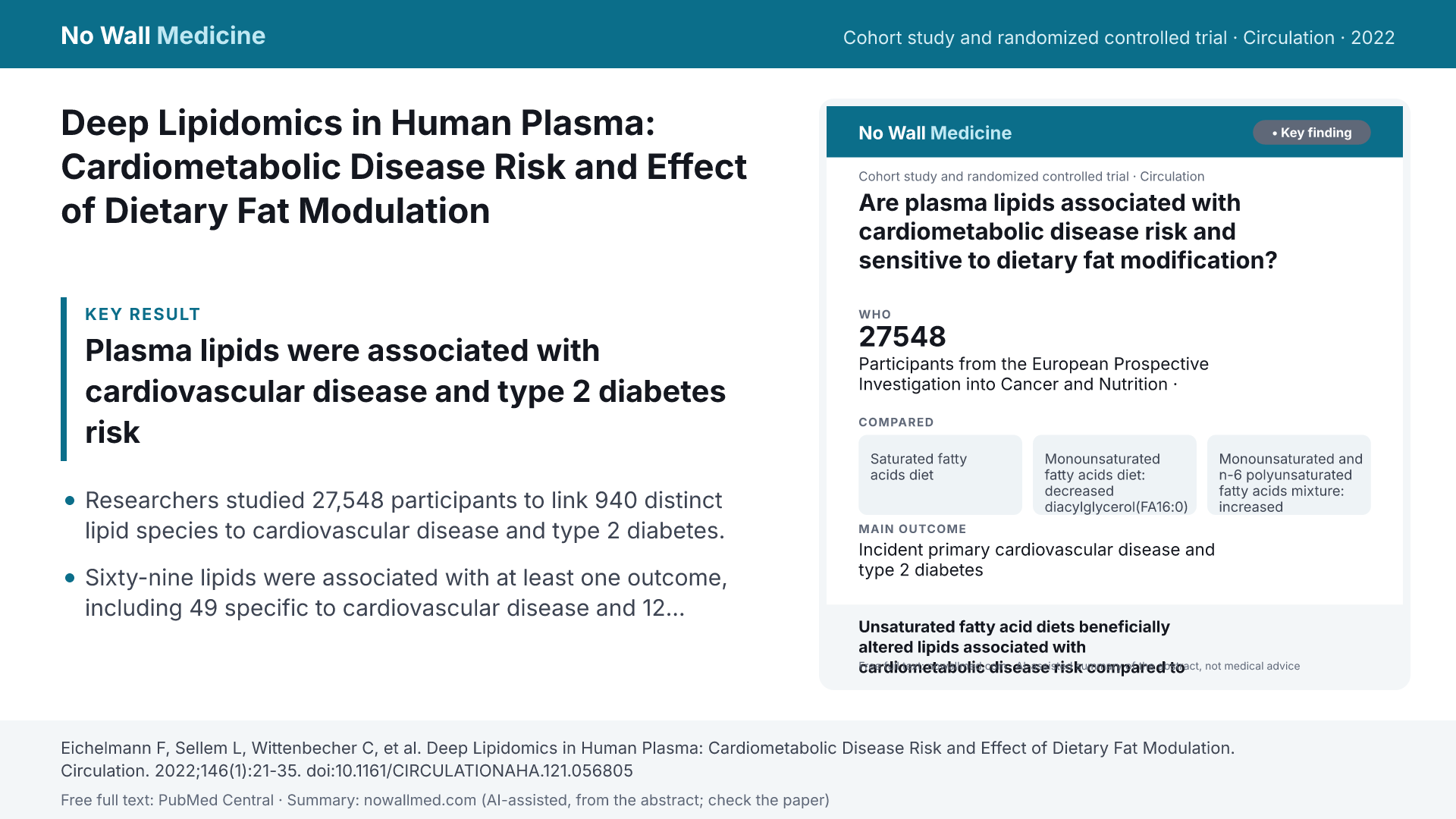
Key result: Plasma lipids were associated with cardiovascular disease and type 2 diabetes risk
Cohort study and randomized controlled trialKey finding
Are plasma lipids associated with cardiometabolic disease risk and sensitive to dietary fat modification?
Who
27548
Participants from the European Prospective Investigation into Cancer and Nutrition · Potsdam, Germany
Compared
Saturated fatty acids diet
Monounsaturated fatty acids diet: decreased diacylglycerol(FA16:0) by 0.4 (95% CI, 0.5-0.3) SD units
Monounsaturated and n-6 polyunsaturated fatty acids mixture: increased triacylglycerol(FA22:1) by 0.5 (95% CI, 0.4-0.7) SD units
Main outcome
Incident primary cardiovascular disease and type 2 diabetes
Bottom line: Unsaturated fatty acid diets beneficially altered lipids associated with cardiometabolic disease risk compared to saturated fat diets.
Circulation · 2022-04-15
Key points
- Researchers studied 27,548 participants to link 940 distinct lipid species to cardiovascular disease and type 2 diabetes.
- Sixty-nine lipids were associated with at least one outcome, including 49 specific to cardiovascular disease and 12 specific to type 2 diabetes.
- In a randomized trial of 113 people, unsaturated fat diets affected 19 risk-associated lipids compared to a saturated fat diet.
Discussion prompts
- Would these patients look like yours? Who was left out?
- Is the main outcome one that matters to patients?
- Is the difference large enough to change what you do?
Cite: Eichelmann F, Sellem L, Wittenbecher C, et al. Deep Lipidomics in Human Plasma: Cardiometabolic Disease Risk and Effect of Dietary Fat Modulation. Circulation. 2022;146(1):21-35. doi:10.1161/CIRCULATIONAHA.121.056805
Free full text: PubMed Central · Summary and visual abstract: nowallmed.com/a/deep-lipidomics-in-human-plasma-cardiometabolic-disease-risk-and-6508vd/ (AI-assisted from the abstract; check the paper before relying on it).