Oral deferiprone was found to be noninferior to subcutaneous deferoxamine for treating iron overload
Deferiprone vs deferoxamine for transfusional iron overload in SCD and other anemias: a randomized, open-label noninferiority study
Randomized, open-label noninferiority studyBenefit found
Is deferiprone noninferior to deferoxamine for transfusional iron overload in sickle cell disease?
Who
228
Patients with sickle cell disease or other anemias receiving chronic transfusion therapy
Compared
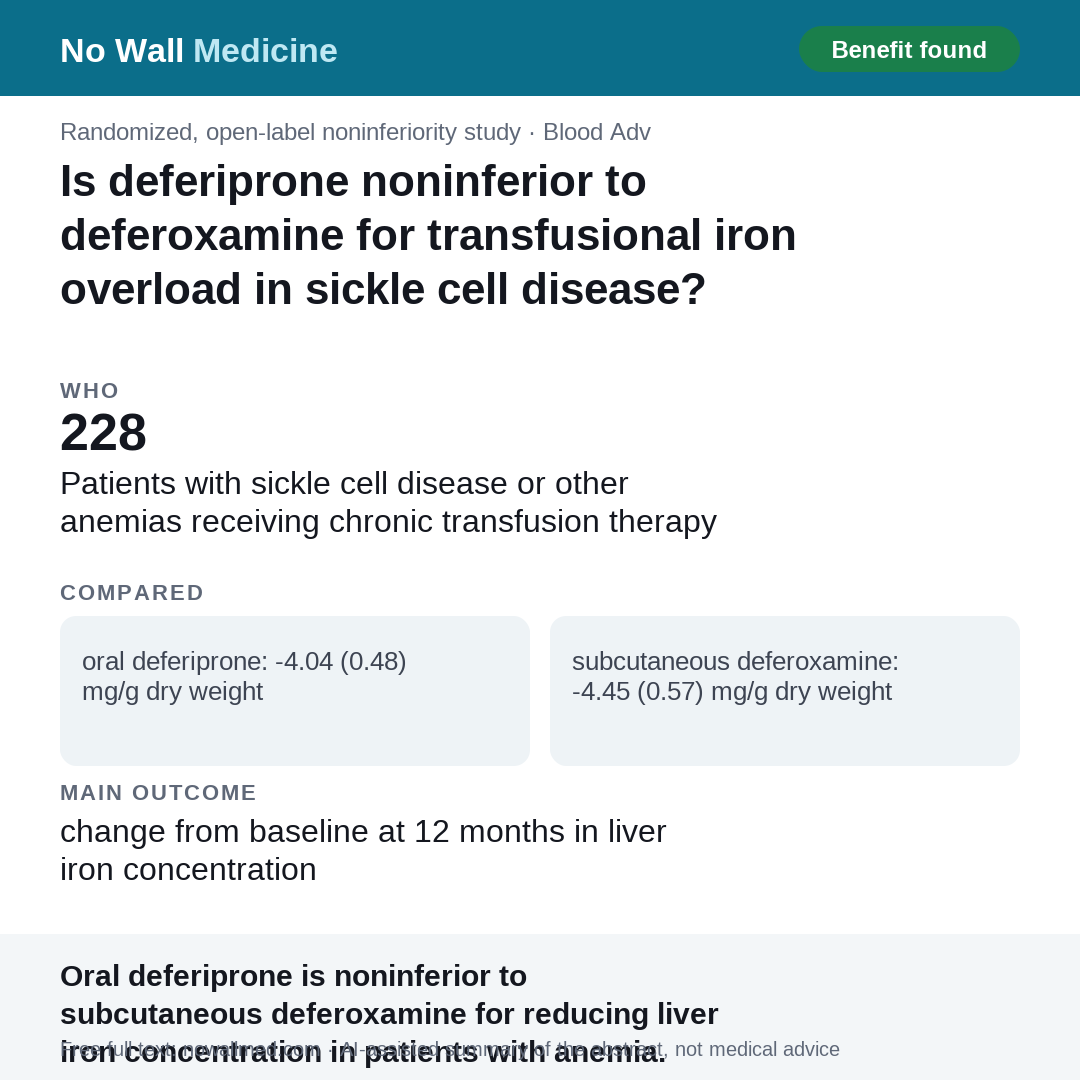
oral deferiprone: -4.04 (0.48) mg/g dry weight
subcutaneous deferoxamine: -4.45 (0.57) mg/g dry weight
Main outcome
change from baseline at 12 months in liver iron concentration
Result: least squares mean difference 0.40 (96.01% confidence interval, -0.76 to 1.57)
Bottom line: Oral deferiprone is noninferior to subcutaneous deferoxamine for reducing liver iron concentration in patients with anemia.
Blood Adv · 2021-12-01Download image
Clinical question: Is deferiprone noninferior to deferoxamine for transfusional iron overload in sickle cell disease?
Why it matters: Data regarding the use of the iron chelator deferiprone in patients with sickle cell disease are limited.
Key points
- Researchers studied 228 patients with sickle cell disease or other anemias who were randomized to receive either oral deferiprone or subcutaneous deferoxamine.
- At 12 months, the change in liver iron concentration was -4.04 (0.48) mg/g dry weight for deferiprone versus -4.45 (0.57) mg/g dry weight for deferoxamine.
- Common side effects for deferiprone included abdominal pain (17.1%), vomiting (14.5%), fever (9.2%), and increased liver enzymes (9.2%).
Headline and key points written with AI from the paper’s abstract, with every number checked against it. Read the paper before relying on them.
Was this summary helpful?
Abstract
Many people with sickle cell disease (SCD) or other anemias require chronic blood transfusions, which often causes iron overload that requires chelation therapy. The iron chelator deferiprone is frequently used in individuals with thalassemia syndromes, but data in patients with SCD are limited. This open-label study assessed the efficacy and safety of deferiprone in patients with SCD or other anemias receiving chronic transfusion therapy. A total of 228 patients (mean age: 16.9 [range, 3-59] years; 46.9% female) were randomized to receive either oral deferiprone (n = 152) or subcutaneous deferoxamine (n = 76). The primary endpoint was change from baseline at 12 months in liver iron concentration (LIC), assessed by R2* magnetic resonance imaging (MRI). The least squares mean (standard error) change in LIC was -4.04 (0.48) mg/g dry weight for deferiprone vs -4.45 (0.57) mg/g dry weight for deferoxamine, with noninferiority of deferiprone to deferoxamine demonstrated by analysis of covariance (least squares mean difference 0.40 [0.56]; 96.01% confidence interval, -0.76 to 1.57). Noninferiority of deferiprone was also shown for both cardiac T2* MRI and serum ferritin. Rates of overall adverse events (AEs), treatment-related AEs, serious AEs, and AEs leading to withdrawal did not differ significantly between the groups. AEs related to deferiprone treatment included abdominal pain (17.1% of patients), vomiting (14.5%), pyrexia (9.2%), increased alanine transferase (9.2%) and aspartate transferase levels (9.2%), neutropenia (2.6%), and agranulocytosis (0.7%). The efficacy and safety profiles of deferiprone were acceptable and consistent with those seen in patients with transfusion-dependent thalassemia. This trial study was registered at www://clinicaltrials.gov as #NCT02041299.
Abstract reproduced under the article’s CC BY NC ND licence.
Subject terms
Cite this article
Kwiatkowski JL, Hamdy M, El-Beshlawy A, Ebeid FSE, Badr M, Alshehri A. Deferiprone vs deferoxamine for transfusional iron overload in SCD and other anemias: a randomized, open-label noninferiority study. Blood Adv. 2021. doi:10.1182/bloodadvances.2021004938
Spotted a mistake? Suggest a correction
Top studies every Monday
The week’s key trials and guidelines in your specialties, plus any topics you follow. By email, free.
Get the weekly digest