Defining indocyanine green fluorescence to assess anastomotic perfusion during gastrointestinal surgery: systematic review
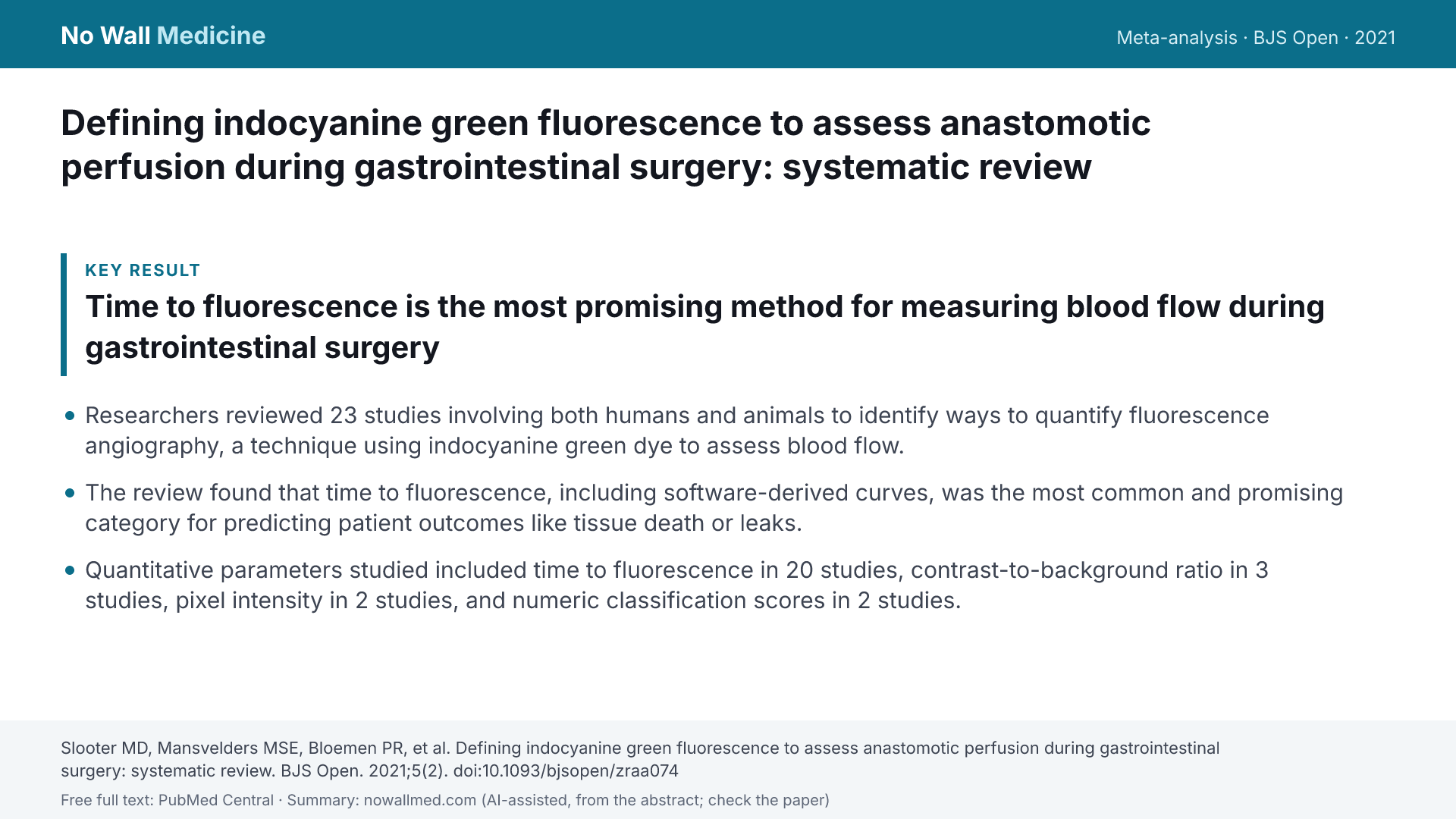
Key result: Time to fluorescence is the most promising method for measuring blood flow during gastrointestinal surgery
Key points
- Researchers reviewed 23 studies involving both humans and animals to identify ways to quantify fluorescence angiography, a technique using indocyanine green dye to assess blood flow.
- The review found that time to fluorescence, including software-derived curves, was the most common and promising category for predicting patient outcomes like tissue death or leaks.
- Quantitative parameters studied included time to fluorescence in 20 studies, contrast-to-background ratio in 3 studies, pixel intensity in 2 studies, and numeric classification scores in 2 studies.
Discussion prompts
- Would these patients look like yours? Who was left out?
- Is the main outcome one that matters to patients?
- Is the difference large enough to change what you do?
Cite: Slooter MD, Mansvelders MSE, Bloemen PR, et al. Defining indocyanine green fluorescence to assess anastomotic perfusion during gastrointestinal surgery: systematic review. BJS Open. 2021;5(2). doi:10.1093/bjsopen/zraa074
Free full text: PubMed Central · Summary and visual abstract: nowallmed.com/a/defining-indocyanine-green-fluorescence-to-assess-anastomotic-1bl4ps3/ (AI-assisted from the abstract; check the paper before relying on it).