Defining stage in mucinous tumours of the appendix with peritoneal dissemination: the importance of grading terminology: systematic review
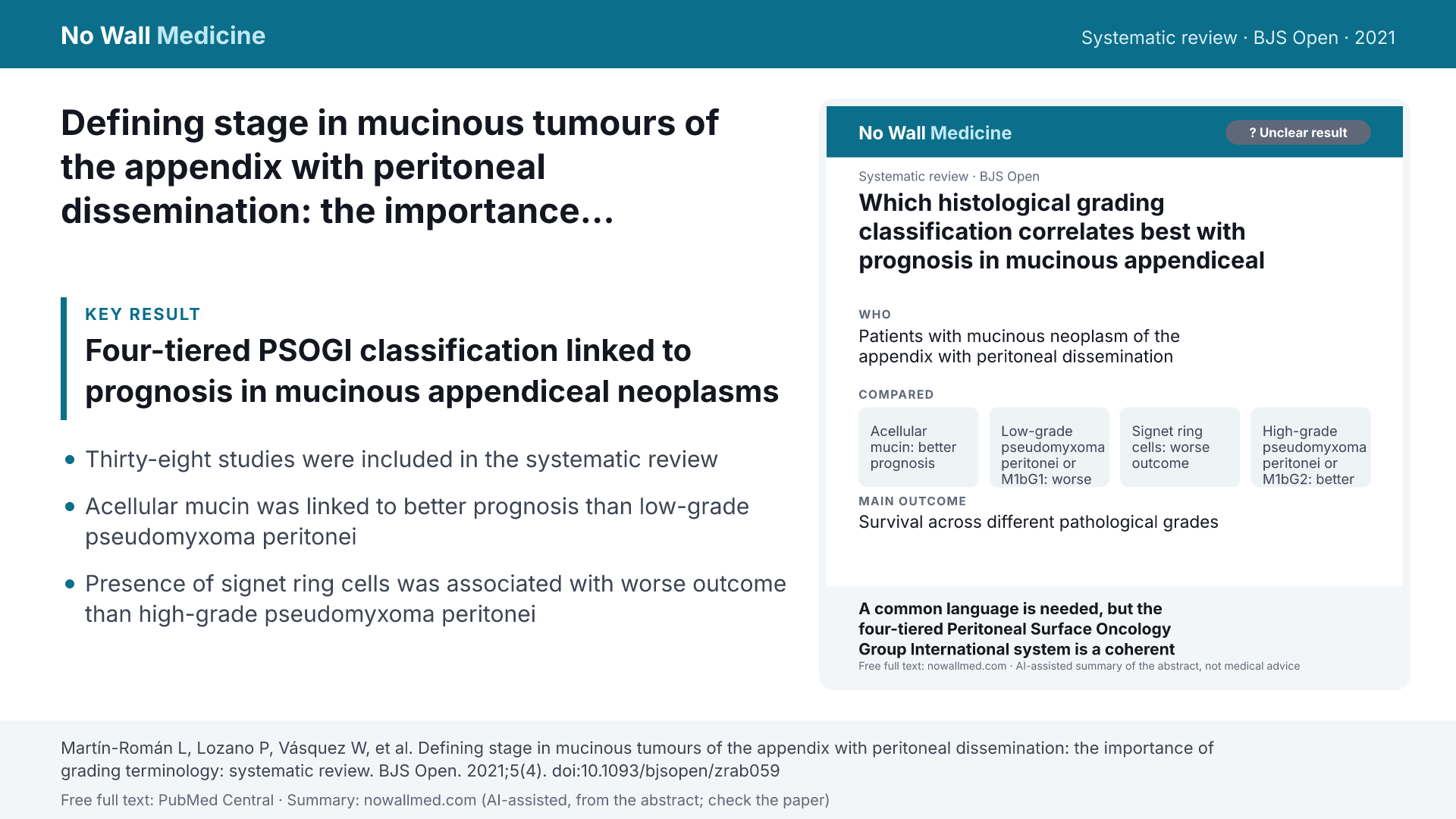
Key result: Four-tiered PSOGI classification linked to prognosis in mucinous appendiceal neoplasms
Systematic reviewUnclear result
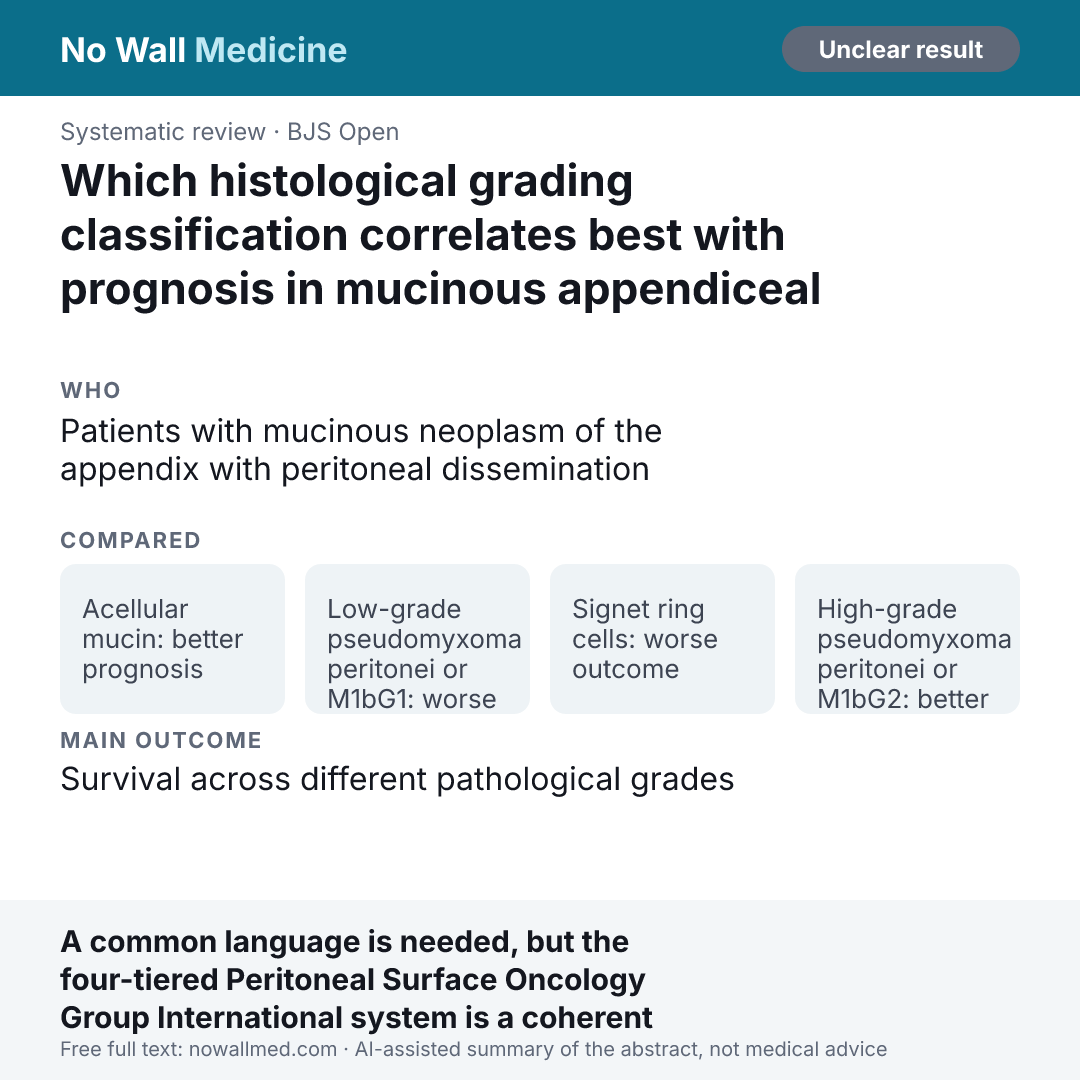
Which histological grading classification correlates best with prognosis in mucinous appendiceal neoplasms?
Who
Patients with mucinous neoplasm of the appendix with peritoneal dissemination
Compared
Acellular mucin: better prognosis
Low-grade pseudomyxoma peritonei or M1bG1: worse prognosis
Signet ring cells: worse outcome
High-grade pseudomyxoma peritonei or M1bG2: better outcome
Main outcome
Survival across different pathological grades
Bottom line: A common language is needed, but the four-tiered Peritoneal Surface Oncology Group International system is a coherent option.
BJS Open · 2021-08-06 · Save PNG
Key points
- Thirty-eight studies were included in the systematic review.
- Acellular mucin was linked to better prognosis than low-grade pseudomyxoma peritonei.
- Presence of signet ring cells was associated with worse outcome than high-grade pseudomyxoma peritonei.
Why it matters: No universally accepted histological grading exists for mucinous appendiceal neoplasms
Discussion prompts
- Would these patients look like yours? Who was left out?
- Is the main outcome one that matters to patients?
- Is the difference large enough to change what you do?
Cite: Martín-Román L, Lozano P, Vásquez W, et al. Defining stage in mucinous tumours of the appendix with peritoneal dissemination: the importance of grading terminology: systematic review. BJS Open. 2021;5(4). doi:10.1093/bjsopen/zrab059
Free full text: PubMed Central · Summary and visual abstract: nowallmed.com/a/defining-stage-in-mucinous-tumours-of-the-appendix-with-peritoneal-12c2lyx/ (AI-assisted from the abstract; check the paper before relying on it).