Inconsistent terminology makes it difficult to define vascular anomalies in Maffucci syndrome
Defining the Vascular Anomalies in Maffucci Syndrome: A Systematic Review
Systematic reviewMixed results
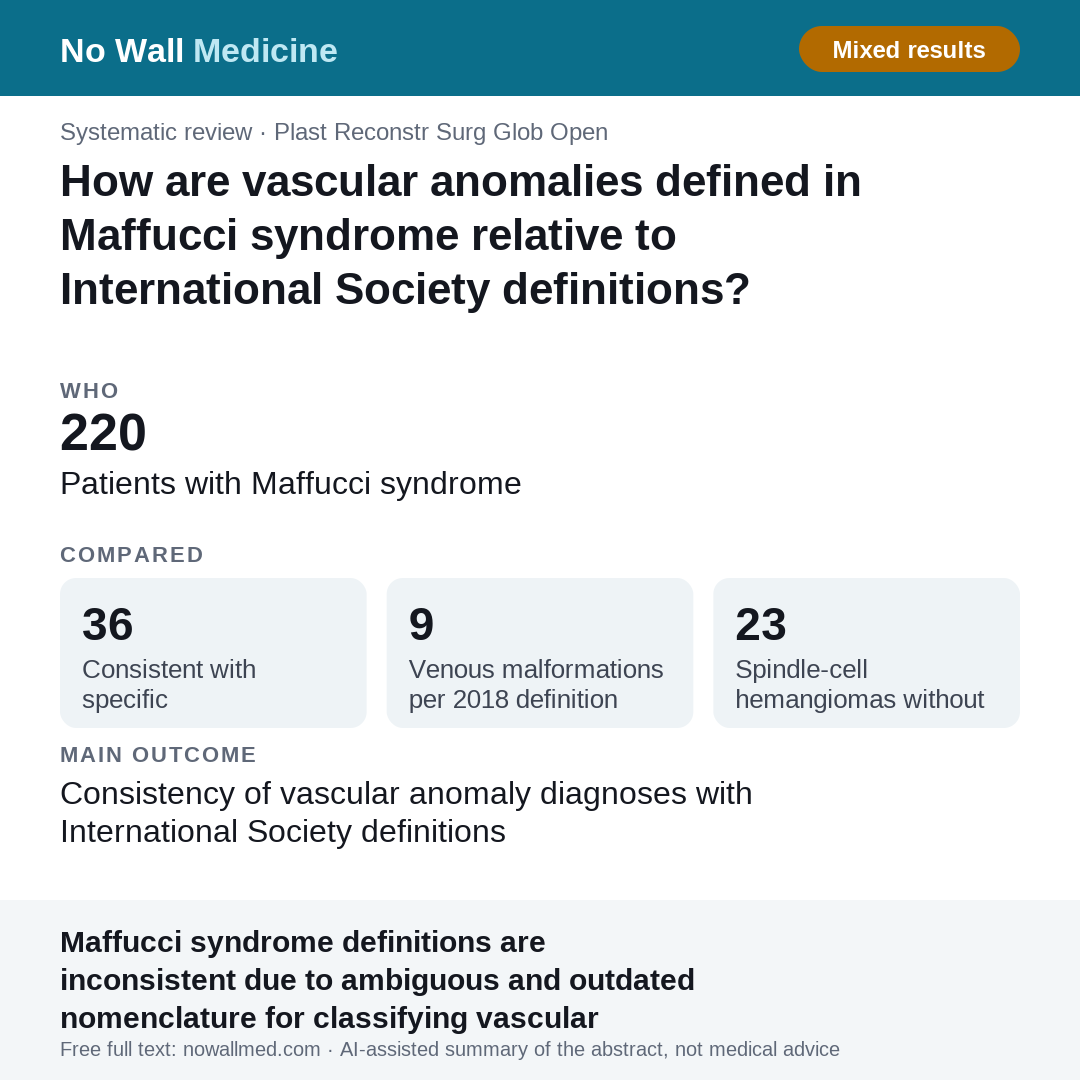
How are vascular anomalies defined in Maffucci syndrome relative to International Society definitions?
Who
220
Patients with Maffucci syndrome
Compared
36Consistent with specific International Society definition (16%)
9Venous malformations per 2018 definition (4%)
23Spindle-cell hemangiomas without venous malformations (11%)
Main outcome
Consistency of vascular anomaly diagnoses with International Society definitions
Bottom line: Maffucci syndrome definitions are inconsistent due to ambiguous and outdated nomenclature for classifying vascular anomalies.
Limitation: The review notes inconsistent use of nomenclature makes identifying the true constellation of anomalies difficult.
Plast Reconstr Surg Glob Open · 2026-06-22Download image
Clinical question: How are vascular anomalies defined in Maffucci syndrome relative to International Society definitions?
Why it matters: The nomenclature used to define Maffucci syndrome is variable, making it difficult to identify the specific types of vascular anomalies present in the disease.
Key points
- Researchers reviewed 265 articles and 220 patients from 183 primary reports to evaluate how Maffucci syndrome is defined.
- Only 36 patients (16%) had a vascular anomaly diagnosis that matched a specific International Society for the Study of Vascular Anomalies label.
- Only 9 patients (4%) were reported to have venous malformations, while 23 patients (11%) had spindle-cell hemangiomas without venous malformations.
Headline and key points written with AI from the paper’s abstract, with every number checked against it. Read the paper before relying on them.
Abstract
Background
Maffucci syndrome (MS) is a rare disorder characterized by enchondromas and vascular anomalies (VAs). However, the nomenclature used to define MS in the literature is variable. The purpose of this review is to evaluate definitions of MS and characterize VAs reported in patients with MS, in relation to International Society for the Study of Vascular Anomalies (ISSVA) definitions. Methods
MEDLINE and Embase were searched for articles that discussed MS. Articles were analyzed for VAs identified in the disease definition. Case reports of MS were analyzed for VAs diagnosed in their patients. Results
Since 1950, 265 articles have defined MS. Disease definitions have varied widely. Over half of the articles identified "hemangioma" nonspecifically as the defining VA, whereas only 2 recognized the ISSVA definition of MS as "enchondromas with venous malformations ± spindle-cell hemangiomas (SCHs)." Of 220 patients in 183 primary reports, only 36 (16%) patients had a VA diagnosis consistent with a specific ISSVA diagnostic label. Only 9 (4%) patients were reported to have venous malformations per the 2018 ISSVA definition of MS, whereas 23 (11%) were reported to have SCHs in the absence of venous malformations. Conclusions
The definition of MS remains inconsistent due to the use of ambiguous and outdated nomenclature for classifying VAs. This makes it difficult to identify the true constellation of VAs present in the disease. Clinicians and researchers should adhere to modern nomenclature when discussing VAs. Given multiple histologically confirmed SCHs in the absence of venous malformations, it seems that either lesion may be diagnostic for MS.
Abstract reproduced under the article’s CC BY-NC-ND licence.
Cite this article
Fang E, Zhou T, Haas J, Yuen K, Choi M. Defining the Vascular Anomalies in Maffucci Syndrome: A Systematic Review. Plast Reconstr Surg Glob Open. 2026. doi:10.1097/gox.0000000000007852
Spotted a mistake? Suggest a correction