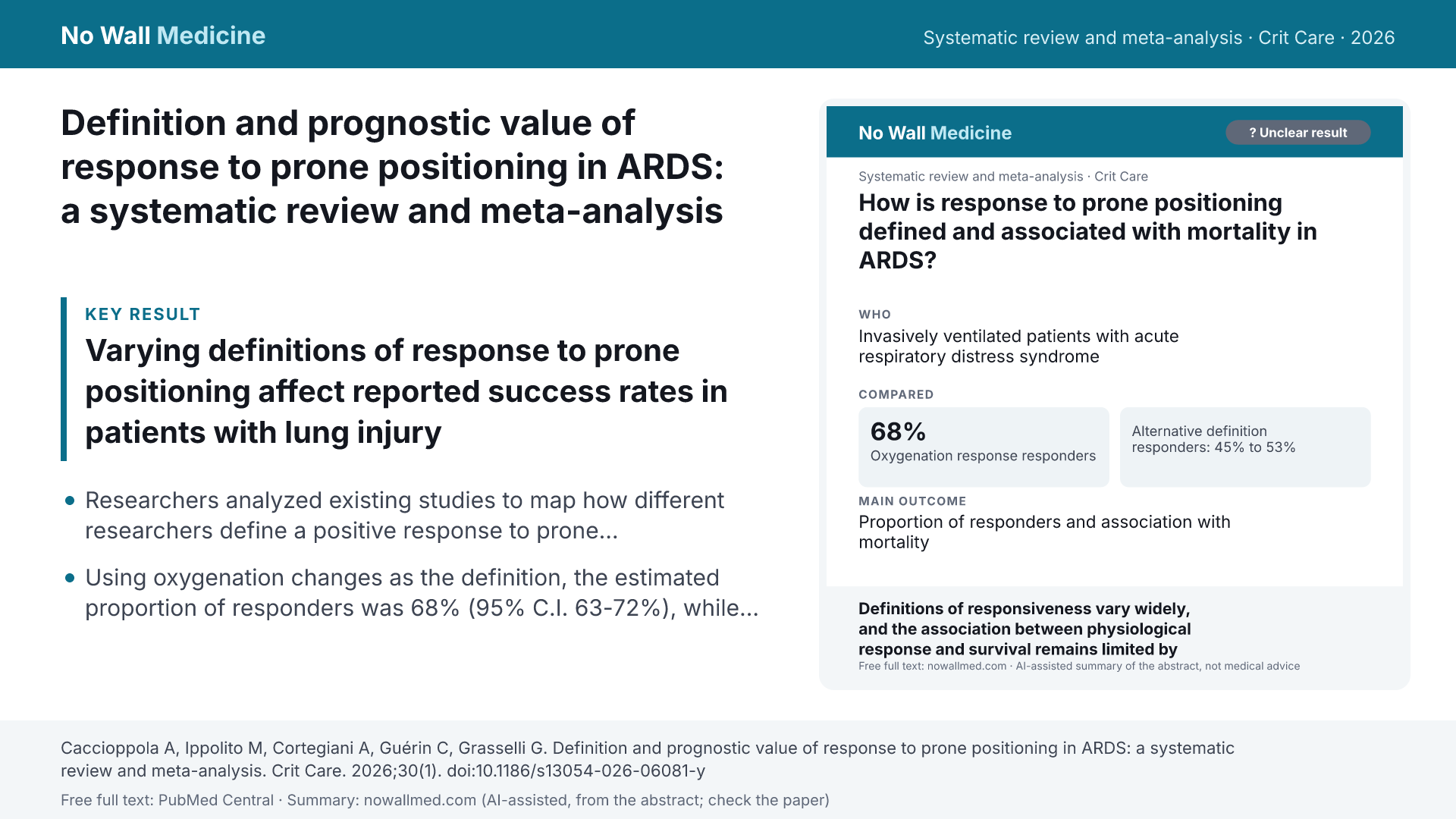
Varying definitions of response to prone positioning affect reported success rates in patients with lung injury
Definition and prognostic value of response to prone positioning in ARDS: a systematic review and meta-analysis
Systematic review and meta-analysisUnclear result
How is response to prone positioning defined and associated with mortality in ARDS?
Who
Invasively ventilated patients with acute respiratory distress syndrome
Compared
68%Oxygenation response responders (95% C.I. 63-72%)
Alternative definition responders: 45% to 53%
Main outcome
Proportion of responders and association with mortality
Result: OR 0.41 (95% CI 0.25-0.68)
Bottom line: Definitions of responsiveness vary widely, and the association between physiological response and survival remains limited by bias and heterogeneity.
Limitation: High risk of bias, residual confounding, and substantial between-study heterogeneity.
Crit Care · 2026-05-15 · Save PNG
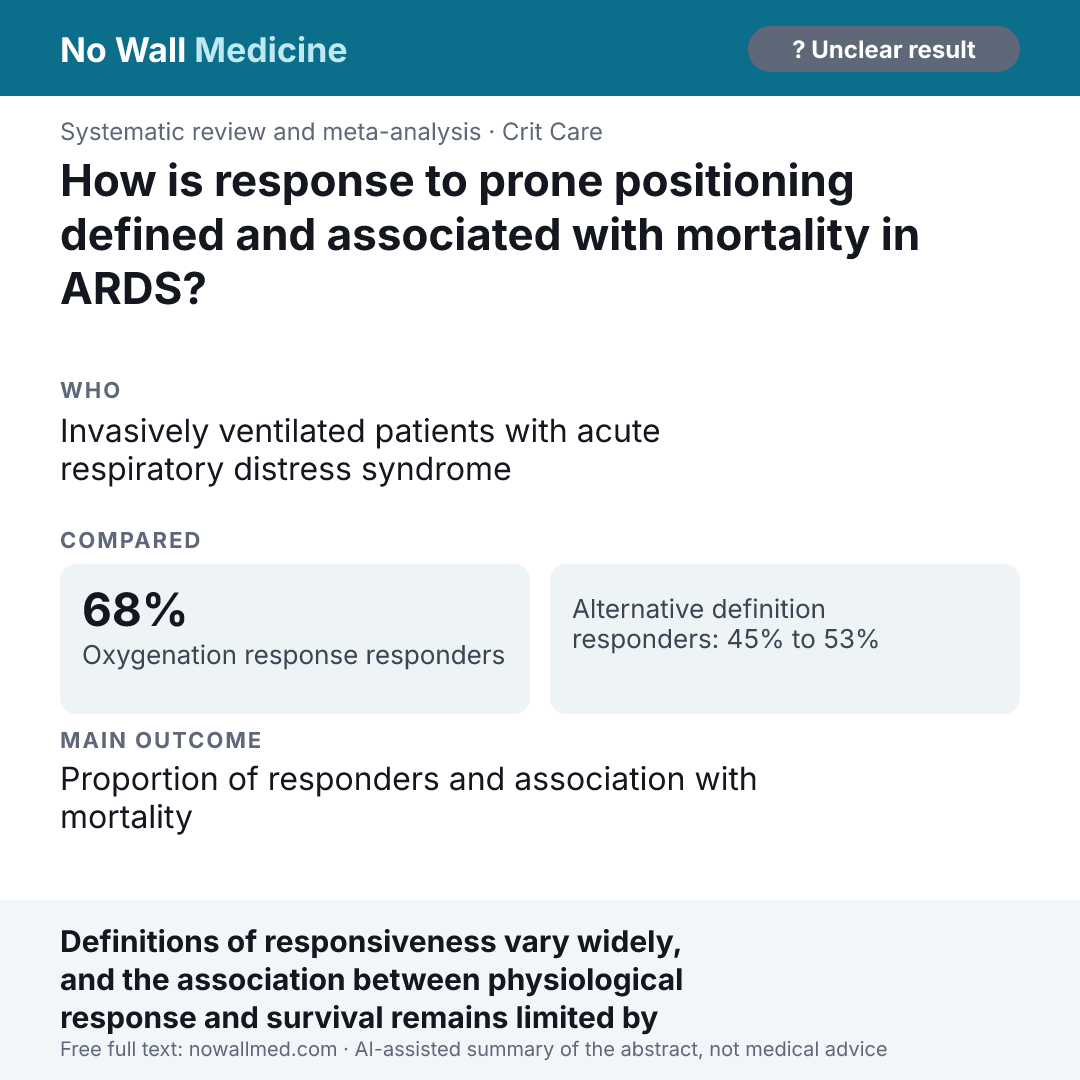
Clinical question: How is response to prone positioning defined and associated with mortality in ARDS?
Why it matters: No consensus exists on how to define a positive response to prone positioning in patients with acute respiratory distress syndrome.
Key points
- Researchers analyzed existing studies to map how different researchers define a positive response to prone positioning, which is lying a patient on their stomach to improve breathing.
- Using oxygenation changes as the definition, the estimated proportion of responders was 68% (95% C.I. 63-72%), while other physiological definitions showed responder rates between 45% and 53%.
- Only 11 of 26 studies (42%) reported a reduced risk of death in patients identified as responders using unadjusted mortality data.
Limitation the authors note: High risk of bias, residual confounding, and substantial between-study heterogeneity limit robust conclusions regarding the association between responsiveness and survival.
Headline and key points written with AI from the paper’s abstract, with every number checked against it. Read the paper before relying on them.
Was this summary helpful?
Subject terms
Headline, design, result, key points, caveat and citation as plain text.
Cite this article
Caccioppola A, Ippolito M, Cortegiani A, Guérin C, Grasselli G. Definition and prognostic value of response to prone positioning in ARDS: a systematic review and meta-analysis. Crit Care. 2026;30(1). doi:10.1186/s13054-026-06081-y
Spotted a mistake? Suggest a correction