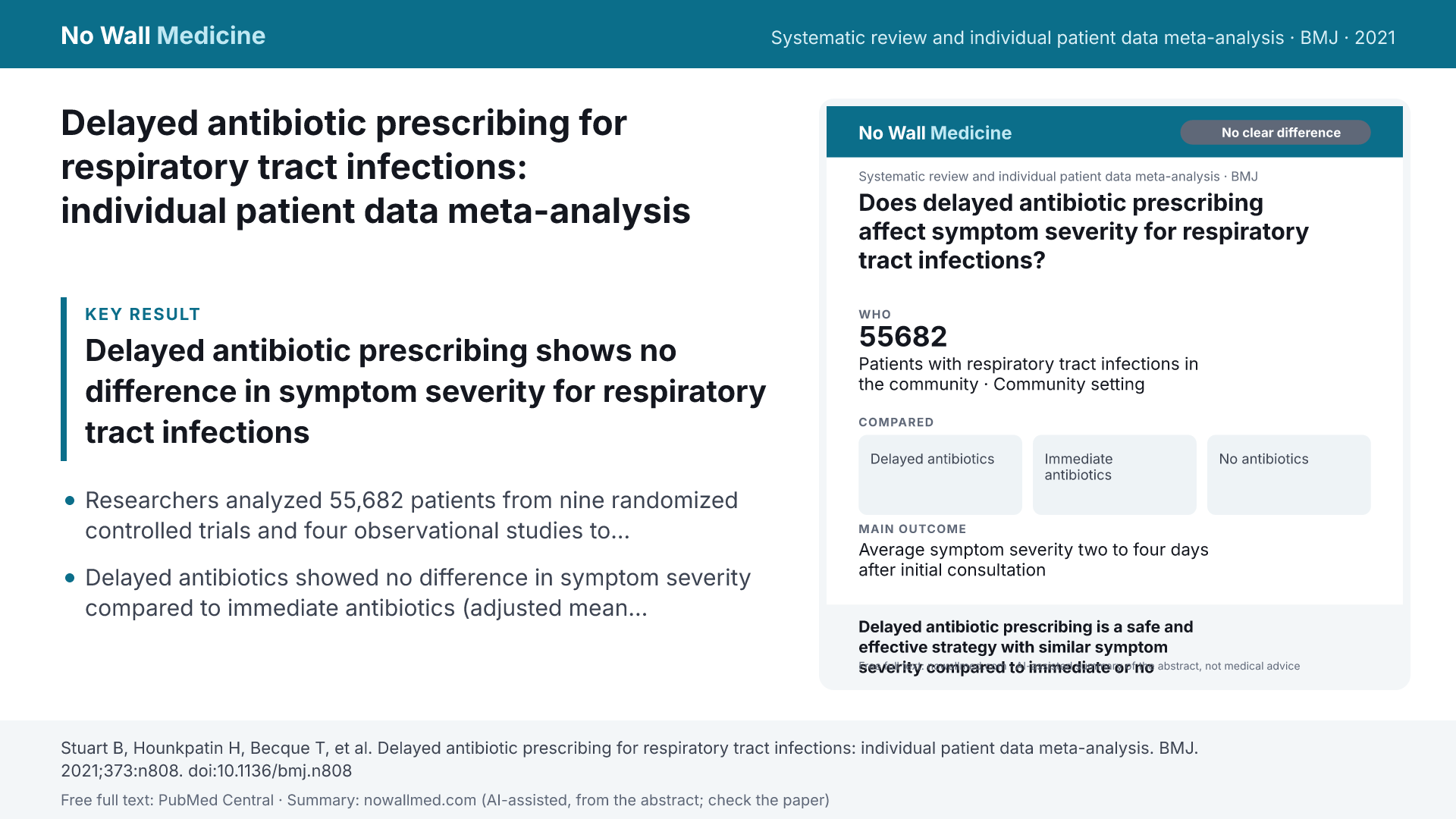
Delayed antibiotic prescribing for respiratory tract infections: individual patient data meta-analysis
Key result: Delayed antibiotic prescribing shows no difference in symptom severity for respiratory tract infections
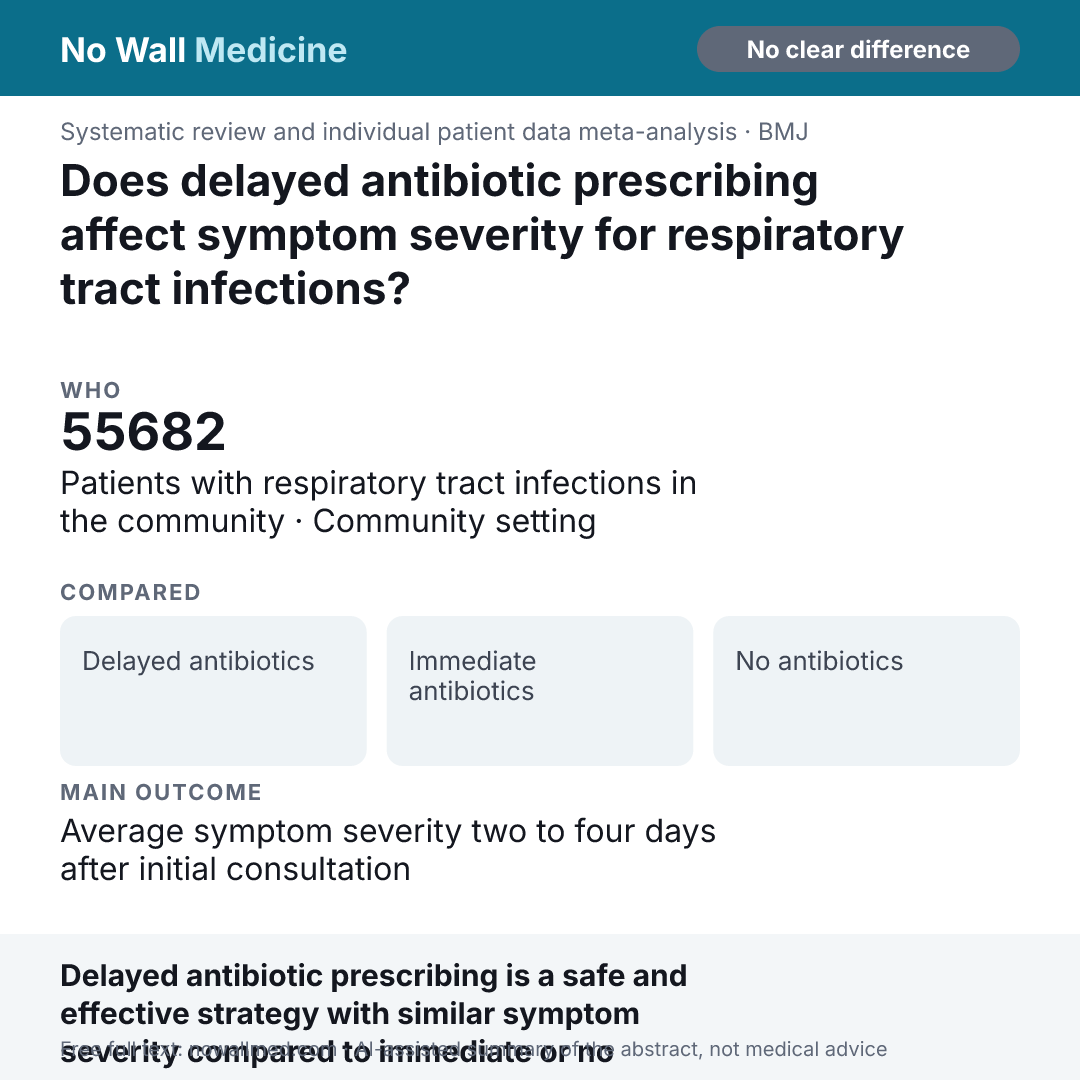
Systematic review and individual patient data meta-analysisNo clear difference
Does delayed antibiotic prescribing affect symptom severity for respiratory tract infections?
Who
55682
Patients with respiratory tract infections in the community · Community setting
Compared
Delayed antibiotics
Immediate antibiotics
No antibiotics
Main outcome
Average symptom severity two to four days after initial consultation
Result: adjusted mean difference -0.003 (95% CI -0.12 to 0.11)
Bottom line: Delayed antibiotic prescribing is a safe and effective strategy with similar symptom severity compared to immediate or no antibiotics.
BMJ · 2021-04-28 · Save PNG
Key points
- Researchers analyzed 55,682 patients from nine randomized controlled trials and four observational studies to compare delayed, immediate, and no antibiotic prescribing.
- Delayed antibiotics showed no difference in symptom severity compared to immediate antibiotics (adjusted mean difference -0.003, 95% confidence interval -0.12 to 0.11) or no antibiotics (0.02, -0.11 to 0.15).
- Delayed prescribing was associated with a reduction in reconsultation rates (odds ratio 0.72, 95% confidence interval 0.60 to 0.87) compared to no antibiotics.
Discussion prompts
- Would these patients look like yours? Who was left out?
- Is the main outcome one that matters to patients?
- Is the difference large enough to change what you do?
Cite: Stuart B, Hounkpatin H, Becque T, et al. Delayed antibiotic prescribing for respiratory tract infections: individual patient data meta-analysis. BMJ. 2021;373:n808. doi:10.1136/bmj.n808
Free full text: PubMed Central · Summary and visual abstract: nowallmed.com/a/delayed-antibiotic-prescribing-for-respiratory-tract-infections-lou0l/ (AI-assisted from the abstract; check the paper before relying on it).