Combining perilymphatic enhancement and endolymphatic hydrops improves MRI accuracy for Meniere's disease diagnosis
Delayed post gadolinium MRI descriptors for Meniere's disease: a systematic review and meta-analysis
Systematic review and meta-analysisBenefit found
What is the diagnostic performance of delayed post gadolinium MRI descriptors for Meniere's disease?
Who
3073
Ears with Meniere's disease and asymptomatic or other audio-vestibular ears
Compared
Increased perilymphatic enhancement and endolymphatic hydrops: sensitivity 87% (95% CI: 79.92%) and specificity 91% (95% CI: 85.95%)
Other MRI descriptors
Main outcome
Diagnostic performance of MRI descriptors
Bottom line: Combining increased perilymphatic enhancement and endolymphatic hydrops optimizes sensitivity and specificity for diagnosing Meniere's disease.
Limitation: Case-controlled design, unblinded observers, variable reference standard, and differing magnetic resonance imaging techniques.
Eur Radiol · 2023-05-12Download image
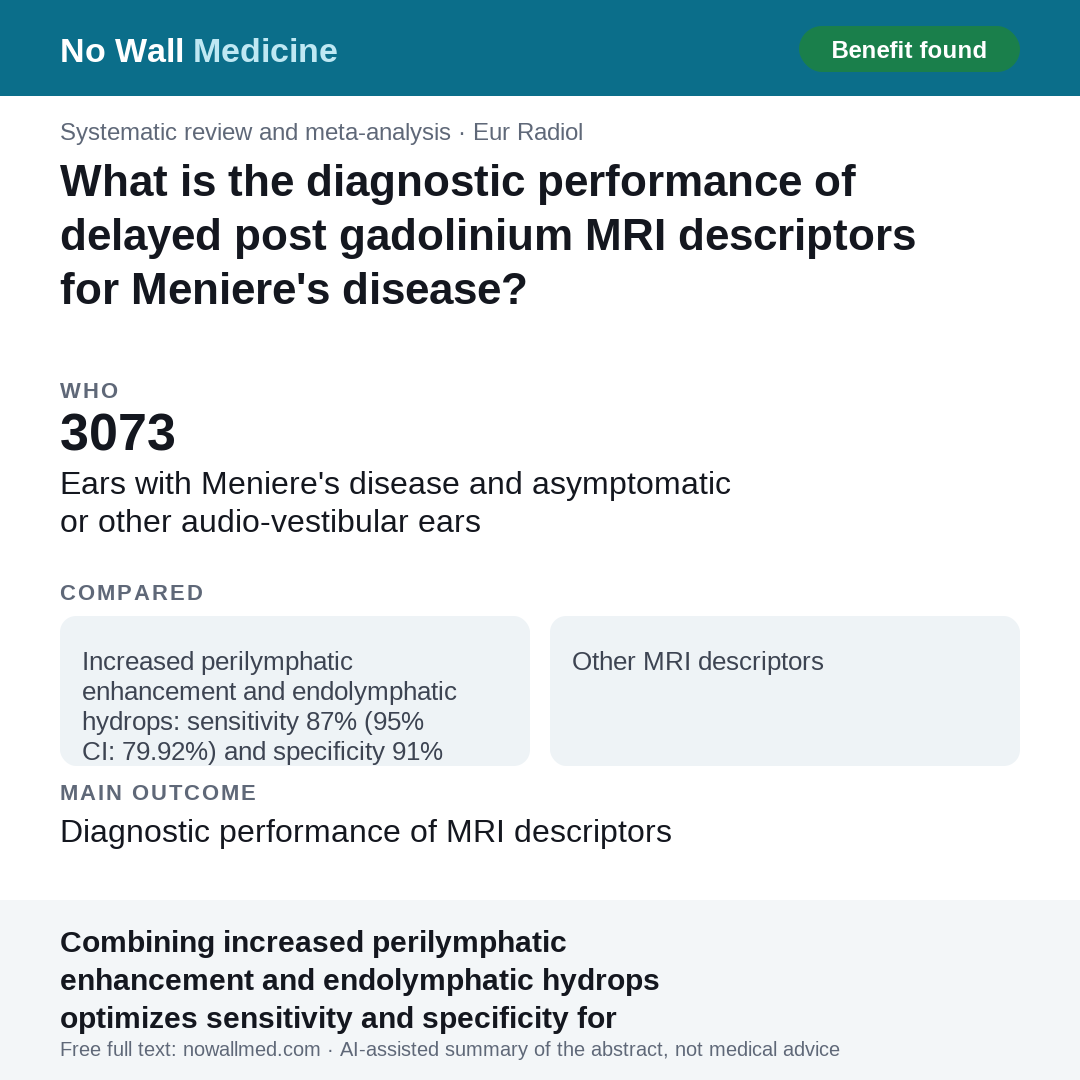
Clinical question: What is the diagnostic performance of delayed post gadolinium MRI descriptors for Meniere's disease?
Why it matters: The diagnostic performance of various magnetic resonance imaging descriptors for Meniere's disease across different clinical classifications was not summarized.
Key points
- Researchers analyzed 66 studies involving 3073 ears with Meniere's disease to evaluate the diagnostic performance of 11 magnetic resonance imaging (MRI) descriptors.
- Combining increased perilymphatic enhancement and endolymphatic hydrops achieved a sensitivity of 87% (95% CI: 79.92%) and a specificity of 91% (95% CI: 85.95%).
- The diagnostic performance of high grade cochlear endolymphatic hydrops and any endolymphatic hydrops did not significantly differ between monosymptomatic cochlear Meniere's disease and the reference standard for definite disease.
Limitation the authors note: Potential sources of bias included case-controlled design, unblinded observers, variable reference standards, and heterogeneity from differing magnetic resonance imaging techniques.
Headline and key points written with AI from the paper’s abstract, with every number checked against it. Read the paper before relying on them.
Topics
Cite this article
Connor S, Grzeda MT, Jamshidi B, Ourselin S, Hajnal JV, Pai I. Delayed post gadolinium MRI descriptors for Meniere's disease: a systematic review and meta-analysis. Eur Radiol. 2023. doi:10.1007/s00330-023-09651-8
Spotted a mistake? Suggest a correction
Top studies every Monday
The week’s key trials and guidelines in your specialties, plus any topics you follow. By email, free.
Get the weekly digest