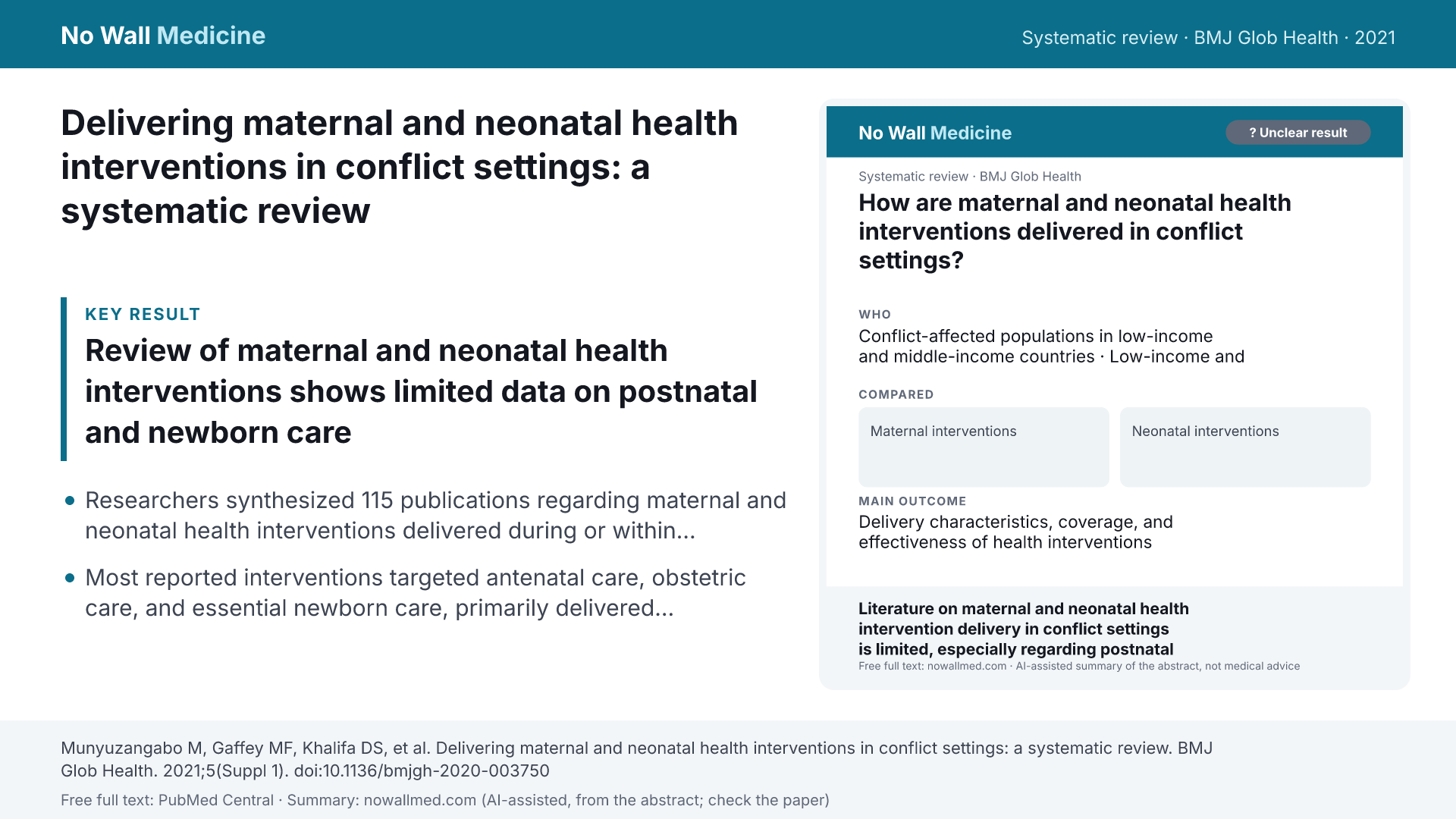
Review of maternal and neonatal health interventions shows limited data on postnatal and newborn care
Delivering maternal and neonatal health interventions in conflict settings: a systematic review
Systematic reviewUnclear result
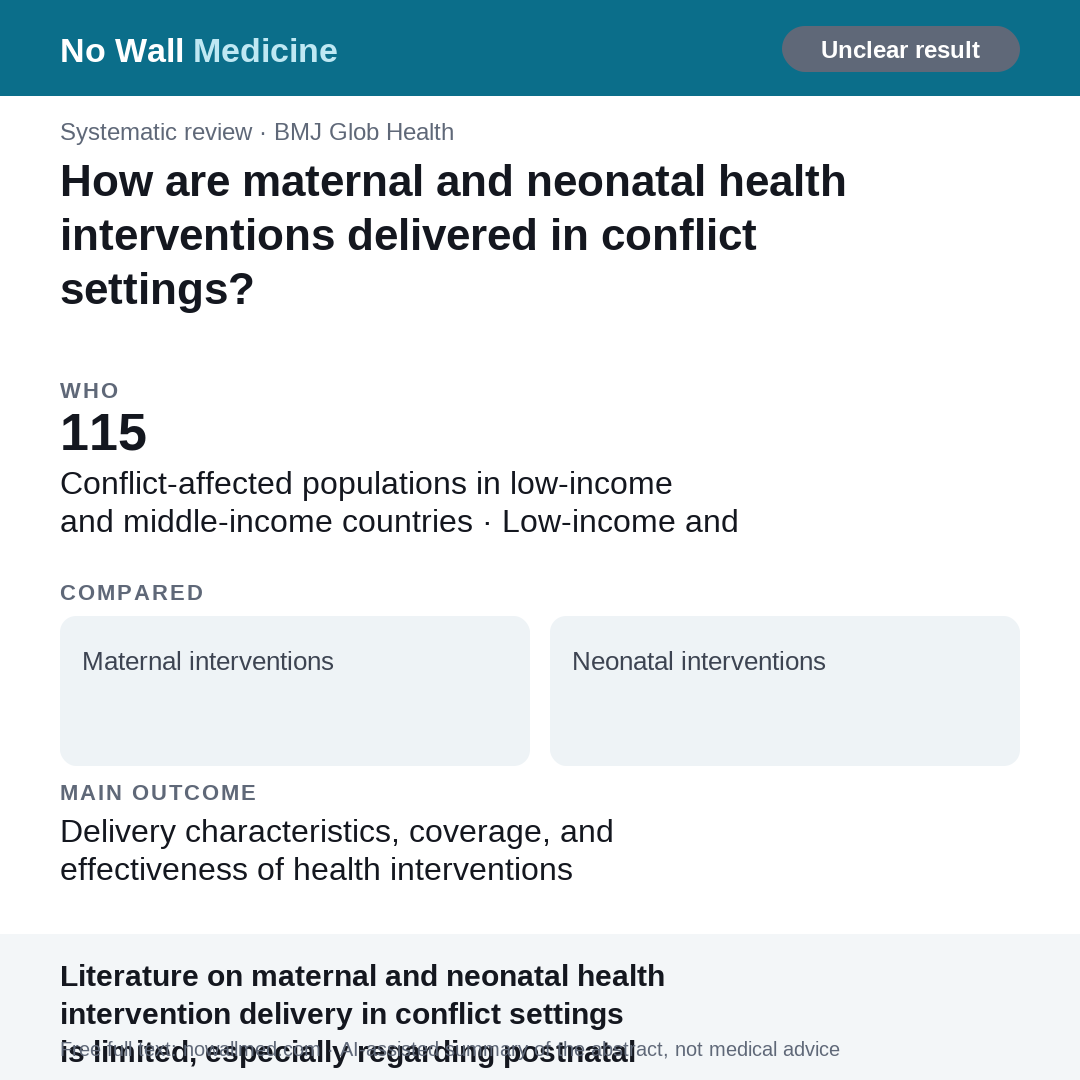
How are maternal and neonatal health interventions delivered in conflict settings?
Who
115
Conflict-affected populations in low-income and middle-income countries · Low-income and middle-income countries, mostly sub-Saharan Africa
Compared
Maternal interventions
Neonatal interventions
Main outcome
Delivery characteristics, coverage, and effectiveness of health interventions
Bottom line: Literature on maternal and neonatal health intervention delivery in conflict settings is limited, especially regarding postnatal and newborn care.
Limitation: Reporting of intervention coverage or effectiveness data was limited.
BMJ Glob Health · 2021-02-20Download image
Clinical question: How are maternal and neonatal health interventions delivered in conflict settings?
Why it matters: Guidance on how to best deliver maternal and neonatal health interventions specifically within conflict settings is currently limited.
Key points
- Researchers synthesized 115 publications regarding maternal and neonatal health interventions delivered during or within 5 years after a conflict in low- and middle-income countries.
- Most reported interventions targeted antenatal care, obstetric care, and essential newborn care, primarily delivered by doctors and nurses in hospitals or clinics.
- Barriers to delivering care included insecurity, lack of resources, and lack of skilled health staff, while staff training and technology were facilitators.
Limitation the authors note: Reporting of intervention coverage or effectiveness data was limited.
Headline and key points written with AI from the paper’s abstract, with every number checked against it. Read the paper before relying on them.
Was this summary helpful?
Abstract
Background
While much progress was made throughout the Millennium Development Goals era in reducing maternal and neonatal mortality, both remain unacceptably high, especially in areas affected by humanitarian crises. While valuable guidance on interventions to improve maternal and neonatal health in both non-crisis and crisis settings exists, guidance on how best to deliver these interventions in crisis settings, and especially in conflict settings, is still limited. This systematic review aimed to synthesise the available literature on the delivery on maternal and neonatal health interventions in conflict settings. Methods
We searched MEDLINE, Embase, CINAHL and PsycINFO databases using terms related to conflict, women and children, and maternal and neonatal health. We searched websites of 10 humanitarian organisations for relevant grey literature. Publications reporting on conflict-affected populations in low-income and middle-income countries and describing a maternal or neonatal health intervention delivered during or within 5 years after the end of a conflict were included. Information on population, intervention, and delivery characteristics were extracted and narratively synthesised. Quantitative data on intervention coverage and effectiveness were tabulated but no meta-analysis was undertaken. Results
115 publications met our eligibility criteria. Intervention delivery was most frequently reported in the sub-Saharan Africa region, and most publications focused on displaced populations based in camps. Reported maternal interventions targeted antenatal, obstetric and postnatal care; neonatal interventions focused mostly on essential newborn care. Most interventions were delivered in hospitals and clinics, by doctors and nurses, and were mostly delivered through non-governmental organisations or the existing healthcare system. Delivery barriers included insecurity, lack of resources and lack of skilled health staff. Multi-stakeholder collaboration, the introduction of new technology or systems innovations, and staff training were delivery facilitators. Reporting of intervention coverage or effectiveness data was limited. Discussion
The relevant existing literature focuses mostly on maternal health especially around the antenatal period. There is still limited literature on postnatal care in conflict settings and even less on newborn care. In crisis settings, as much as in non-crisis settings, there is a need to focus on the first day of birth for both maternal and neonatal health. There is also a need to do more research on how best to involve community members in the delivery of maternal and neonatal health interventions. Prospero registration number
CRD42019125221.
Abstract reproduced under the article’s CC BY licence.
Subject terms
Cite this article
Munyuzangabo M, Gaffey MF, Khalifa DS, et al. Delivering maternal and neonatal health interventions in conflict settings: a systematic review. BMJ Glob Health. 2021. doi:10.1136/bmjgh-2020-003750
Spotted a mistake? Suggest a correction