Targeted information transfer increased adherence to a three-day malaria prevention regimen in pregnant women
Delivery effectiveness of and adherence to intermittent preventive treatment for malaria in pregnancy with dihydroartemisinin-piperaquine with or without targeted information transfer or sulfadoxine-pyrimethamine in western Kenya: a three-armed, pragmatic, open-label, cluster-randomised trial
Three-armed, pragmatic, open-label, cluster-randomised trialBenefit found
What is the adherence and delivery effectiveness of dihydroartemisinin-piperaquine compared to sulfadoxine-pyrimethamine?
Who
1189
Pregnant women in antenatal clinics in western Kenya · 18 health-care facilities in western Kenya
Compared
Sulfadoxine-pyrimethamine
73%Dihydroartemisinin-piperaquine only (196/267)
83%Dihydroartemisinin-piperaquine plus targeted information transfer (266/319)
Main outcome
Adherence to the 3-day dihydroartemisinin-piperaquine regimen
Result: adjusted relative risk 1·16 (95% CI 1·03-1·31)
Bottom line: Targeted information transfer increased adherence to the dihydroartemisinin-piperaquine regimen compared to dihydroartemisinin-piperaquine alone.
Limitation: Masking was not possible.
Lancet Glob Health · 2024-09-21Download image
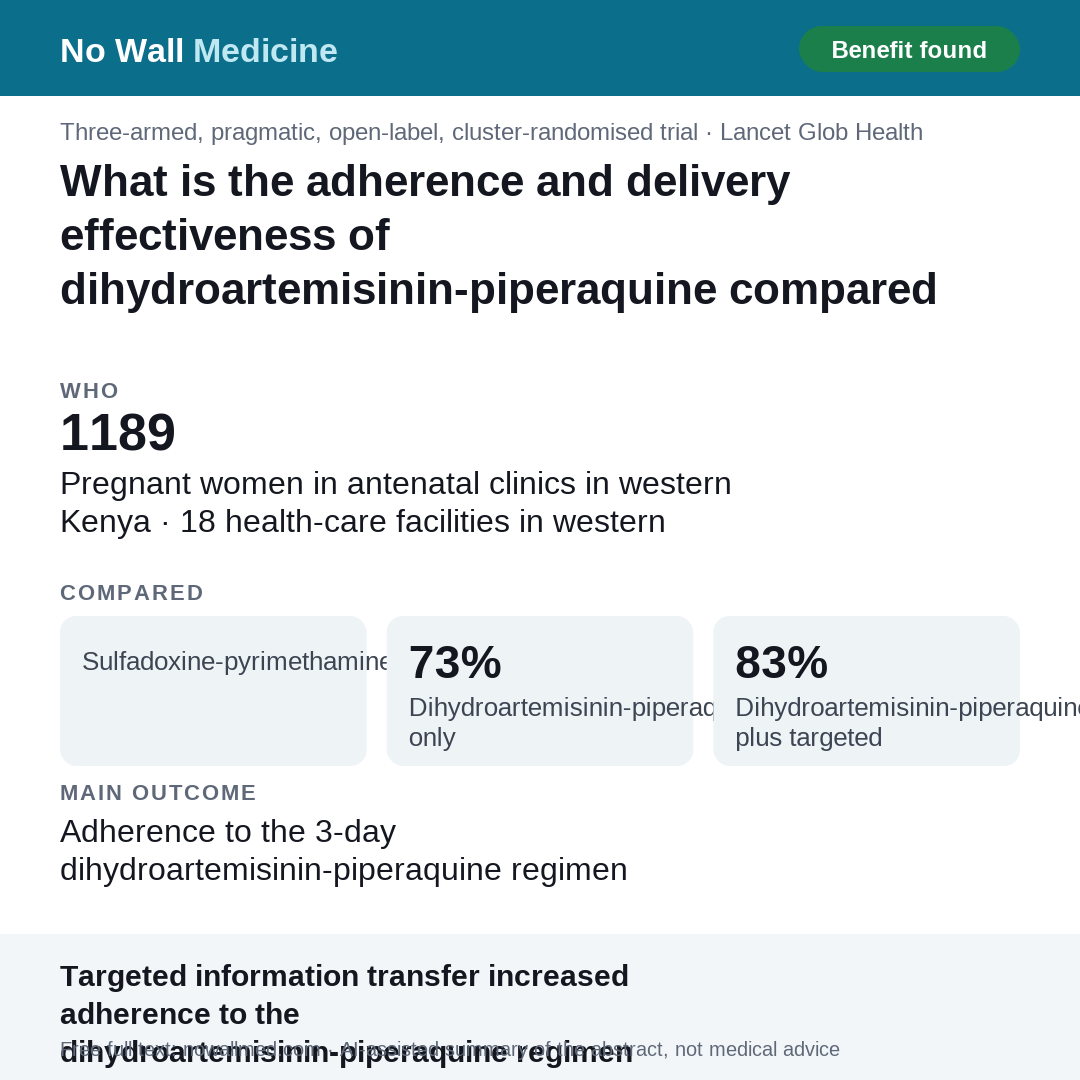
Clinical question: What is the adherence and delivery effectiveness of dihydroartemisinin-piperaquine compared to sulfadoxine-pyrimethamine?
Why it matters: Resistance to the standard sulfadoxine-pyrimethamine malaria prevention treatment makes the three-day dihydroartemisinin-piperaquine regimen a potential alternative, but its implementation and adherence are unknown.
Key points
- The trial studied 1189 participants across 15 health facilities in western Kenya comparing different malaria prevention methods.
- Adding targeted information transfer to a three-day dihydroartemisinin-piperaquine regimen was associated with 83% adherence compared to 73% in the group without extra information.
- Delivery effectiveness for the information transfer group was 87% compared to 89% for the standard sulfadoxine-pyrimethamine group, which was not a significant difference.
Headline and key points written with AI from the paper’s abstract, with every number checked against it. Read the paper before relying on them.
Was this summary helpful?
Abstract
Background
High-level resistance to sulfadoxine-pyrimethamine threatens the efficacy of WHO-recommended intermittent preventive treatment in pregnancy (IPTp) with single-dose sulfadoxine-pyrimethamine to prevent malaria. Monthly IPTp with dihydroartemisinin-piperaquine, a 3-day regimen, is an emerging alternative, but this regimen poses potential implementation and adherence challenges. We aimed to assess adherence to a multiday IPTp with dihydroartemisinin-piperaquine regimen and its delivery effectiveness in routine antenatal care settings in western Kenya. Methods
We conducted a pragmatic, three-armed, open-label, cluster-randomised trial in antenatal clinics in 18 health-care facilities (six facilities per group) in Kisumu County and Homa Bay County in western Kenya. Clusters were facilities offering routine antenatal care services provided by trained Ministry of Health staff with 100 or more antenatal clinic attendances per month between July, 2018, and June, 2019. Private or mission hospitals, dispensaries, referral hospitals, and trial sites were excluded. Individuals in their first trimester, living with HIV, or who were not attending a scheduled antenatal clinic visit were excluded. The 18 antenatal clinics were grouped into matched triplets stratified by location and clinics in each matched triplet were randomly assigned to one of the three study groups (1:1:1). Masking was not possible. Two groups were given IPTp with dihydroartemisinin-piperaquine (one group with a targeted information transfer intervention and one group without any additional interventions) and one group was given the standard of care (ie, IPTp with sulfadoxine-pyrimethamine). The primary endpoint, adherence, was defined as the proportion of participants completing their most recent 3-day IPTp with dihydroartemisinin-piperaquine regimen. This completion was verified by pill counts during home visits no more than 2 days after participants' 3-day regimens ended. The secondary endpoint, delivery effectiveness, was defined as the proportion of participants who received the correct number of IPTp tablets and correctly repeated dosing instructions (ie, correctly recalled the instructions they received about self-administered dihydroartemisinin-piperaquine doses and the number of sulfadoxine-pyrimethamine tablets they had received) at their exit from the antenatal clinic. Individuals receiving treatment for malaria, visiting a clinic for registration only, or interviewed during IPTp drug stock-outs were excluded from analyses. We used generalised linear mixed models to compare endpoints among the IPTp with dihydroartemisinin-piperaquine groups. This trial was registered with ClinicalTrials.gov, NCT04160026, and is complete. Findings
15 facilities (five per group) completed the trial, with 1189 participants having exit interviews (377 in the IPTp with sulfadoxine-pyrimethamine group, 408 in the IPTp with dihydroartemisinin-piperaquine only group, and 404 in the IPTp with dihydroartemisinin-piperaquine plus targeted information transfer intervention group) and 586 participants having home visits (267 in the IPTp with dihydroartemisinin-piperaquine only group and 319 in the IPTp with dihydroartemisinin-piperaquine plus targeted information transfer intervention group) from Sept 8 to Dec 10, 2020. Relative to the IPTp with dihydroartemisinin-piperaquine only group, adherence was 16% higher in the IPTp with dihydroartemisinin-piperaquine plus targeted information transfer intervention group (266 [83%] of 319 participants vs 196 [73%] of 267 participants; adjusted relative risk [RR] 1·16, 95% CI 1·03-1·31; p=0·0140). Delivery effectiveness in the IPTp with dihydroartemisinin-piperaquine plus targeted information transfer intervention group was not significantly different from that in the IPTp with sulfadoxine-pyrimethamine group (352 [87%] of 403 participants vs 335 [89%] of 375 participants; adjusted RR 0·97, 95% CI 0·90-1·05; p=0·4810). However, delivery effectiveness in the IPTp with dihydroartemisinin-piperaquine only group was significantly lower than in the IPTp with sulfadoxine-pyrimethamine group (300 [74%] of 404 participants vs 335 [89%] of 375 participants; 0·84, 0·75-0·95; p=0·0030). Interpretation
Targeted information transfer interventions to health-care providers and pregnant individuals boost antenatal care delivery adherence to a multiday regimen with dihydroartemisinin-piperaquine. Funding
European and Developing Countries Clinical Trials Partnership 2, UK Joint Global Health Trials Scheme of the Foreign, Commonwealth and Development Office, Medical Research Council, National Institute for Health and Care Research, and Wellcome Trust; and Swedish International Development Cooperation Agency.
Abstract reproduced under the article’s CC BY licence.
Subject terms
Cite this article
Barsosio HC, Webster J, Omiti F, K'Oloo A, Odero IA, Ojuok MA. Delivery effectiveness of and adherence to intermittent preventive treatment for malaria in pregnancy with dihydroartemisinin-piperaquine with or without targeted information transfer or sulfadoxine-pyrimethamine in western Kenya: a three-armed, pragmatic, open-label, cluster-randomised trial. Lancet Glob Health. 2024. doi:10.1016/S2214-109X(24)00261-4
Spotted a mistake? Suggest a correction
Top studies every Monday
The week’s key trials and guidelines in your specialties, plus any topics you follow. By email, free.
Get the weekly digest