Denifanstat improved liver disease activity and resolution in patients with metabolic dysfunction-associated steatohepatitis
Denifanstat for the treatment of metabolic dysfunction-associated steatohepatitis: a multicentre, double-blind, randomised, placebo-controlled, phase 2b trial
Multicentre, double-blind, randomised, placebo-controlled, phase 2b trialBenefit found
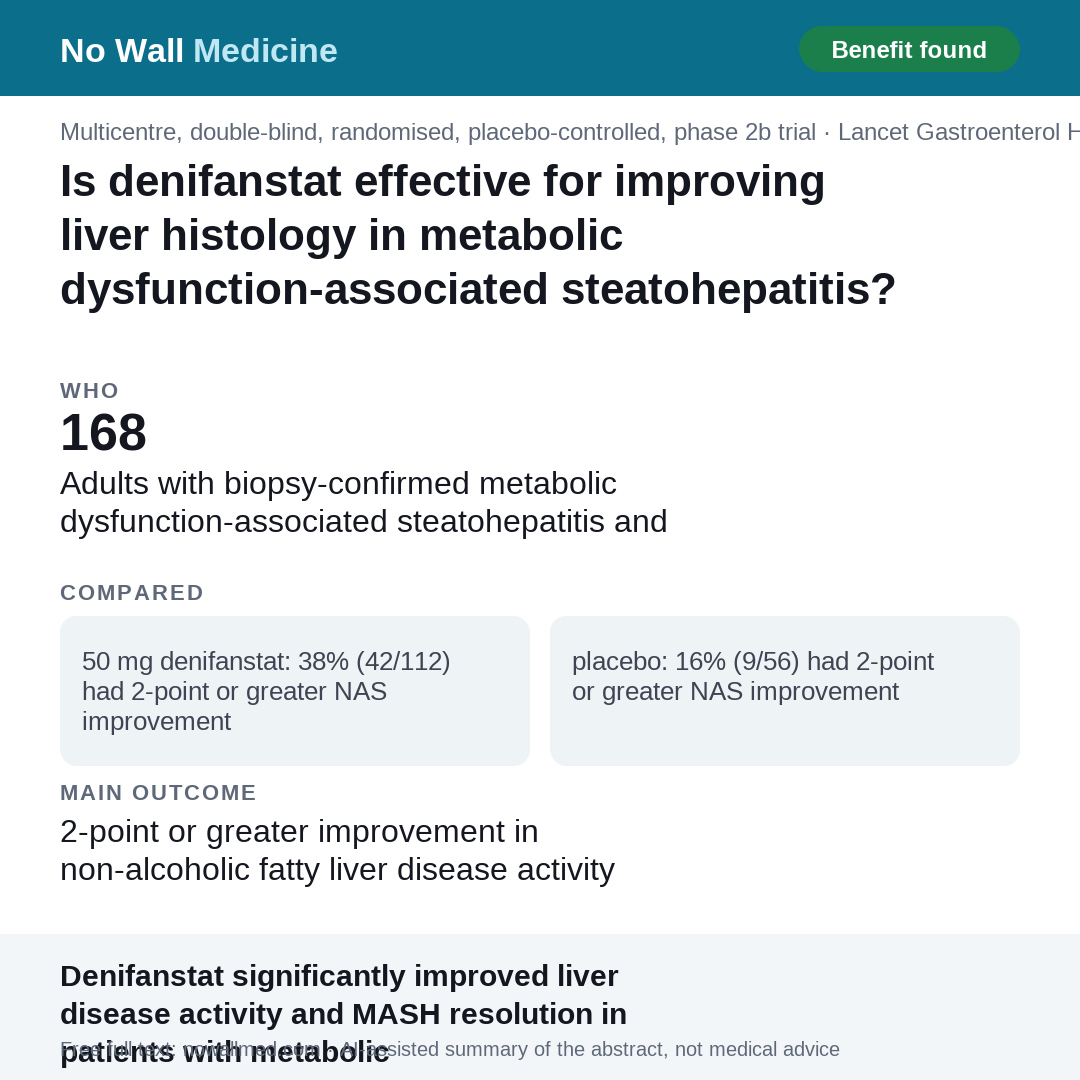
Is denifanstat effective for improving liver histology in metabolic dysfunction-associated steatohepatitis?
Who
168
Adults with biopsy-confirmed metabolic dysfunction-associated steatohepatitis and moderate to advanced fibrosis · 100 clinical sites in USA, Canada, and Poland
Compared
50 mg denifanstat: 38% (42/112) had 2-point or greater NAS improvement
placebo: 16% (9/56) had 2-point or greater NAS improvement
Main outcome
2-point or greater improvement in non-alcoholic fatty liver disease activity score
Result: common risk difference 21·0%, 95% CI 8·1-33·9
Bottom line: Denifanstat significantly improved liver disease activity and MASH resolution in patients with metabolic dysfunction-associated steatohepatitis.
Funded by: Sagimet Biosciences
Lancet Gastroenterol Hepatol · 2024-10-11Download image
Clinical question: Is denifanstat effective for improving liver histology in metabolic dysfunction-associated steatohepatitis?
Why it matters: It is unknown if the fatty acid synthase inhibitor denifanstat can improve liver histology in individuals with metabolic dysfunction-associated steatohepatitis and moderate to advanced fibrosis.
Key points
- In this trial, 168 participants with biopsy-confirmed metabolic dysfunction-associated steatohepatitis and moderate to advanced fibrosis were assigned to receive either 50 mg denifanstat or a placebo.
- At week 52, 38% of the denifanstat group showed a 2-point or greater improvement in the non-alcoholic fatty liver disease activity score without worsening fibrosis, compared to 16% in the placebo group.
- MASH resolution without worsening fibrosis occurred in 26% of the denifanstat group versus 11% of the placebo group, while alopecia was reported in 19% of those taking denifanstat.
Headline and key points written with AI from the paper’s abstract, with every number checked against it. Read the paper before relying on them.
Was this summary helpful?
Abstract
Background
Denifanstat, an oral fatty acid synthase (FASN) inhibitor, blocks de-novo lipogenesis, a key pathway driving progressive lipotoxicity, inflammation, and fibrosis in metabolic dysfunction-associated steatohepatitis (MASH). This study aimed to examine the safety and efficacy of denifanstat for improving liver histology in individuals with MASH and moderate to advanced fibrosis. Methods
This multicentre, double-blind, randomised, placebo-controlled, phase 2b trial was conducted at 100 clinical sites in the USA, Canada, and Poland. After a screening period of up to 90 days, participants aged 18 years and older with biopsy-confirmed MASH and stage F2 or F3 fibrosis were randomly assigned (2:1) to receive either 50 mg oral denifanstat or placebo once per day for 52 weeks. Participants were dynamically allocated to treatment groups via a centrally administered interactive web-based response system and stratified by type 2 diabetes, region, and fibrosis stage. Investigators, patients, and the sponsor were masked to group allocation until database lock. The primary efficacy endpoints were a 2-point or greater improvement in non-alcoholic fatty liver disease activity score (NAS) without a worsening of fibrosis or MASH resolution with a 2-point or greater improvement in NAS without a worsening of fibrosis at week 52, assessed by intention to treat. Safety was assessed in all participants who received at least one dose of study drug. This trial is registered with ClinicalTrials.gov, NCT04906421, and is closed for enrolment. Findings
Of the 1087 individuals screened between June 2, 2021, and June 28, 2022, 168 eligible participants were randomly assigned to receive a dose of 50 mg denifanstat once per day (n=112) or placebo (n=56). All 168 participants (100 female, 68 male) received at least one dose of study treatment. In the ITT population, 42 (38%) of 112 participants in the denifanstat group had a 2-point or greater improvement in NAS without a worsening of fibrosis versus nine (16%) of 56 participants in the placebo group (common risk difference 21·0%, 95% CI 8·1-33·9; p=0·0035). 29 (26%) of 112 participants in the denifanstat group showed MASH resolution with a 2-point or greater improvement in NAS without a worsening of fibrosis compared with six (11%) of 56 participants in the placebo group (common risk difference 13·0%, 0·7-25·3; p=0·0173). The most common treatment-emergent adverse events were COVID-19 (19 [17%] of 112 in the denifanstat group vs six [11%] of 56) in the placebo group, dry eye symptoms (ten [9%] of 112 vs eight [14%] of 56), and alopecia (21 [19%] of 112 vs two [4%] of 56). All adverse events considered to be related to the study drug were of grade 1 or grade 2. None of the serious adverse events (13 [12%] of 112 participants in the denifanstat group vs three [5%] of 56 in the placebo group) were considered drug-related. Interpretation
Treatment with denifanstat resulted in statistically significant and clinically meaningful improvements in disease activity, MASH resolution, and fibrosis. The results of this phase 2b trial support the advancement of denifanstat to phase 3 development. Funding
Sagimet Biosciences.
Abstract reproduced under the article’s CC BY licence.
Subject terms
Cite this article
Loomba R, Bedossa P, Grimmer K, Kemble G, Bruno Martins E, McCulloch W. Denifanstat for the treatment of metabolic dysfunction-associated steatohepatitis: a multicentre, double-blind, randomised, placebo-controlled, phase 2b trial. Lancet Gastroenterol Hepatol. 2024. doi:10.1016/S2468-1253(24)00246-2
Spotted a mistake? Suggest a correction
Top studies every Monday
The week’s key trials and guidelines in your specialties, plus any topics you follow. By email, free.
Get the weekly digest