Depression and anxiety levels may influence how well a behavioral intervention helps lung cancer patients with breathlessness
Depression and Anxiety as Moderators for a Behavioral Treatment for Dyspnea in Advanced Lung Cancer
Secondary analysis of a randomized controlled trialMixed results
Do depression and anxiety moderate a behavioral intervention for dyspnea in advanced lung cancer?
Who
247
Patients with advanced lung cancer
Compared
Behavioral intervention
Usual care
Main outcome
Dyspnea-related functioning and multidimensional dyspnea
Bottom line: Patients with elevated baseline depression and improved distress may benefit more from this behavioral intervention.
Limitation: Reduced power in testing moderators.
J Pain Symptom Manage · 2025-04-04Download image
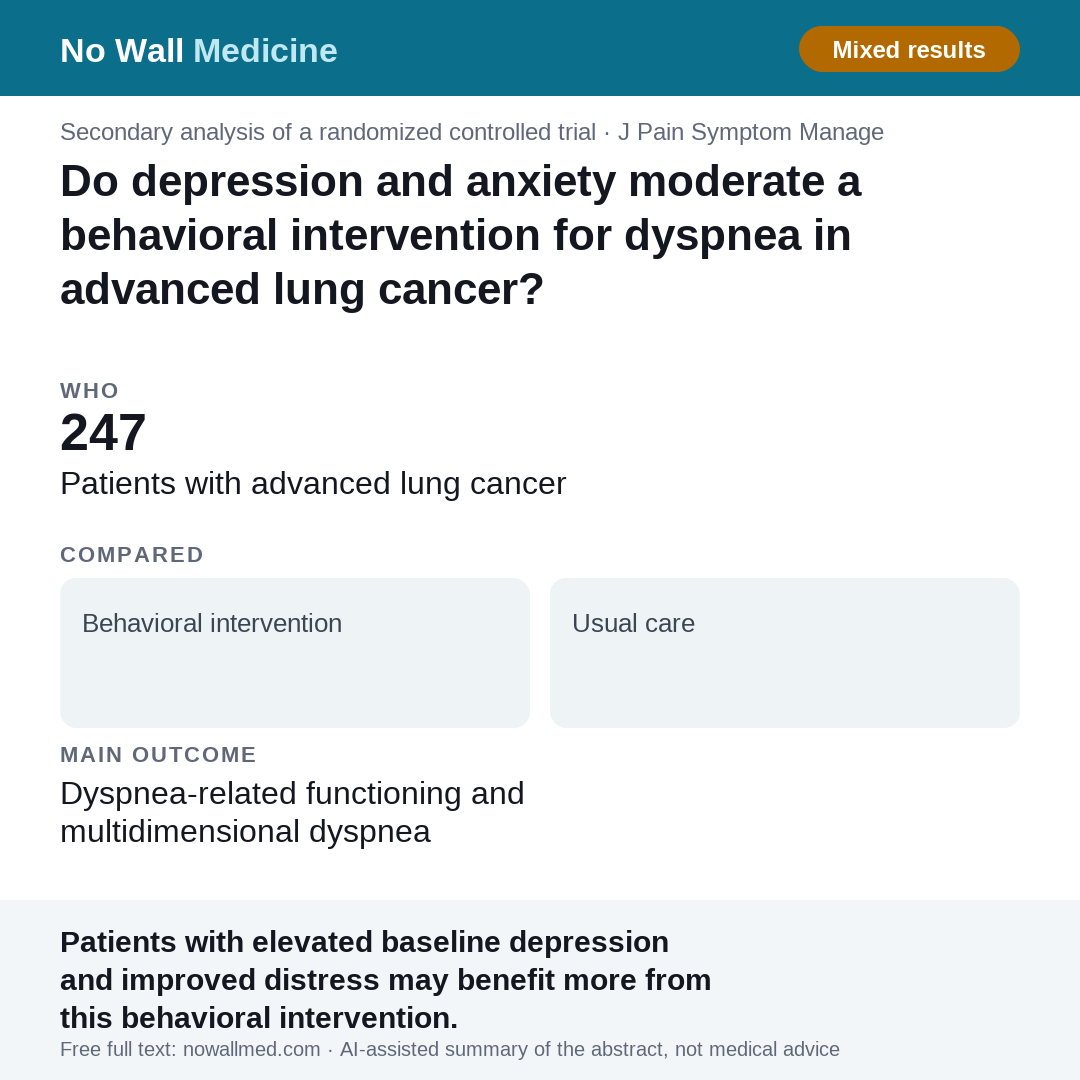
Clinical question: Do depression and anxiety moderate a behavioral intervention for dyspnea in advanced lung cancer?
Why it matters: It is unclear if the effectiveness of a brief behavioral intervention for breathlessness varies depending on a patient's levels of depression and anxiety.
Key points
- Researchers analyzed 247 patients with advanced lung cancer to see if depression and anxiety levels changed the effectiveness of a two-session, nurse-led behavioral intervention for breathlessness.
- Baseline depression scores above 6 on the Hospital Anxiety and Depression Scale were associated with better outcomes for dyspnea-related functioning.
- Improvements of at least 3 on the depression subscale after treatment were associated with better outcomes for total breathlessness and dyspnea-related functioning.
Limitation the authors note: The study had reduced power in testing moderators.
Headline and key points written with AI from the paper’s abstract, with every number checked against it. Read the paper before relying on them.
Was this summary helpful?
Subject terms
Cite this article
Lo SB, Holtze M, Post KE, Eche-Ugwu IJ, Cooley ME, Pirl WF. Depression and Anxiety as Moderators for a Behavioral Treatment for Dyspnea in Advanced Lung Cancer. J Pain Symptom Manage. 2025. doi:10.1016/j.jpainsymman.2025.03.030
Spotted a mistake? Suggest a correction
Top studies every Monday
The week’s key trials and guidelines in your specialties, plus any topics you follow. By email, free.
Get the weekly digest