Deramiocel cellular therapy improved upper limb muscle function in patients with advanced Duchenne muscular dystrophy
Deramiocel heart-derived cellular therapy in advanced Duchenne muscular dystrophy (HOPE-3): a phase 3, randomised, double-blind, placebo-controlled trial
Phase 3, randomized, double-blind, placebo-controlled trialBenefit found
Does deramiocel improve skeletal and cardiac function in advanced Duchenne muscular dystrophy?
Who
106
Participants aged 10 years or older with Duchenne muscular dystrophy · Multicentre, outpatient settings
Compared
deramiocel: 4.55% least-squares mean percentage change
placebo
Main outcome
Total Performance of the Upper Limb 2.0 percentage change
Result: 4.55% (95% CI 0.47-8.63; p=0.029)
Bottom line: Deramiocel safely slows disease progression and preserves skeletal muscle function in advanced Duchenne muscular dystrophy.
Funded by: Capricor Therapeutics
Lancet · 2026-07-29Download image
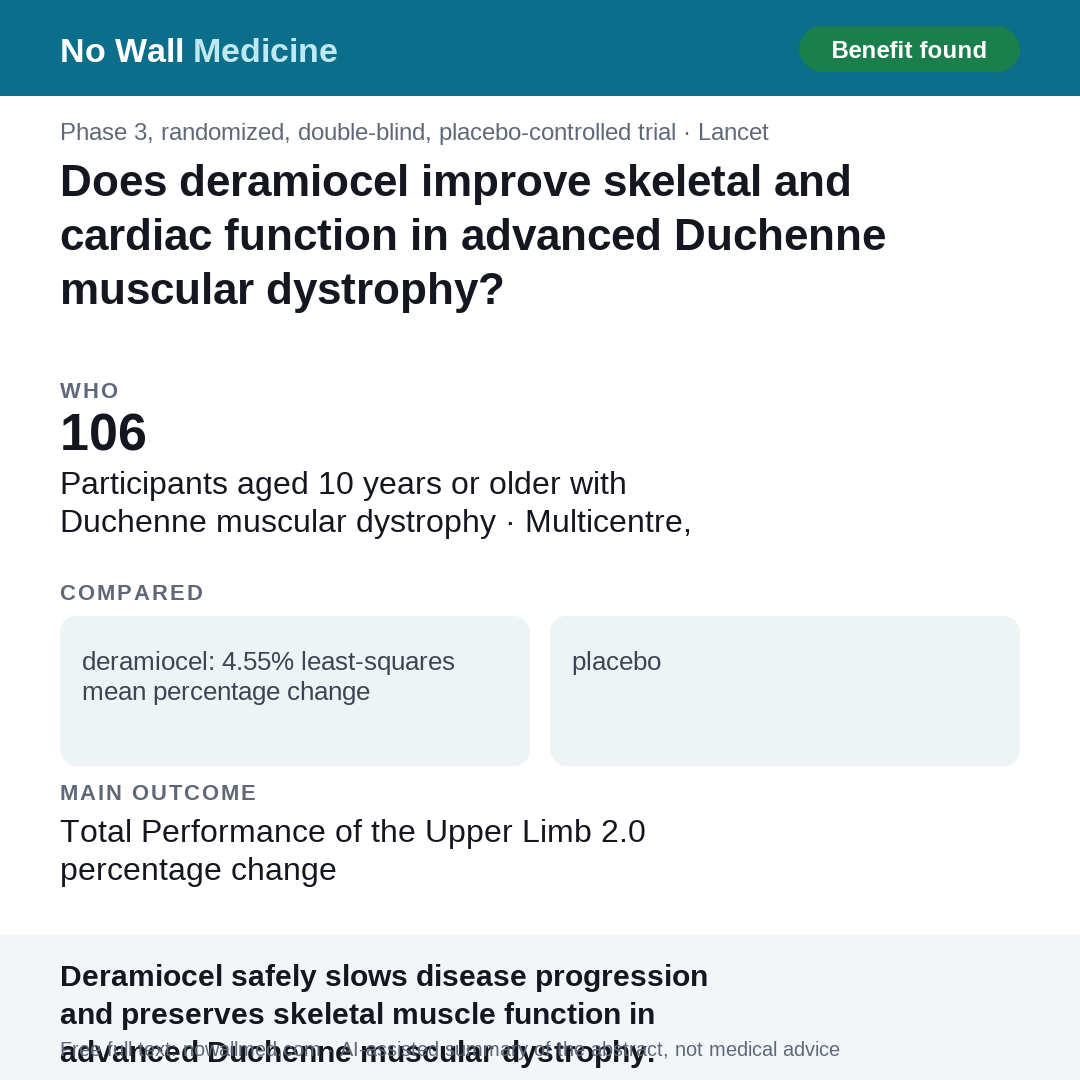
Clinical question: Does deramiocel improve skeletal and cardiac function in advanced Duchenne muscular dystrophy?
Why it matters: Duchenne muscular dystrophy is a genetic disease that causes progressive muscle weakness in both skeletal and cardiac muscles, leading to loss of movement and premature death.
Key points
- The study randomized 106 participants aged 10 years or older with Duchenne muscular dystrophy to receive either deramiocel or a placebo every 3 months.
- At 12 months, the deramiocel group showed a 4.55% greater improvement in the Performance of the Upper Limb 2.0 score compared to the placebo group.
- The safety profile of the heart-derived cellular therapy was similar to that of the placebo.
Headline and key points written with AI from the paper’s abstract, with every number checked against it. Read the paper before relying on them.
Abstract
Background
Duchenne muscular dystrophy (DMD) is an X-linked genetic disease of skeletal and cardiac muscle that leads to loss of ambulation and premature death due to progressive myopathy and cardiomyopathy. Deramiocel, a heart-derived cellular therapy consisting of human allogeneic cardiosphere-derived cells, improved cardiac and skeletal muscle function in phase 1-2 studies of DMD. Our aim was to assess the efficacy and safety of deramiocel in advanced DMD and support the findings of HOPE-2. Methods
HOPE-3, a phase 3, multicentre, randomised (1:1), double-blind, placebo-controlled study, included participants aged 10 years or older with DMD. Investigational product was infused intravenously every 3 months in outpatient settings. Skeletal and cardiac function was evaluated at 12 months. The primary endpoint was total Performance of the Upper Limb 2.0 (PUL2.0) percentage change from baseline. The trial is registered with ClinicalTrials.gov (NCT05126758). Findings
Between June 22, 2022, and May 28, 2024, 139 participants were screened, of whom 106 were randomly assigned to deramiocel (n=54) or placebo (n=52), and included in the intention-to-treat population. The primary endpoint showed significant improvements in the deramiocel group versus placebo. For total PUL2.0, least-squares mean percentage change at 12 months favoured deramiocel by 4·55% (95% CI 0·47-8·63; p=0·029). The safety profile of deramiocel was similar to that of placebo. Interpretation
Deramiocel safely slows disease progression in advanced DMD, preserving skeletal muscle function. Administered quarterly in a simple outpatient regimen, deramiocel is a promising treatment for DMD, agnostic to the precise underlying genetic lesion. Funding
Capricor Therapeutics.
Abstract reproduced under the article’s CC BY licence.
Topics
Spotted a mistake? Suggest a correction
More in Cardiology
Clonal hematopoiesis mutations linked to higher atrial fibrillation risk in cancer populations
Association of Clonal Hematopoiesis Mutations With Incident Atrial Fibrillation: A Systematic Review and Meta-Analysis
Deep learning model detects aortic stenosis from finger-cuff pressure waveforms accurately
Aortic Valve Stenosis Screening Using Deep Learning on Noninvasive Arterial Pressure Waveforms
Spontaneous coronary artery dissection affects younger women more often than expected
Spontaneous coronary artery dissection: implications for women's health, clinical care, and future research
Early lipid-lowering strategies may reduce atherosclerotic cardiovascular disease risk
Lipid-Lowering Strategies in the Era of Early Atherosclerosis Detection: 2026 ACC Scientific Statement: A Report of the American College of Cardiology