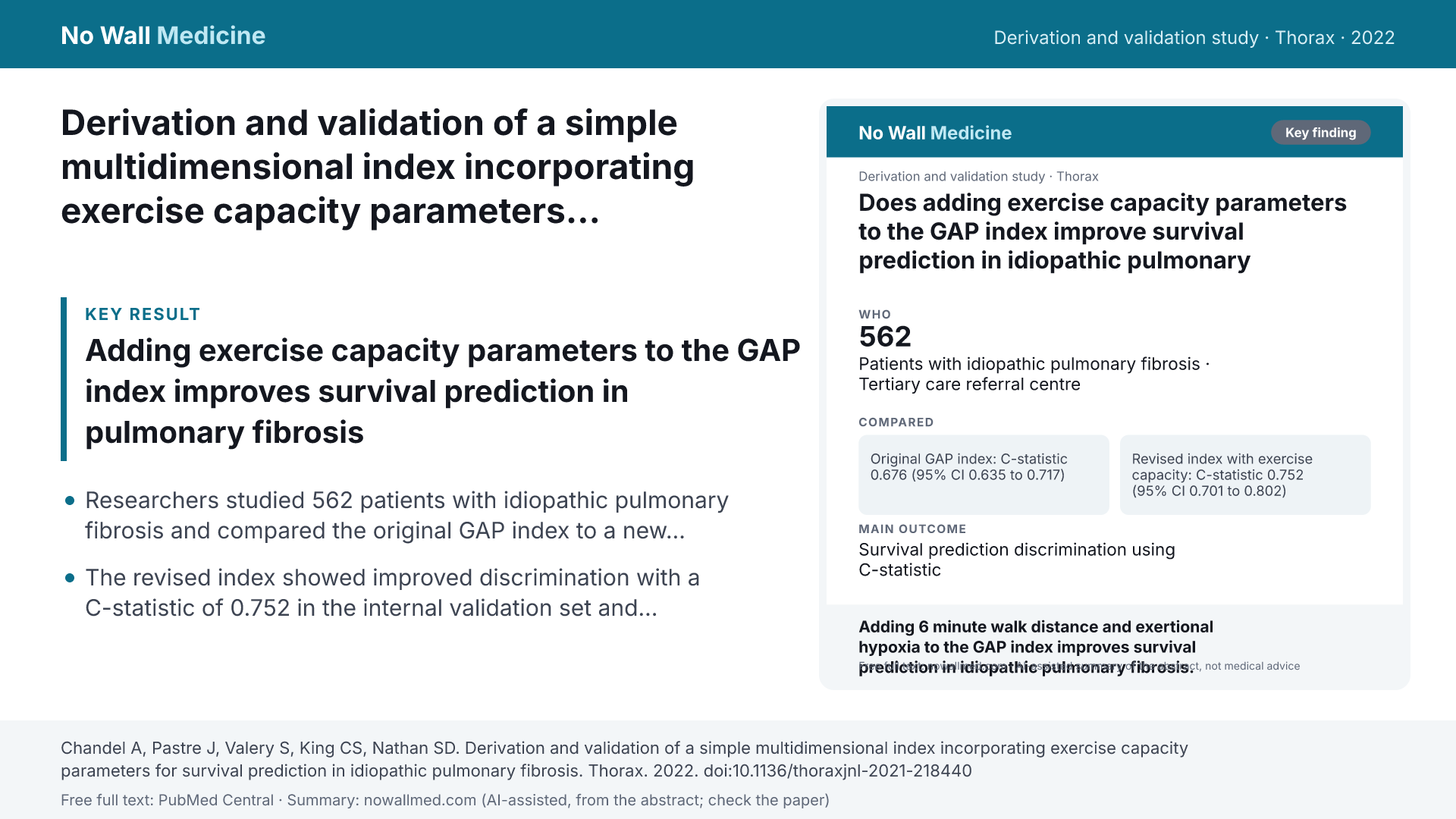
Adding exercise capacity parameters to the GAP index improves survival prediction in pulmonary fibrosis
Derivation and validation of a simple multidimensional index incorporating exercise capacity parameters for survival prediction in idiopathic pulmonary fibrosis
Derivation and validation studyKey finding
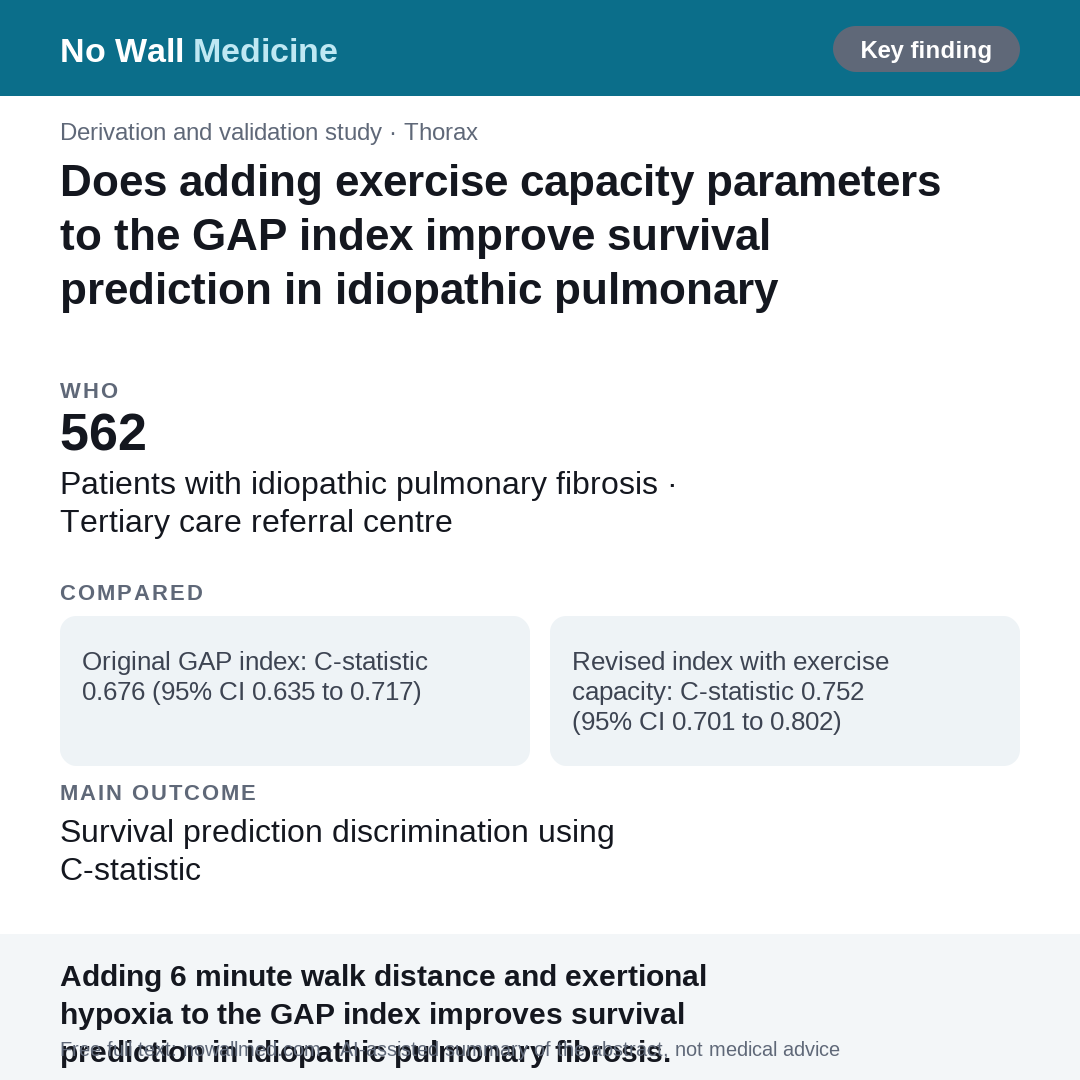
Does adding exercise capacity parameters to the GAP index improve survival prediction in idiopathic pulmonary fibrosis?
Who
562
Patients with idiopathic pulmonary fibrosis · Tertiary care referral centre
Compared
Original GAP index: C-statistic 0.676 (95% CI 0.635 to 0.717)
Revised index with exercise capacity: C-statistic 0.752 (95% CI 0.701 to 0.802)
Main outcome
Survival prediction discrimination using C-statistic
Result: difference in C-statistic 0.050 (95% CI 0.004 to 0.097)
Bottom line: Adding 6 minute walk distance and exertional hypoxia to the GAP index improves survival prediction in idiopathic pulmonary fibrosis.
Thorax · 2022-03-24Download image
Clinical question: Does adding exercise capacity parameters to the GAP index improve survival prediction in idiopathic pulmonary fibrosis?
Why it matters: The original GAP index does not incorporate exercise capacity parameters like 6 minute walk distance or oxygen levels during exertion to predict mortality.
Key points
- Researchers studied 562 patients with idiopathic pulmonary fibrosis and compared the original GAP index to a new model including walking distance and oxygen levels during exertion.
- The revised index showed improved discrimination with a C-statistic of 0.752 in the internal validation set and 0.780 in an external cohort of 108 patients.
- The original GAP index had a C-statistic of 0.676 and was found to overestimate the observed risk of death.
Headline and key points written with AI from the paper’s abstract, with every number checked against it. Read the paper before relying on them.
Was this summary helpful?
Abstract
Introduction
The gender-age-physiology (GAP) index is an easy-to-use baseline mortality prediction model in idiopathic pulmonary fibrosis (IPF). The GAP index does not incorporate exercise capacity parameters such as 6 min walk distance (6MWD) or exertional hypoxia. We evaluated if the addition of 6MWD and exertional hypoxia to the GAP index improves survival prediction in IPF. Methods
Patients with IPF were identified at a tertiary care referral centre. Discrimination and calibration of the original GAP index were assessed. The cohort was then randomly divided into a derivation and validation set and performance of the GAP index with the addition of 6MWD and exertional hypoxia was evaluated. A final model was selected based on improvement in discrimination. Application of this model was then evaluated in a geographically distinct external cohort. Results
There were 562 patients with IPF identified in the internal cohort. Discrimination of the original GAP index was measured by a C-statistic of 0.676 (95% CI 0.635 to 0.717) and overestimated observed risk. 6MWD and exertional hypoxia were strongly predictive of mortality. The addition of these variables to the GAP index significantly improved model discrimination. A revised index incorporating exercise capacity parameters was constructed and performed well in the internal validation set (C-statistic: 0.752; 95% CI 0.701 to 0.802, difference in C-statistic compared with the refit GAP index: 0.050; 95% CI 0.004 to 0.097) and external validation set (N=108 (C-statistic: 0.780; 95% CI 0.682 to 0.877)). Conclusion
A simple point-based baseline-risk prediction model incorporating exercise capacity predictors into the original GAP index may improve prognostication in patients with IPF.
Abstract reproduced under the article’s CC BY NC licence.
Subject terms
Headline, design, result, key points, caveat and citation as plain text.
Cite this article
Chandel A, Pastre J, Valery S, King CS, Nathan SD. Derivation and validation of a simple multidimensional index incorporating exercise capacity parameters for survival prediction in idiopathic pulmonary fibrosis. Thorax. 2022. doi:10.1136/thoraxjnl-2021-218440
Spotted a mistake? Suggest a correction