Design and rationale of the SPARC trial: a phase II, single-system randomized controlled trial of immediate transfer to specialty post-arrest care
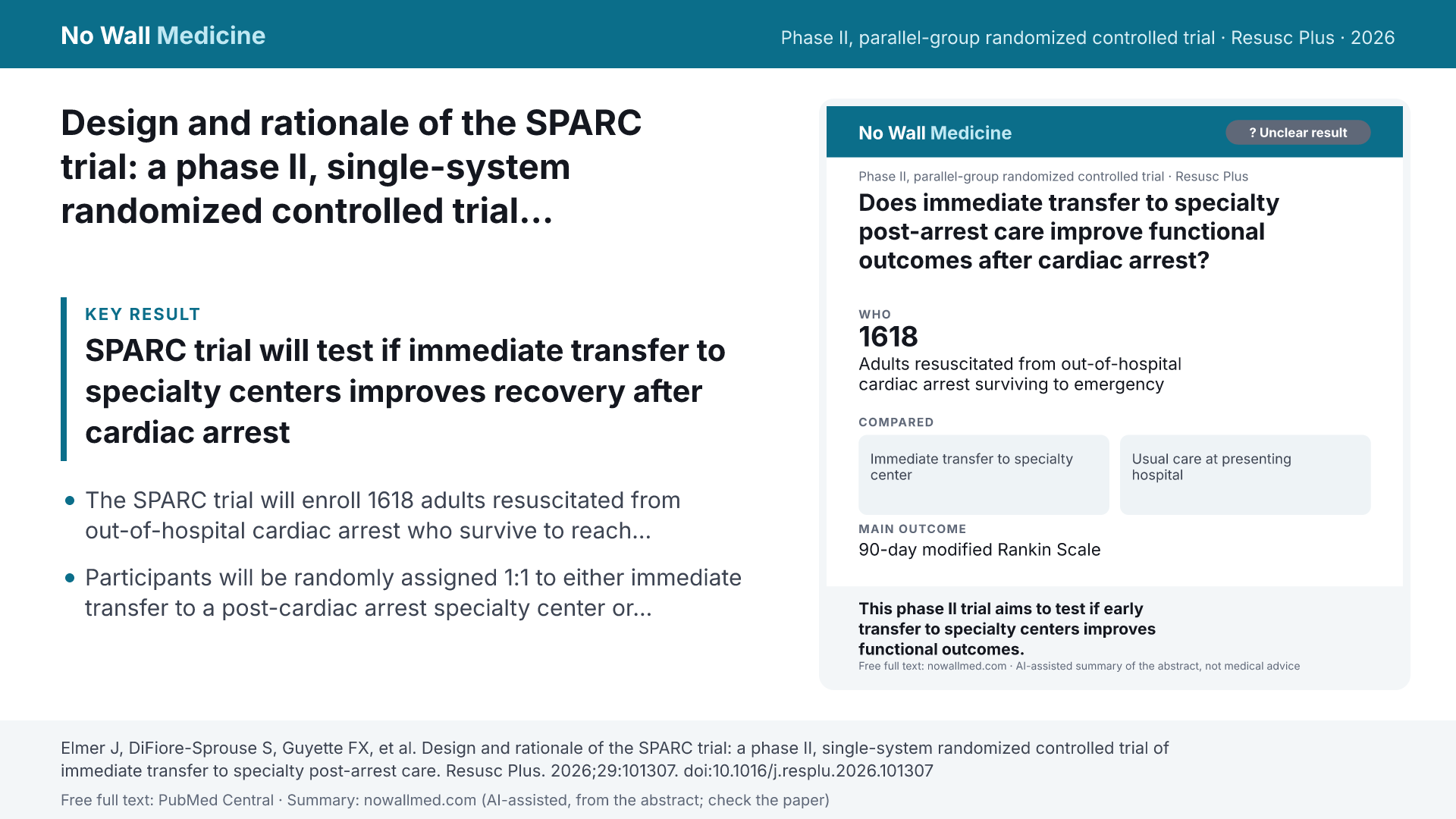
Key result: SPARC trial will test if immediate transfer to specialty centers improves recovery after cardiac arrest
Phase II, parallel-group randomized controlled trialUnclear result
Does immediate transfer to specialty post-arrest care improve functional outcomes after cardiac arrest?
Who
1618
Adults resuscitated from out-of-hospital cardiac arrest surviving to emergency department care · Single United States health system
Compared
Immediate transfer to specialty center
Usual care at presenting hospital
Main outcome
90-day modified Rankin Scale
Bottom line: This phase II trial aims to test if early transfer to specialty centers improves functional outcomes.
Resusc Plus · 2026-03-31
Key points
- The SPARC trial will enroll 1618 adults resuscitated from out-of-hospital cardiac arrest who survive to reach an emergency department.
- Participants will be randomly assigned 1:1 to either immediate transfer to a post-cardiac arrest specialty center or receive usual care at their presenting hospital.
- The primary outcome being measured is the 90-day modified Rankin Scale, which is a tool used to assess a patient's level of disability.
Discussion prompts
- Would these patients look like yours? Who was left out?
- Is the main outcome one that matters to patients?
- Is the difference large enough to change what you do?
Cite: Elmer J, DiFiore-Sprouse S, Guyette FX, et al. Design and rationale of the SPARC trial: a phase II, single-system randomized controlled trial of immediate transfer to specialty post-arrest care. Resusc Plus. 2026;29:101307. doi:10.1016/j.resplu.2026.101307
Free full text: PubMed Central · Summary and visual abstract: nowallmed.com/a/design-and-rationale-of-the-sparc-trial-a-phase-ii-single-system-123abiu/ (AI-assisted from the abstract; check the paper before relying on it).