Phase III trial design evaluates BI 1015550 for patients with progressive pulmonary fibrosis
Design of a phase III, double-blind, randomised, placebo-controlled trial of BI 1015550 in patients with progressive pulmonary fibrosis (FIBRONEER-ILD)
Phase III, double-blind, placebo-controlled trialUnclear result
Is BI 1015550 effective and safe in patients with progressive pulmonary fibrosis?
Who
Patients with progressive pulmonary fibrosis other than idiopathic pulmonary fibrosis
Compared
BI 1015550 (9 mg)
BI 1015550 (18 mg)
placebo
Main outcome
absolute change from baseline in forced vital capacity at week 52
Bottom line: This phase III trial is investigating the efficacy and safety of BI 1015550 in progressive pulmonary fibrosis.
BMJ Open Respir Res · 2023-09-15Download image
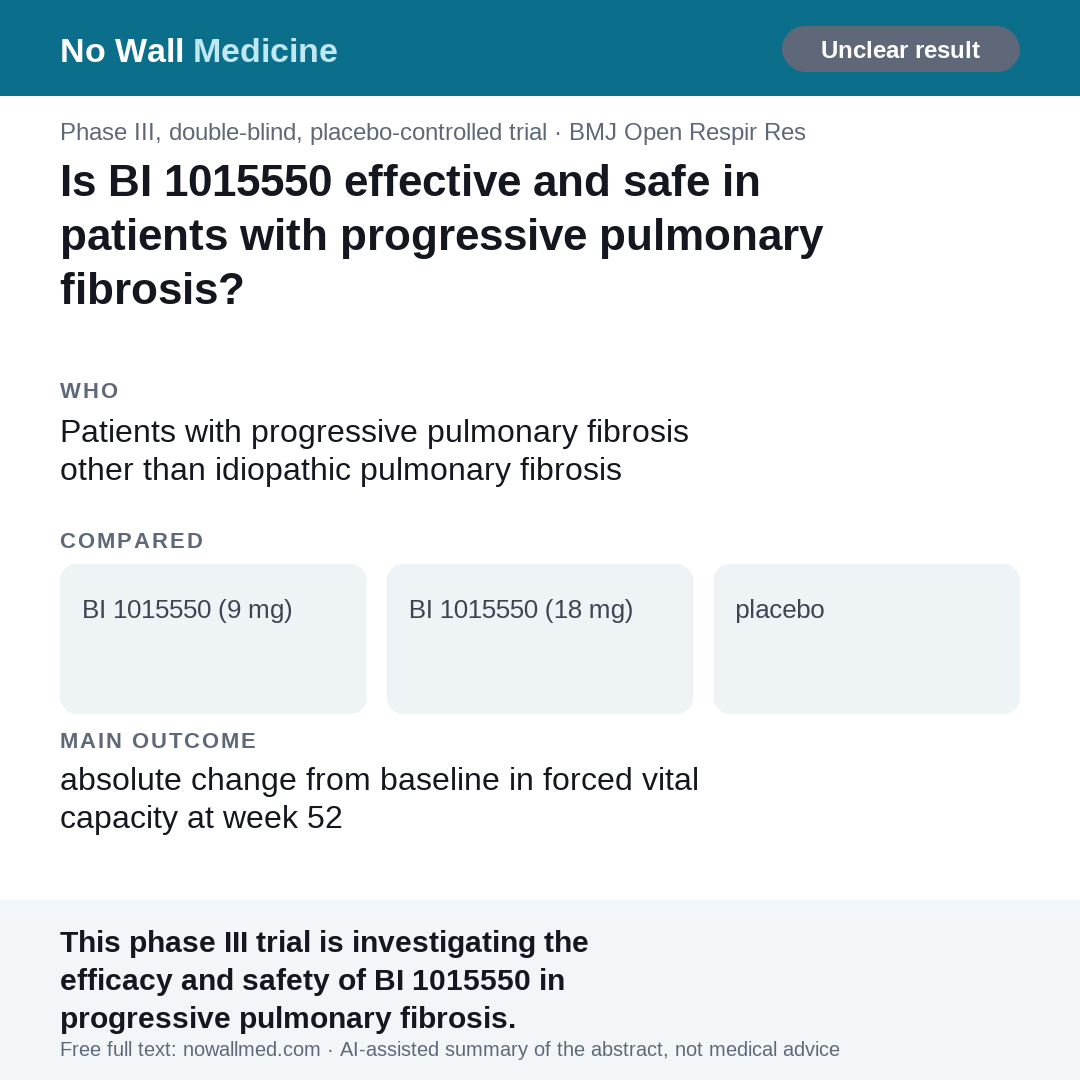
Clinical question: Is BI 1015550 effective and safe in patients with progressive pulmonary fibrosis?
Why it matters: It is unknown if BI 1015550 is effective and safe for treating progressive pulmonary fibrosis following positive phase II results in idiopathic pulmonary fibrosis.
Key points
- The study involves patients with progressive pulmonary fibrosis, excluding idiopathic pulmonary fibrosis, who are randomized to receive BI 1015550 at 9 mg or 18 mg or a placebo.
- Researchers will measure the absolute change from baseline in forced vital capacity, a measure of lung function, at week 52 as the primary endpoint.
- Secondary endpoints include the time to the first occurrence of acute interstitial lung disease exacerbation, respiratory hospitalization, or death.
Headline and key points written with AI from the paper’s abstract, with every number checked against it. Read the paper before relying on them.
Was this summary helpful?
Abstract
Introduction
Progressive pulmonary fibrosis (PPF) includes any diagnosis of progressive fibrotic interstitial lung disease (ILD) other than idiopathic pulmonary fibrosis (IPF). However, disease progression appears comparable between PPF and IPF, suggesting a similar underlying pathology relating to pulmonary fibrosis. Following positive results in a phase II study in IPF, this phase III study will investigate the efficacy and safety of BI 1015550 in patients with PPF (FIBRONEER-ILD). Methods and analysis
In this phase III, double-blind, placebo-controlled trial, patients are being randomised 1:1:1 to receive BI 1015550 (9 mg or 18 mg) or placebo twice daily over at least 52 weeks, stratified by background nintedanib use. Patients must be diagnosed with pulmonary fibrosis other than IPF that is progressive, based on predefined criteria. Patients must have forced vital capacity (FVC) ≥45% predicted and haemoglobin-corrected diffusing capacity of the lung for carbon monoxide ≥25% predicted. Patients must be receiving nintedanib for at least 12 weeks, or not receiving nintedanib for at least 8 weeks, prior to screening. Patients on stable treatment with permitted immunosuppressives (eg, methotrexate, azathioprine) may continue their treatment throughout the trial. Patients with clinically significant airway obstruction or other pulmonary abnormalities, and those using immunosuppressives that may confound FVC results (cyclophosphamide, tocilizumab, mycophenolate, rituximab) or high-dose steroids will be excluded. The primary endpoint is absolute change from baseline in FVC (mL) at week 52. The key secondary endpoint is time to the first occurrence of any acute ILD exacerbation, hospitalisation for respiratory cause or death, over the duration of the trial. Ethics and dissemination
The trial is being carried out in accordance with the ethical principles of the Declaration of Helsinki, the International Council on Harmonisation Guideline for Good Clinical Practice and other local ethics committees. The study results will be disseminated at scientific congresses and in peer-reviewed publications. Trial registration number
NCT05321082.
Abstract reproduced under the article’s CC BY NC licence.
Subject terms
Cite this article
Maher TM, Assassi S, Azuma A, Cottin V, Hoffmann-Vold AM, Kreuter M. Design of a phase III, double-blind, randomised, placebo-controlled trial of BI 1015550 in patients with progressive pulmonary fibrosis (FIBRONEER-ILD). BMJ Open Respir Res. 2023. doi:10.1136/bmjresp-2022-001580
Spotted a mistake? Suggest a correction
Top studies every Monday
The week’s key trials and guidelines in your specialties, plus any topics you follow. By email, free.
Get the weekly digest