Systematic review shows designathons produce diverse health outputs and are estimated to be cost-effective
Designathons in health research: a global systematic review
Systematic reviewBenefit found
What are the effectiveness and implementation-related factors of designathons in health research?
Who
42
Studies containing primary data on designathons for health · Global
Compared
Designathon effectiveness
Implementation factors
Main outcome
Effectiveness and implementation-related factors
Bottom line: Designathons are adaptable and highly cost-effective tools for addressing various health issues through diverse participant involvement.
Limitation: There were limited data on required resources and further implementation of solutions after designathons.
BMJ Glob Health · 2024-03-07Download image
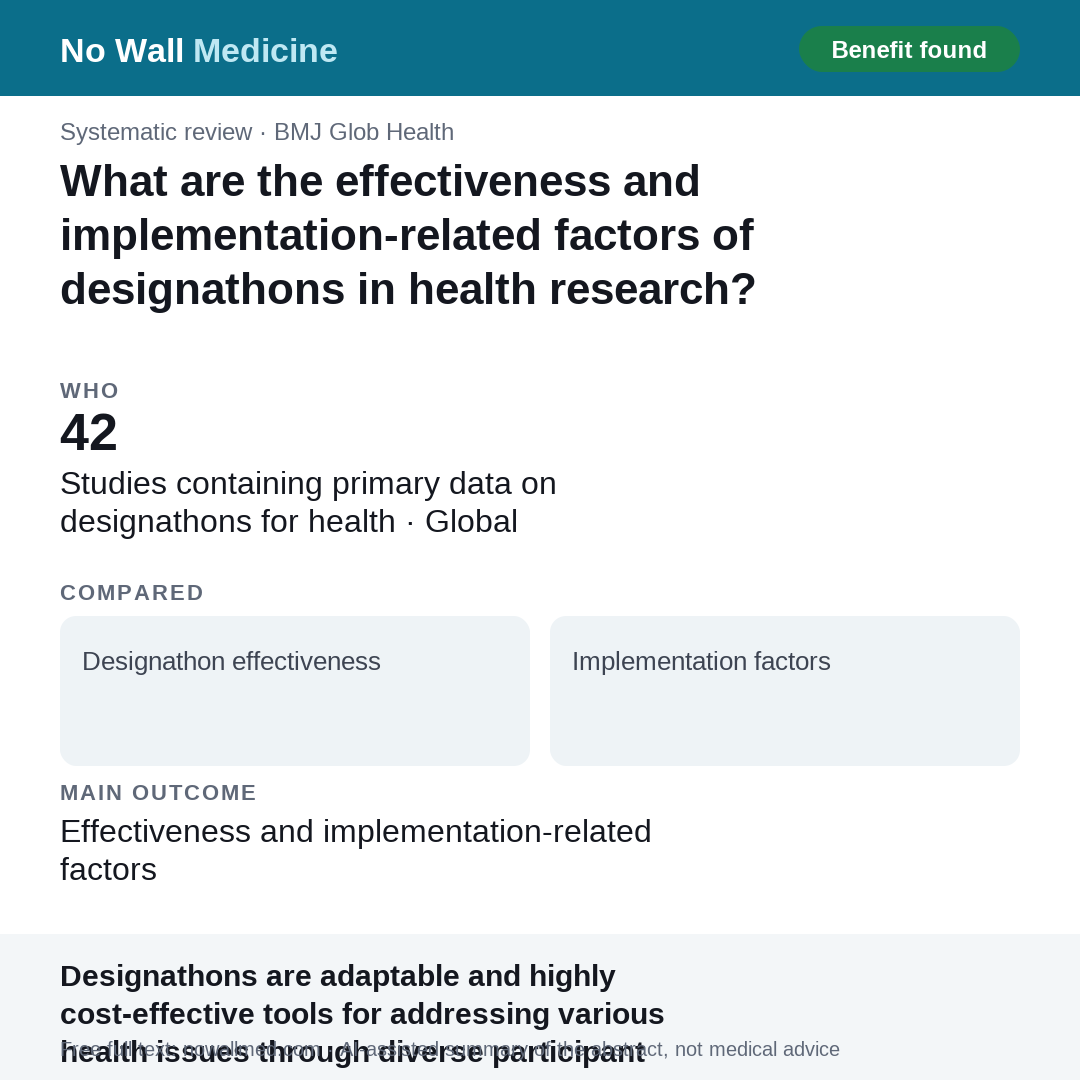
Clinical question: What are the effectiveness and implementation-related factors of designathons in health research?
Why it matters: It was unknown how effective designathons are and what factors influence their implementation to address health challenges.
Key points
- Researchers reviewed 42 studies involving a median of 49 total participants divided into a median of 8 teams.
- Outputs from these designathons included medical devices, educational programmes, and mobile phone applications.
- Common barriers to success included suboptimal event execution and difficulties balancing interdisciplinary participants across teams.
Limitation the authors note: There were limited data on required resources and further implementation of solutions after designathons.
Headline and key points written with AI from the paper’s abstract, with every number checked against it. Read the paper before relying on them.
Was this summary helpful?
Abstract
Introduction
A designathon is a three-stage participatory activity informed by design thinking. There is a growing literature on designathons in health. This study synthesised designathons' effectiveness and implementation-related factors to address health challenges. Methods
We searched Cochrane Library, Embase, PubMed, Scopus and the ClinicalTrials.gov registry for articles containing primary data on designathons for health from their dates of inception to 29 November 2022. We retrieved additional studies from citation searching and a complementary open call. We synthesised data on designathons' effectiveness (ie, engagement, outputs and implementation), required resources and implementation-related factors (ie, resources, facilitators, barriers, strengths and limitations). We assessed the risk of bias using a checklist adapted from Joanna Briggs Institute Critical Appraisal tools. Results
In total, 4973 citations were identified, and 42 studies were included. In total, 26 studies (62%) were from high-income countries. The median number of total participants was 49, divided into a median of 8 teams. The duration of the intensive collaboration phase ranged from 3 hours to 7 days. Common evaluation criteria were feasibility, innovation and impact. Idea and prototype outputs included mobile phone applications, educational programmes and medical devices. Interventions developed from a designathon was estimated to be highly cost-effective. The most common facilitators were interdisciplinary participants and high-quality mentorship. The most common barriers were suboptimal execution of the events, difficulties in balancing interdisciplinary participants across teams and limited support for participants along the process. There were limited data on required resources and further implementation of solutions after designathons. Conclusion
Given designathons' adaptability in terms of budget, mode of delivery, type of output and involvement of diverse participants, including end users, designathons can be implemented in a wide range of contexts to address various health issues. Prospero registration number
CRD42023389685.
Abstract reproduced under the article’s CC BY NC licence.
Cite this article
Tieosapjaroen W, Chen E, Ritchwood T, Li C, Conklin JL, Babatunde AO. Designathons in health research: a global systematic review. BMJ Glob Health. 2024. doi:10.1136/bmjgh-2023-013961
Spotted a mistake? Suggest a correction
Top studies every Monday
The week’s key trials and guidelines in your specialties, plus any topics you follow. By email, free.
Get the weekly digest