Deception detection procedures flagged 26% of prescreeners as potentially deceptive in a remote mobile health trial
Detecting Deception and Ensuring Data Integrity in a Nationwide mHealth Randomized Controlled Trial: Factorial Design Survey Study
32-group factorial design studyBenefit found
Can deception detection procedures identify deceptive attempts during remote enrollment?
Who
485
Adults in the United States with compatible Android smartphones · United States, remote recruitment
Compared
Pre-eligible participants: 26% (501/1928) flagged as potentially deceptive
Phone call screening: 1% (18/1928) flagged as potentially deceptive
Main outcome
Prevalence of deceptive attempts at study enrollment
Bottom line: Systematic deception detection procedures identified a substantial proportion of potentially deceptive enrollment attempts in a remote randomized controlled trial.
J Med Internet Res · 2025-01-28Download image
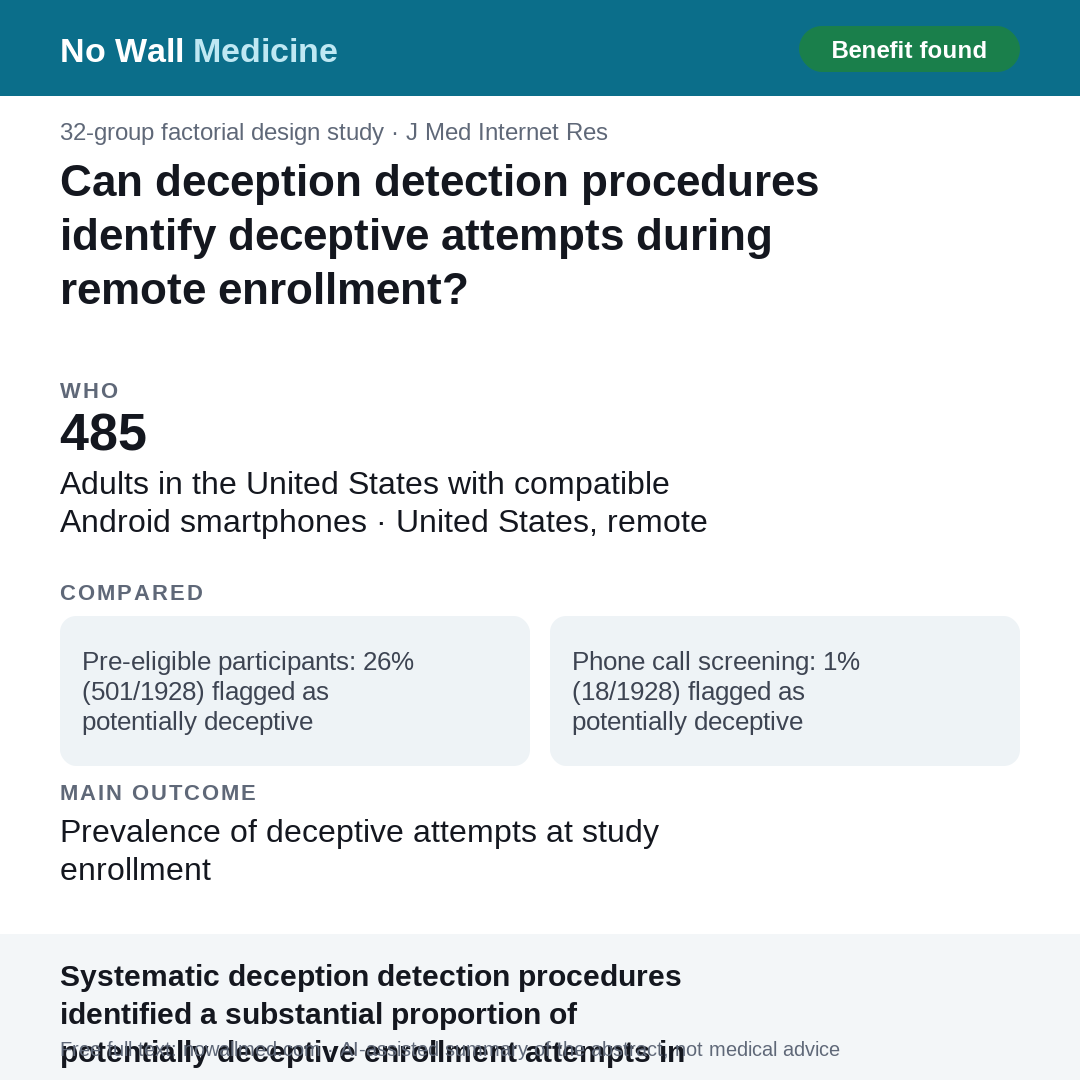
Clinical question: Can deception detection procedures identify deceptive attempts during remote enrollment?
Why it matters: The shift toward remote recruitment in behavioral research creates a need for methods to mitigate the negative impacts of deceptive attempts like fake profiles and bots.
Key points
- Researchers implemented a 12-step checklist to identify fake profiles and bots during the enrollment of a remote mobile health study involving 485 participants.
- Of 1928 pre-eligible individuals, 26% (501/1928) were flagged as potentially deceptive, with 60.1% (301/501) completing multiple prescreeners and 31.1% (156/501) providing invalid addresses.
- After all checks, 1409 individuals were eligible, and 0.6% (3/485) of fully enrolled participants provided erroneous social security numbers.
Headline and key points written with AI from the paper’s abstract, with every number checked against it. Read the paper before relying on them.
Topics
Cite this article
Kezbers KM, Robertson MC, Hébert ET, Montgomery A, Businelle MS. Detecting Deception and Ensuring Data Integrity in a Nationwide mHealth Randomized Controlled Trial: Factorial Design Survey Study. J Med Internet Res. 2025. doi:10.2196/66384
Spotted a mistake? Suggest a correction
Top studies every Monday
The week’s key trials and guidelines in your specialties, plus any topics you follow. By email, free.
Get the weekly digest