Accuracy of tools used to detect depression in long-term care settings was reviewed
Detecting depression in persons living in long-term care: a systematic review and meta-analysis of diagnostic test accuracy studies
Systematic review and meta-analysisMixed results
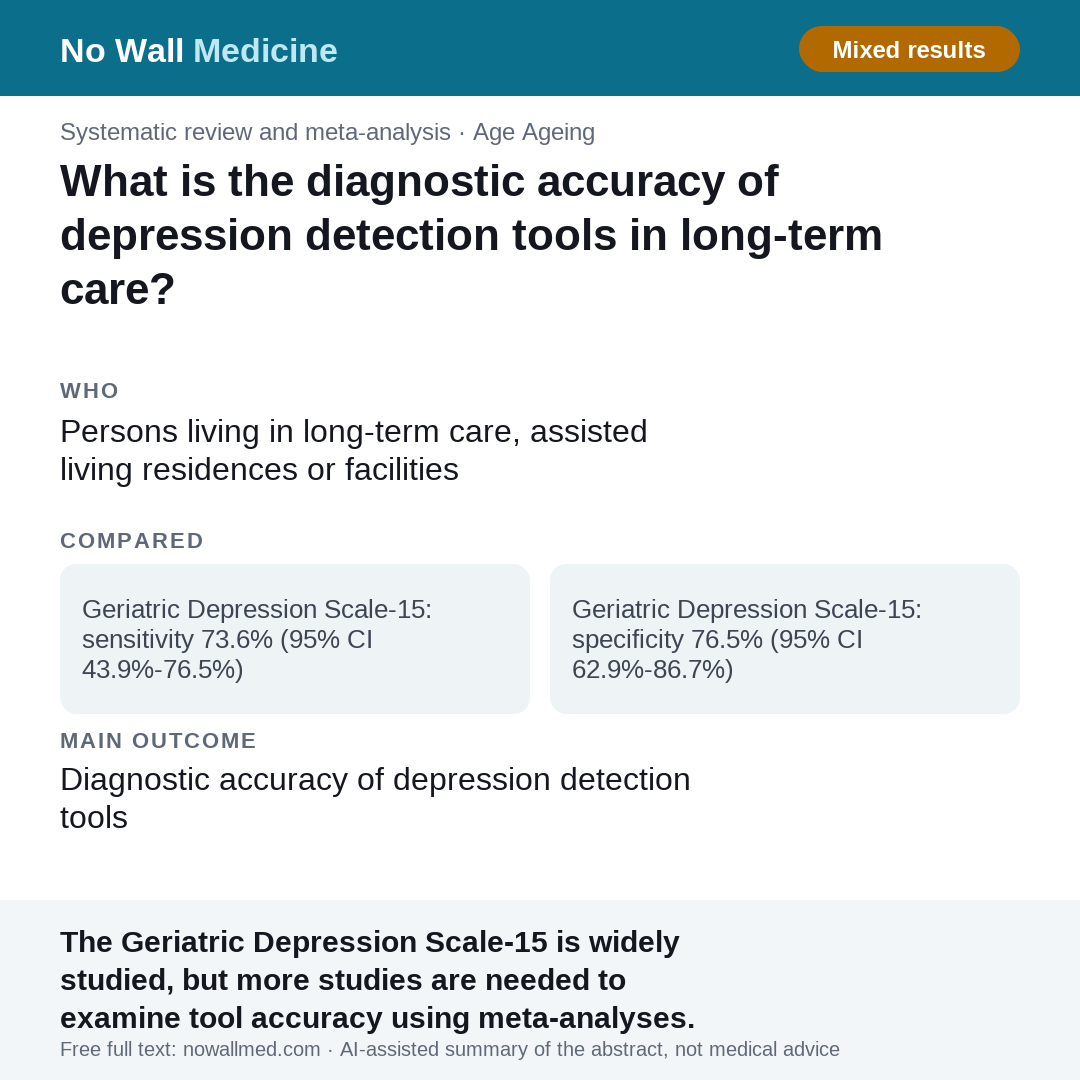
What is the diagnostic accuracy of depression detection tools in long-term care?
Who
Persons living in long-term care, assisted living residences or facilities
Compared
Geriatric Depression Scale-15: sensitivity 73.6% (95% CI 43.9%-76.5%)
Geriatric Depression Scale-15: specificity 76.5% (95% CI 62.9%-86.7%)
Main outcome
Diagnostic accuracy of depression detection tools
Result: area under the curve 0.83
Bottom line: The Geriatric Depression Scale-15 is widely studied, but more studies are needed to examine tool accuracy using meta-analyses.
Limitation: There was significant heterogeneity in these analyses.
Age Ageing · 2022-03-01Download image
Clinical question: What is the diagnostic accuracy of depression detection tools in long-term care?
Why it matters: There is no single standardized process used to detect depressive disorders among people living in long-term care settings.
Key points
- Researchers analyzed 19 studies involving 23 different depression detection tools used for people in long-term care or assisted living facilities.
- For the Geriatric Depression Scale-15 at a cut-off of 6, the pooled sensitivity was 73.6% and specificity was 76.5%.
- The 4-item Cornell Scale for Depression in Dementia showed a sensitivity between 67.0% and 90.0% for people living with dementia.
Limitation the authors note: There was significant heterogeneity in the analyses and insufficient data to conduct a meta-analysis of other screening tools.
Headline and key points written with AI from the paper’s abstract, with every number checked against it. Read the paper before relying on them.
Was this summary helpful?
Subject terms
Cite this article
Mele B, Watt J, Wu P, Azeem F, Lew G, Holroyd-Leduc J. Detecting depression in persons living in long-term care: a systematic review and meta-analysis of diagnostic test accuracy studies. Age Ageing. 2022. doi:10.1093/ageing/afac039
Spotted a mistake? Suggest a correction
Top studies every Monday
The week’s key trials and guidelines in your specialties, plus any topics you follow. By email, free.
Get the weekly digest