Multiple biopsies are required to accurately detect eosinophilic gastritis and eosinophilic duodenitis
Determination of Biopsy Yield That Optimally Detects Eosinophilic Gastritis and/or Duodenitis in a Randomized Trial of Lirentelimab
Randomized trial analysisNo clear difference
How many biopsies are required to optimally detect eosinophilic gastritis and eosinophilic duodenitis?
Who
88
Subjects with moderate-to-severe gastrointestinal symptoms
Compared
Gastric biopsies: 2.6 per 8 biopsies met thresholds
Duodenal biopsies: 2.2 per 4 biopsies met thresholds
Main outcome
Diagnostic yield of eosinophilic gastritis and eosinophilic duodenitis
Bottom line: At least 8 gastric and 4 duodenal biopsies are required to capture 100% of eosinophilic gastritis and duodenitis cases.
Clin Gastroenterol Hepatol · 2021-06-02Download image
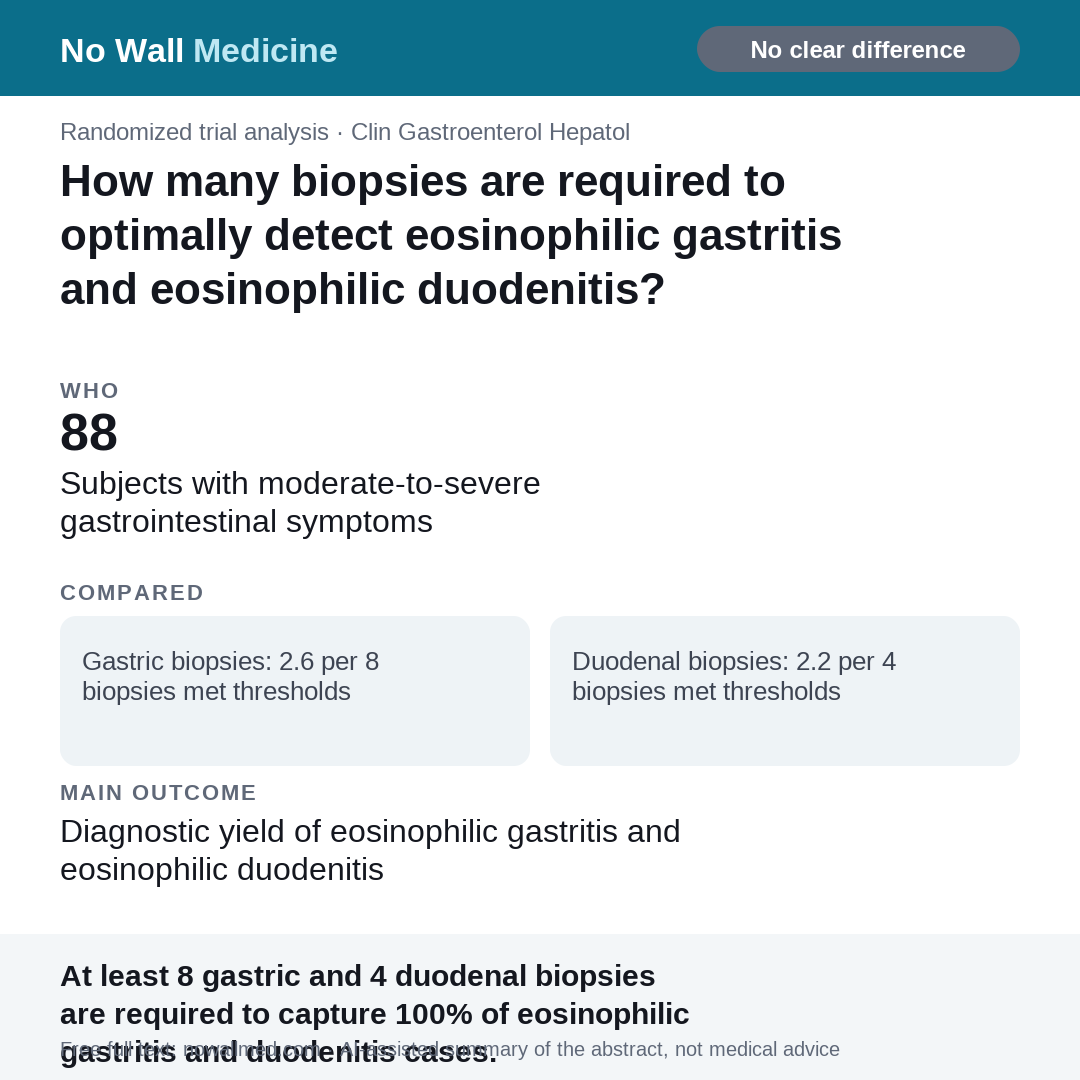
Clinical question: How many biopsies are required to optimally detect eosinophilic gastritis and eosinophilic duodenitis?
Why it matters: It is unknown how many biopsies are necessary to optimize the detection of eosinophilic gastritis and eosinophilic duodenitis during an endoscopy.
Key points
- Researchers analyzed 88 subjects with moderate-to-severe gastrointestinal symptoms to determine the number of biopsies needed to detect eosinophilic gastritis and eosinophilic duodenitis.
- To capture 100% of cases, the study found that evaluating 8 gastric biopsies and 4 duodenal biopsies was necessary due to patchy eosinophil distribution.
- Neither the severity of symptoms nor findings seen during endoscopy were linked to the number of eosinophils counted.
Headline and key points written with AI from the paper’s abstract, with every number checked against it. Read the paper before relying on them.
Was this summary helpful?
Subject terms
Cite this article
Dellon ES, Gonsalves N, Rothenberg ME, Hirano I, Chehade M, Peterson KA. Determination of Biopsy Yield That Optimally Detects Eosinophilic Gastritis and/or Duodenitis in a Randomized Trial of Lirentelimab. Clin Gastroenterol Hepatol. 2021. doi:10.1016/j.cgh.2021.05.053
Spotted a mistake? Suggest a correction
Top studies every Monday
The week’s key trials and guidelines in your specialties, plus any topics you follow. By email, free.
Get the weekly digest