Urinary gluten peptide testing may not reliably detect gluten contamination in gluten-free diets
Determination of Urinary Gluten Immunogenic Peptides to Assess Adherence to the Gluten-Free Diet: A Randomized, Double-Blind, Controlled Study
Randomized, double-blind, controlled studyHarm found
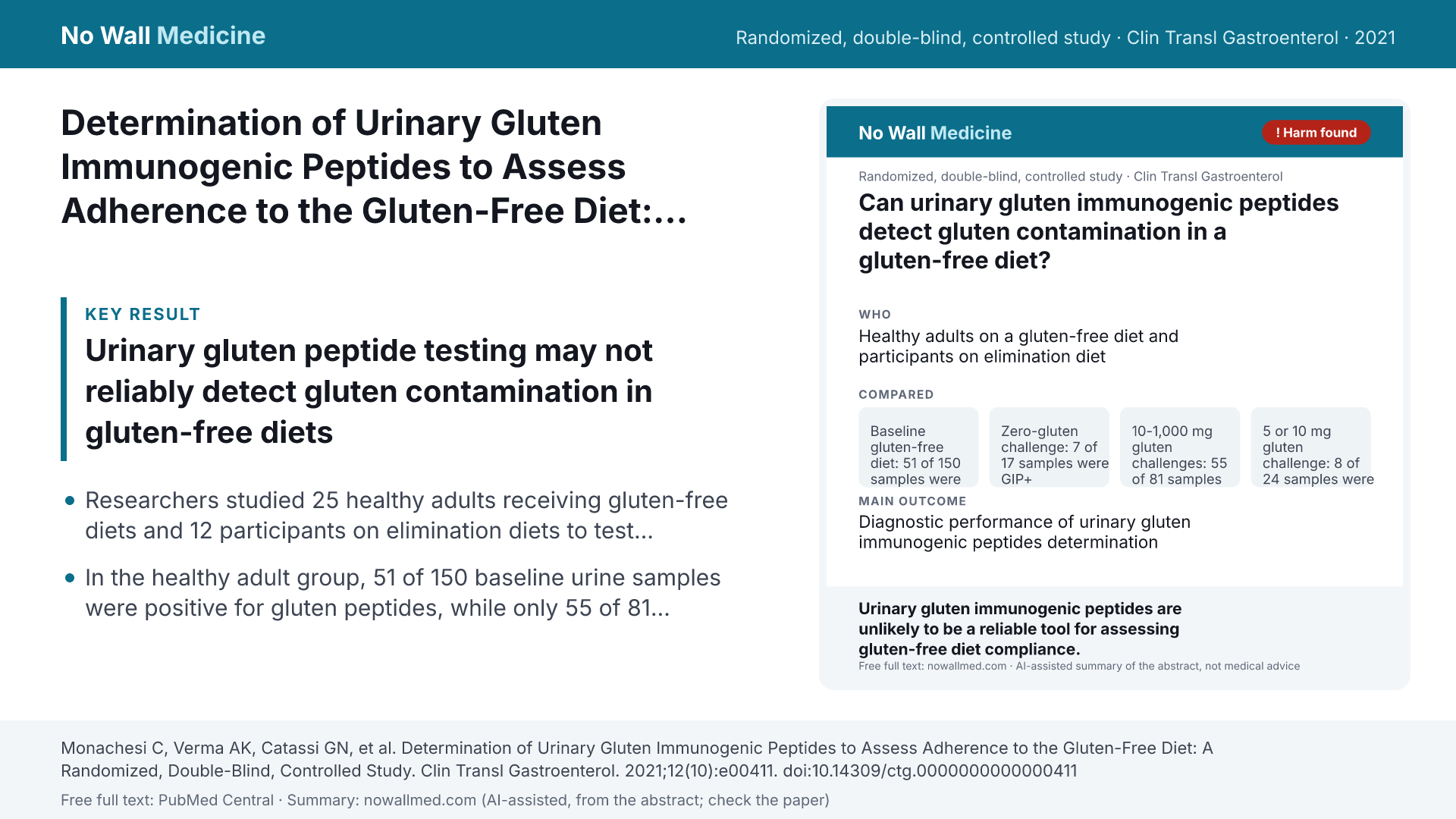
Can urinary gluten immunogenic peptides detect gluten contamination in a gluten-free diet?
Who
Healthy adults on a gluten-free diet and participants on elimination diet
Compared
Baseline gluten-free diet: 51 of 150 samples were GIP+
Zero-gluten challenge: 7 of 17 samples were GIP+
10-1,000 mg gluten challenges: 55 of 81 samples were GIP+
5 or 10 mg gluten challenge: 8 of 24 samples were GIP+
Main outcome
Diagnostic performance of urinary gluten immunogenic peptides determination
Bottom line: Urinary gluten immunogenic peptides are unlikely to be a reliable tool for assessing gluten-free diet compliance.
Clin Transl Gastroenterol · 2021-10-06

Headline and visual abstract written with AI from the paper’s abstract, with every number checked against it. Read the paper before relying on them.
Was this summary helpful?
Subject terms
Cite this article
Monachesi C, Verma AK, Catassi GN, et al. Determination of Urinary Gluten Immunogenic Peptides to Assess Adherence to the Gluten-Free Diet: A Randomized, Double-Blind, Controlled Study. Clin Transl Gastroenterol. 2021;12(10):e00411. doi:10.14309/ctg.0000000000000411
Spotted a mistake? Suggest a correction