Determining the frequency and level of task-sharing for hypertension management in LMICs: A systematic review and meta-analysis
Key result: Team-based care for hypertension management in low- and middle-income countries lowers systolic blood pressure
Key points
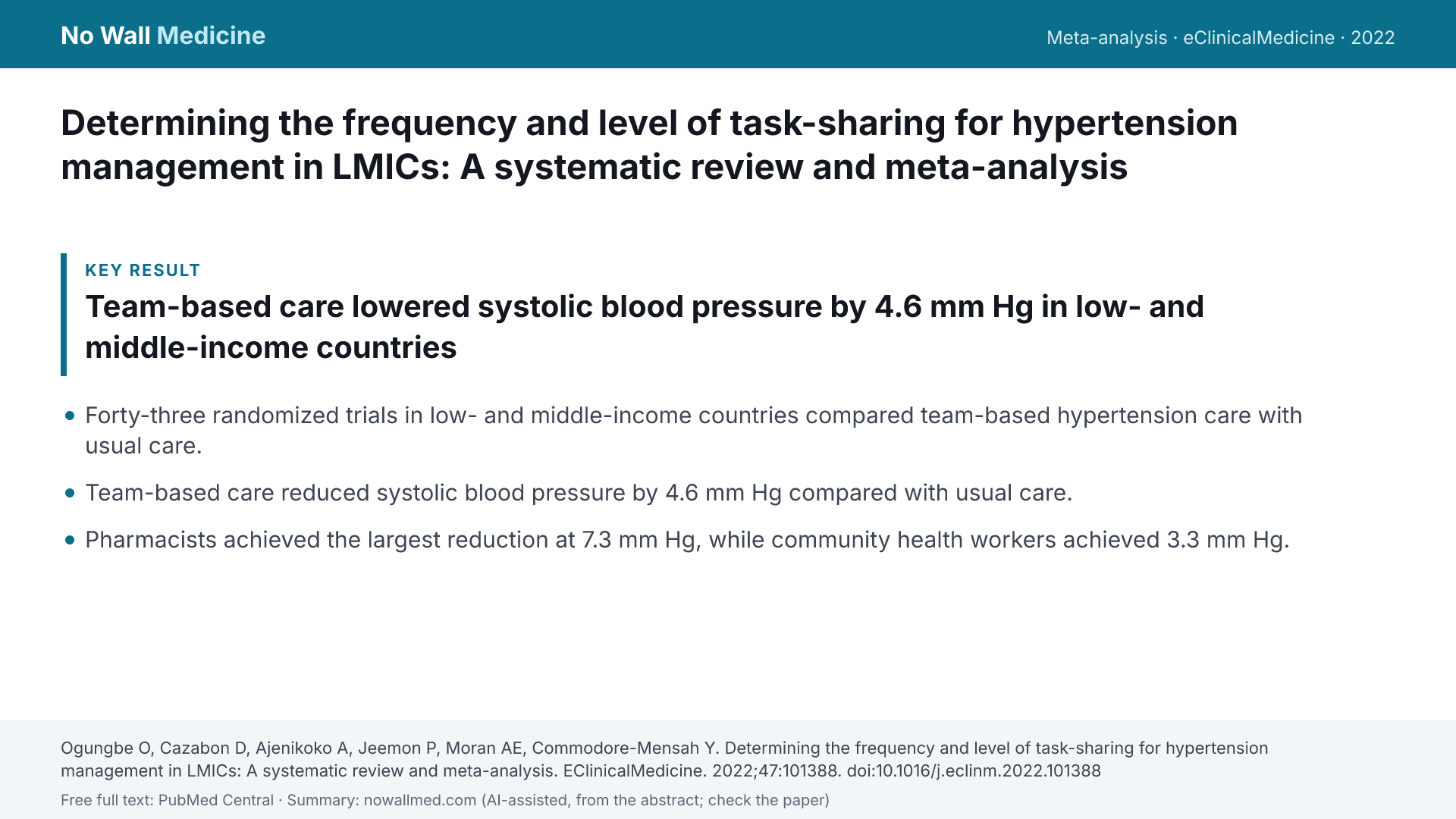
- Researchers analyzed 43 randomized controlled trials to compare team-based care against usual care for managing high blood pressure in low- and middle-income countries.
- Team-based care resulted in a pooled mean decrease in systolic blood pressure of -4.6 mm Hg compared to usual care.
- The greatest systolic blood pressure reduction was seen with pharmacists at -7.3 mm Hg, followed by nurses at -5.1 mm Hg, dieticians at -4.7 mm Hg, and community health workers at -3.3 mm Hg.
Why it matters: It is unknown how different levels of task-sharing complexity and different types of healthcare workers affect the efficacy of team-based hypertension management.
Discussion prompts
- Would these patients look like yours? Who was left out?
- Is the main outcome one that matters to patients?
- Is the difference large enough to change what you do?
Cite: Ogungbe O, Cazabon D, Ajenikoko A, Jeemon P, Moran AE, Commodore-Mensah Y. Determining the frequency and level of task-sharing for hypertension management in LMICs: A systematic review and meta-analysis. eClinicalMedicine. 2022. doi:10.1016/j.eclinm.2022.101388
Free full text: PubMed Central · Summary and visual abstract: nowallmed.com/a/determining-the-frequency-and-level-of-task-sharing-for-hypertension-4kxn9c/ (AI-assisted from the abstract; check the paper before relying on it).