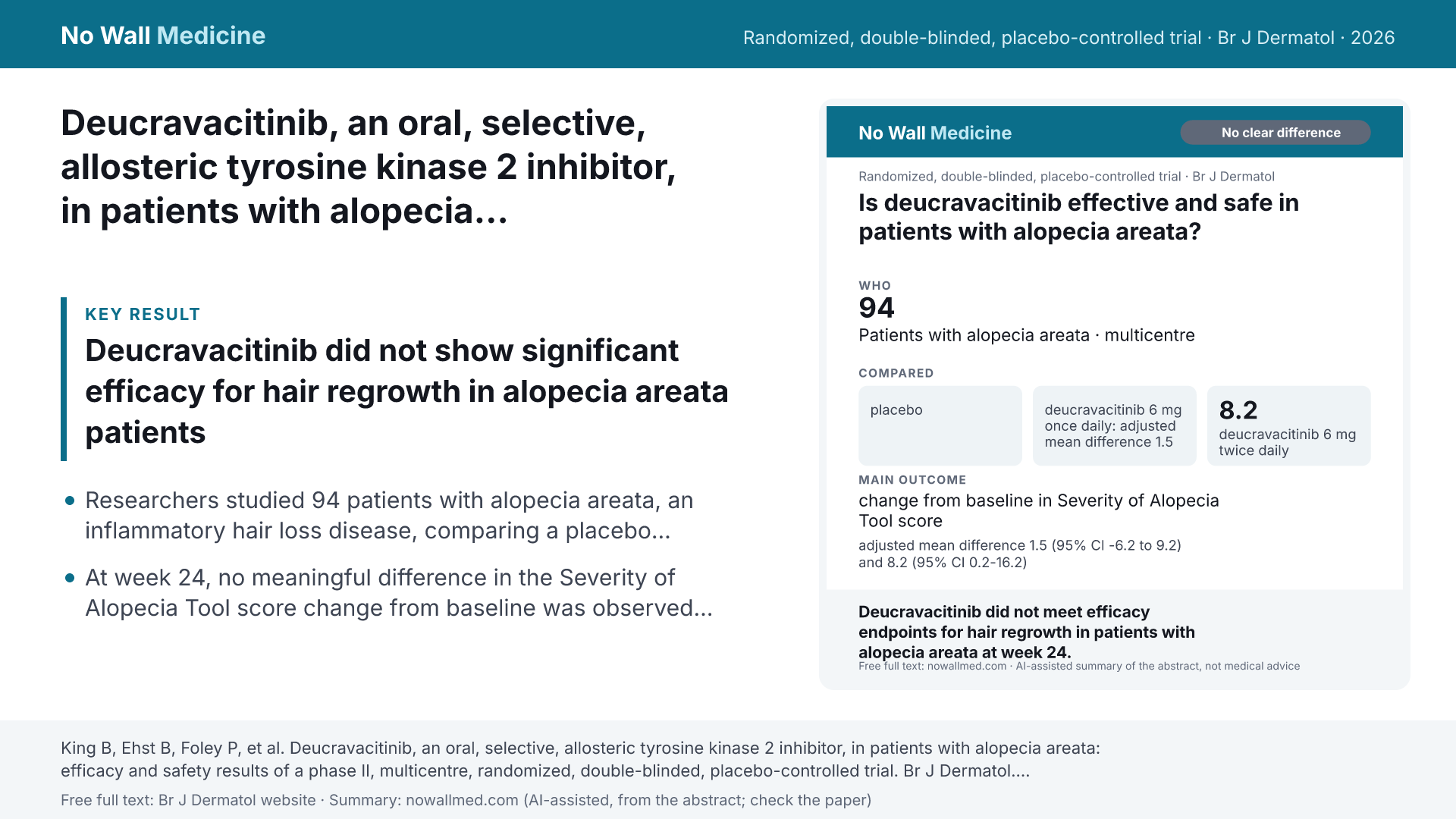
Deucravacitinib did not show significant efficacy for hair regrowth in alopecia areata patients
Deucravacitinib, an oral, selective, allosteric tyrosine kinase 2 inhibitor, in patients with alopecia areata: efficacy and safety results of a phase II, multicentre, randomized, double-blinded, placebo-controlled trial
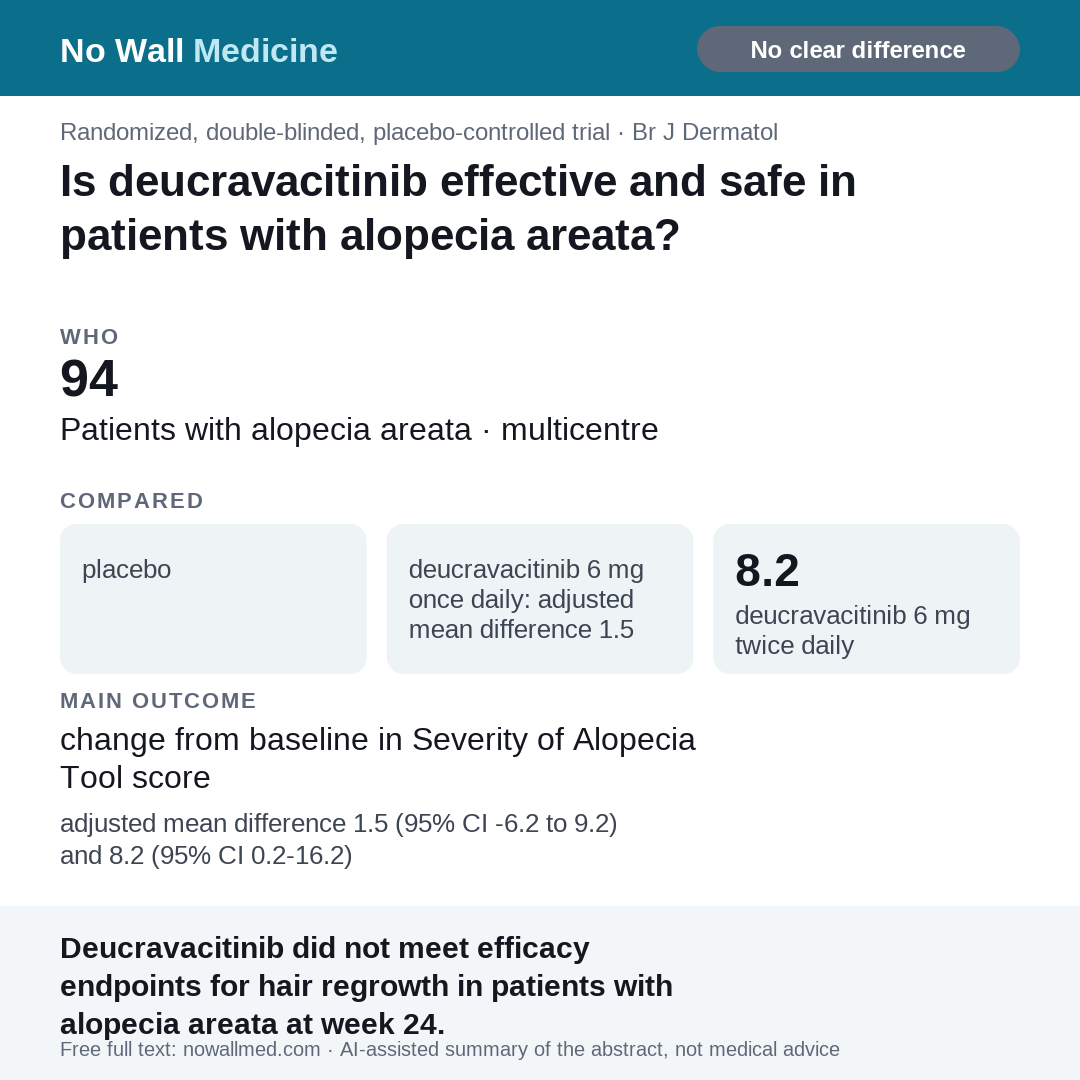
Randomized, double-blinded, placebo-controlled trialNo clear difference
Is deucravacitinib effective and safe in patients with alopecia areata?
Who
94
Patients with alopecia areata · multicentre
Compared
placebo
deucravacitinib 6 mg once daily: adjusted mean difference 1.5
8.2deucravacitinib 6 mg twice daily
Main outcome
change from baseline in Severity of Alopecia Tool score
Result: adjusted mean difference 1.5 (95% CI -6.2 to 9.2) and 8.2 (95% CI 0.2-16.2)
Bottom line: Deucravacitinib did not meet efficacy endpoints for hair regrowth in patients with alopecia areata at week 24.
Br J Dermatol · 2026-03-30Download image
Clinical question: Is deucravacitinib effective and safe in patients with alopecia areata?
Why it matters: It was unknown if inhibiting the tyrosine kinase 2 enzyme with deucravacitinib could effectively promote hair regrowth in patients with alopecia areata.
Key points
- Researchers studied 94 patients with alopecia areata, an inflammatory hair loss disease, comparing a placebo to deucravacitinib 6 mg once daily or twice daily.
- At week 24, no meaningful difference in the Severity of Alopecia Tool score change from baseline was observed between deucravacitinib and placebo groups.
- No differences were observed for secondary endpoints, and no new safety signals were identified during the trial.
Headline and key points written with AI from the paper’s abstract, with every number checked against it. Read the paper before relying on them.
Was this summary helpful?
Subject terms
Cite this article
King B, Ehst B, Foley P, et al. Deucravacitinib, an oral, selective, allosteric tyrosine kinase 2 inhibitor, in patients with alopecia areata: efficacy and safety results of a phase II, multicentre, randomized, double-blinded, placebo-controlled trial. Br J Dermatol. 2026. doi:10.1093/bjd/ljag109
Spotted a mistake? Suggest a correction