Electronic learning curriculum for anesthesia residents did not change anesthetic doses in older patients
Developing a Real-Time Electroencephalogram-Guided Anesthesia-Management Curriculum for Educating Residents: A Single-Center Randomized Controlled Trial
Single-center randomized controlled trialNo clear difference
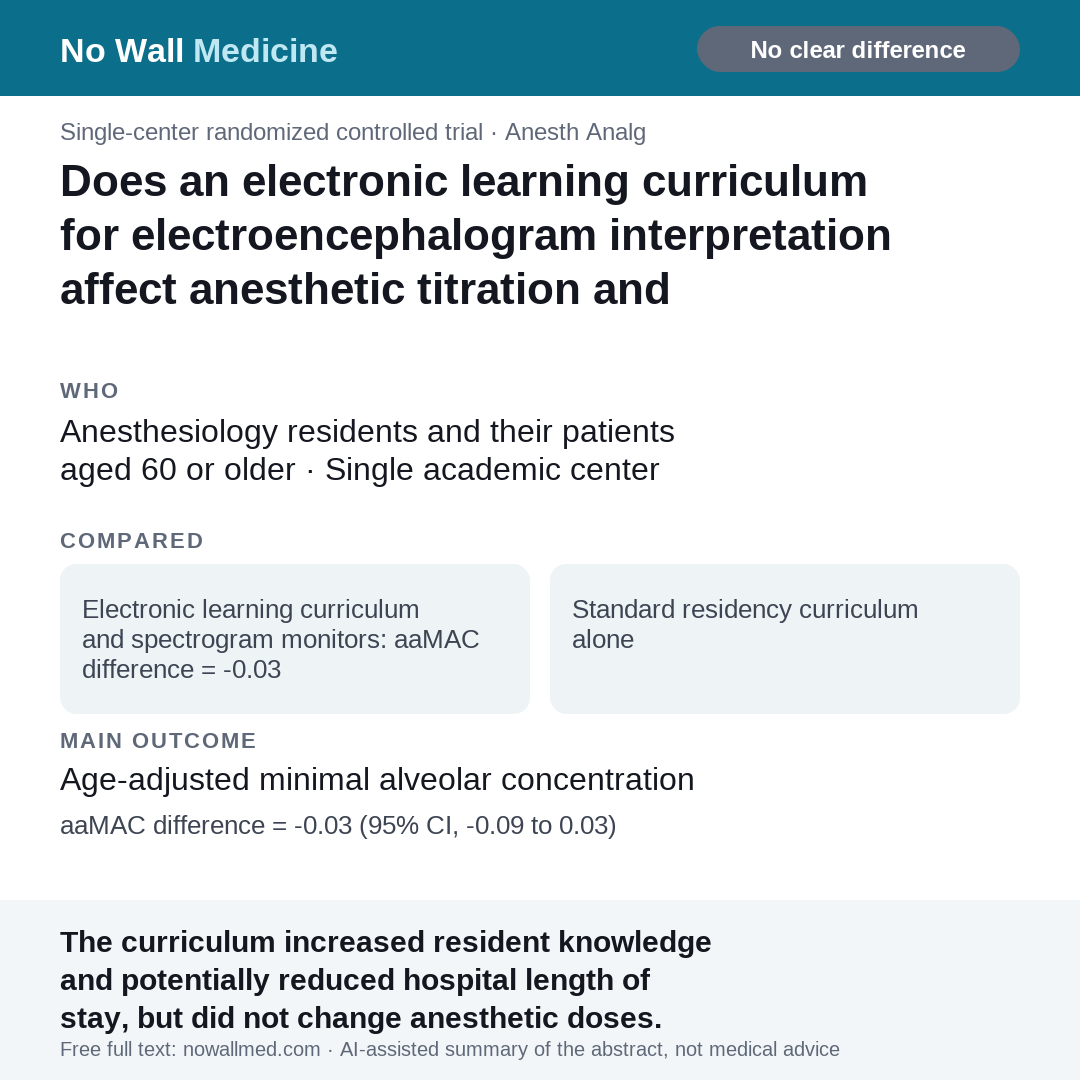
Does an electronic learning curriculum for electroencephalogram interpretation affect anesthetic titration and outcomes?
Who
Anesthesiology residents and their patients aged 60 or older · Single academic center
Compared
Electronic learning curriculum and spectrogram monitors: aaMAC difference = -0.03
Standard residency curriculum alone
Main outcome
Age-adjusted minimal alveolar concentration
Result: aaMAC difference = -0.03 (95% CI, -0.09 to 0.03)
Bottom line: The curriculum increased resident knowledge and potentially reduced hospital length of stay, but did not change anesthetic doses.
Anesth Analg · 2021-10-29Download image
Clinical question: Does an electronic learning curriculum for electroencephalogram interpretation affect anesthetic titration and outcomes?
Why it matters: It is unclear how to best teach trainees to interpret electroencephalogram time series data and spectral information for adjusting anesthesia during surgery.
Key points
- Anesthesiology residents were randomized to receive an electronic learning curriculum and spectrogram monitors or the standard curriculum alone.
- Postintervention, there was no significant difference in age-adjusted minimal alveolar concentration between the intervention group (n = 159) and control group (N = 325).
- The electronic learning curriculum was associated with a 6-point increase in EEG knowledge test scores and a shorter median hospital length of stay (2.48 vs 3.86 days).
Headline and key points written with AI from the paper’s abstract, with every number checked against it. Read the paper before relying on them.
Was this summary helpful?
Subject terms
Cite this article
Berger M, Eleswarpu SS, Cooter Wright M, Ray AM, Wingfield SA, Heflin MT. Developing a Real-Time Electroencephalogram-Guided Anesthesia-Management Curriculum for Educating Residents: A Single-Center Randomized Controlled Trial. Anesth Analg. 2021. doi:10.1213/ANE.0000000000005677
Spotted a mistake? Suggest a correction
Top studies every Monday
The week’s key trials and guidelines in your specialties, plus any topics you follow. By email, free.
Get the weekly digest