Brain wave model predicts response to two different antidepressant medications in depression patients
Developing an Electroencephalography-Based Model for Predicting Response to Antidepressant Medication
Prognostic studyBenefit found
Can an electroencephalography-based model predict response to antidepressant medication?
Who
Participants aged 18 to 65 years with major depressive disorder · Canada and multiple sites
Compared
Internal validation (CAN-BIND): 64.2% balanced accuracy
External validation (EMBARC sertraline): 63.7% balanced accuracy
External validation (EMBARC placebo): 48.7% balanced accuracy
Main outcome
Response to treatment defined as 50% or greater reduction in depression severity
Bottom line: An electroencephalography-based model showed promising accuracy in predicting response to two distinct selective serotonin reuptake inhibitors.
JAMA Netw Open · 2023-09-05Download image
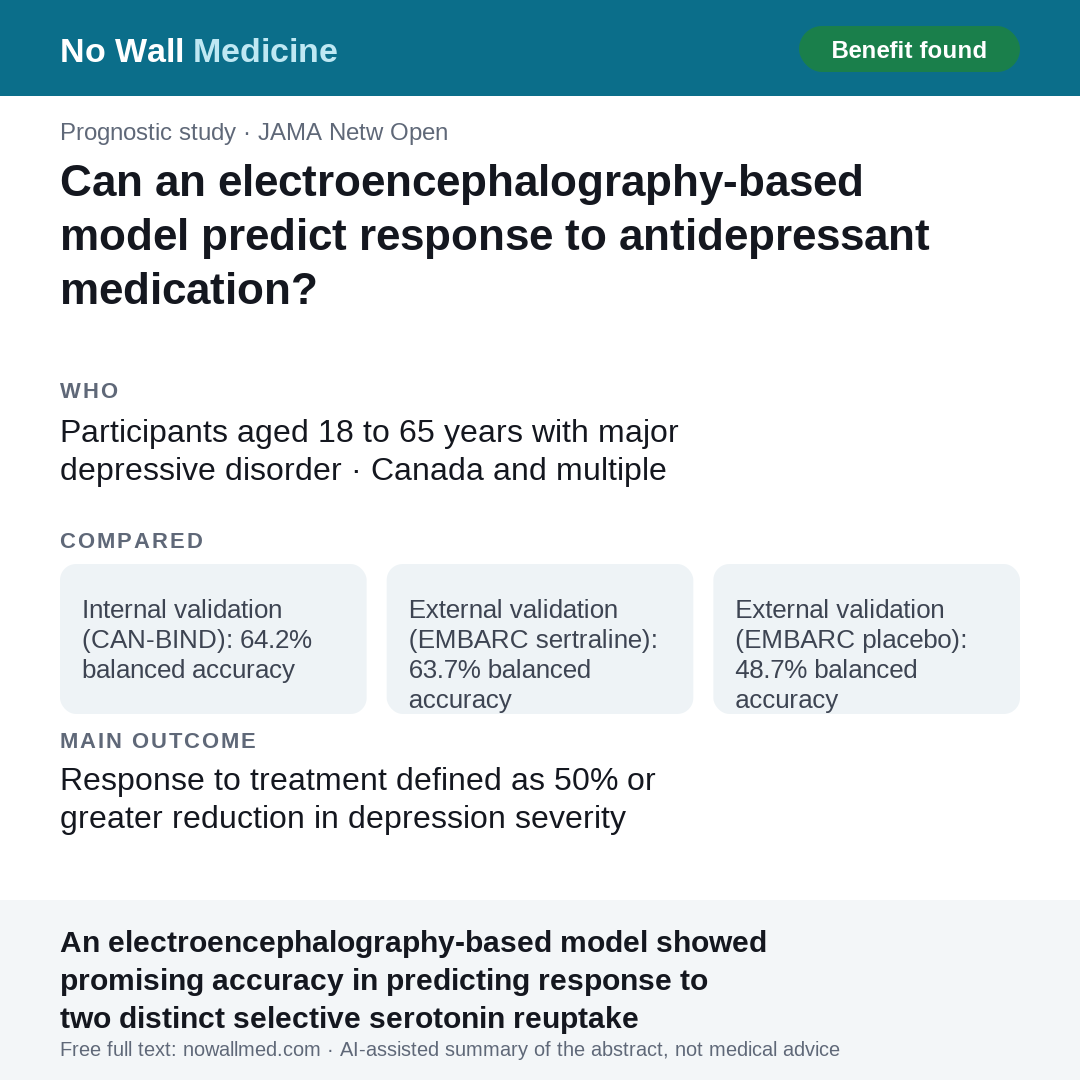
Clinical question: Can an electroencephalography-based model predict response to antidepressant medication?
Why it matters: Finding effective antidepressant treatments often involves a prolonged trial-and-error process for patients with major depressive disorder.
Key points
- Researchers developed a model using electroencephalography, which measures electrical activity in the brain, to predict response to escitalopram and sertraline in two cohorts of people with depression.
- In the internal validation of 125 participants, the model achieved a balanced accuracy of 64.2%, a sensitivity of 66.1%, and a specificity of 62.3%.
- In the external validation of 105 participants receiving sertraline, the model achieved a balanced accuracy of 63.7%, a sensitivity of 58.8%, and a specificity of 68.5%.
Headline and key points written with AI from the paper’s abstract, with every number checked against it. Read the paper before relying on them.
Was this summary helpful?
Subject terms
Cite this article
Schwartzmann B, Dhami P, Uher R, Lam RW, Frey BN, Milev R. Developing an Electroencephalography-Based Model for Predicting Response to Antidepressant Medication. JAMA Netw Open. 2023. doi:10.1001/jamanetworkopen.2023.36094
Spotted a mistake? Suggest a correction
Top studies every Monday
The week’s key trials and guidelines in your specialties, plus any topics you follow. By email, free.
Get the weekly digest