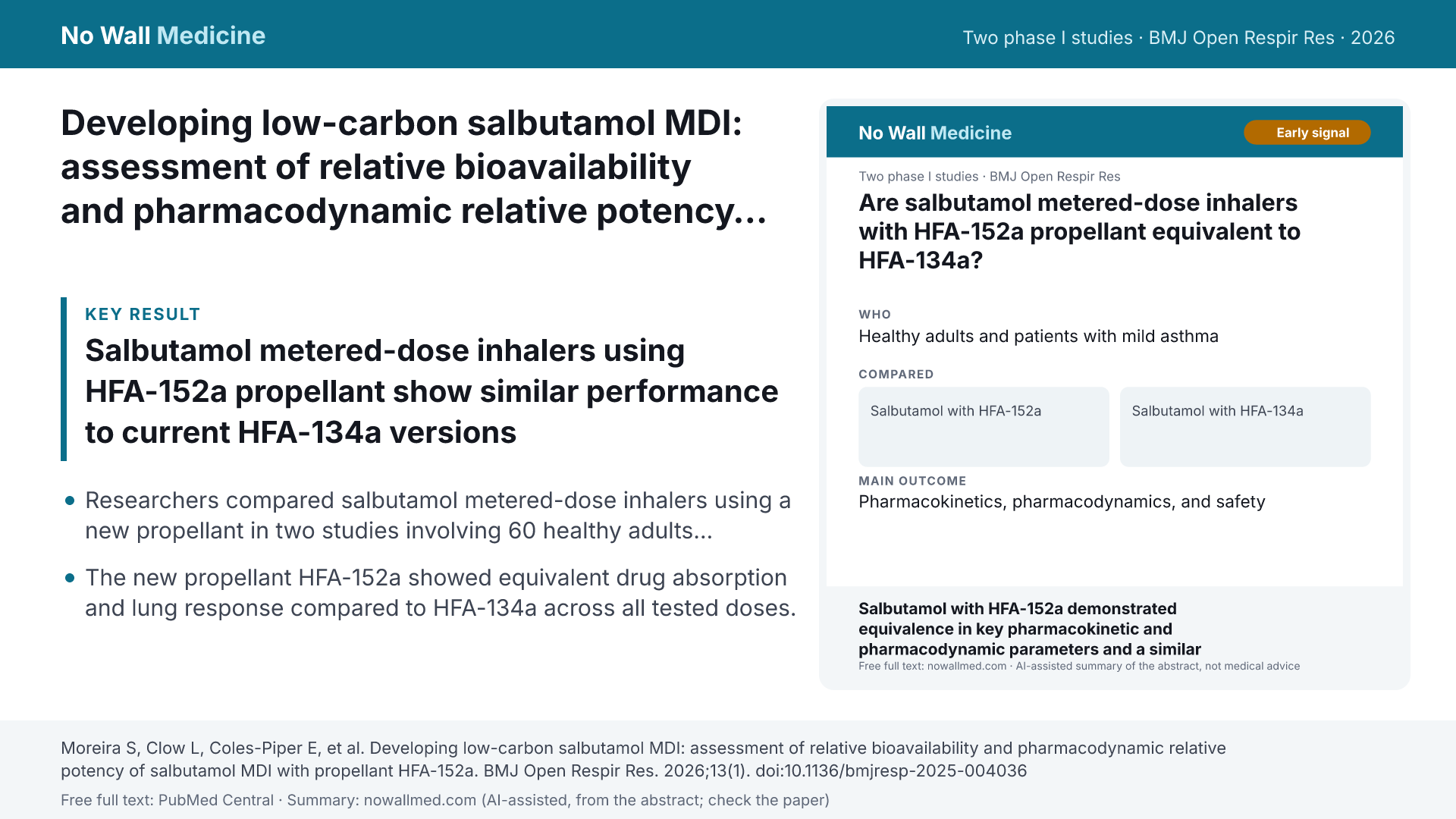
Salbutamol metered-dose inhalers using HFA-152a propellant show similar performance to current HFA-134a versions
Developing low-carbon salbutamol MDI: assessment of relative bioavailability and pharmacodynamic relative potency of salbutamol MDI with propellant HFA-152a
Two phase I studiesEarly signal
Are salbutamol metered-dose inhalers with HFA-152a propellant equivalent to HFA-134a?
Who
Healthy adults and patients with mild asthma
Compared
Salbutamol with HFA-152a
Salbutamol with HFA-134a
Main outcome
Pharmacokinetics, pharmacodynamics, and safety
Bottom line: Salbutamol with HFA-152a demonstrated equivalence in key pharmacokinetic and pharmacodynamic parameters and a similar safety profile.
BMJ Open Respir Res · 2026-06-17Download image
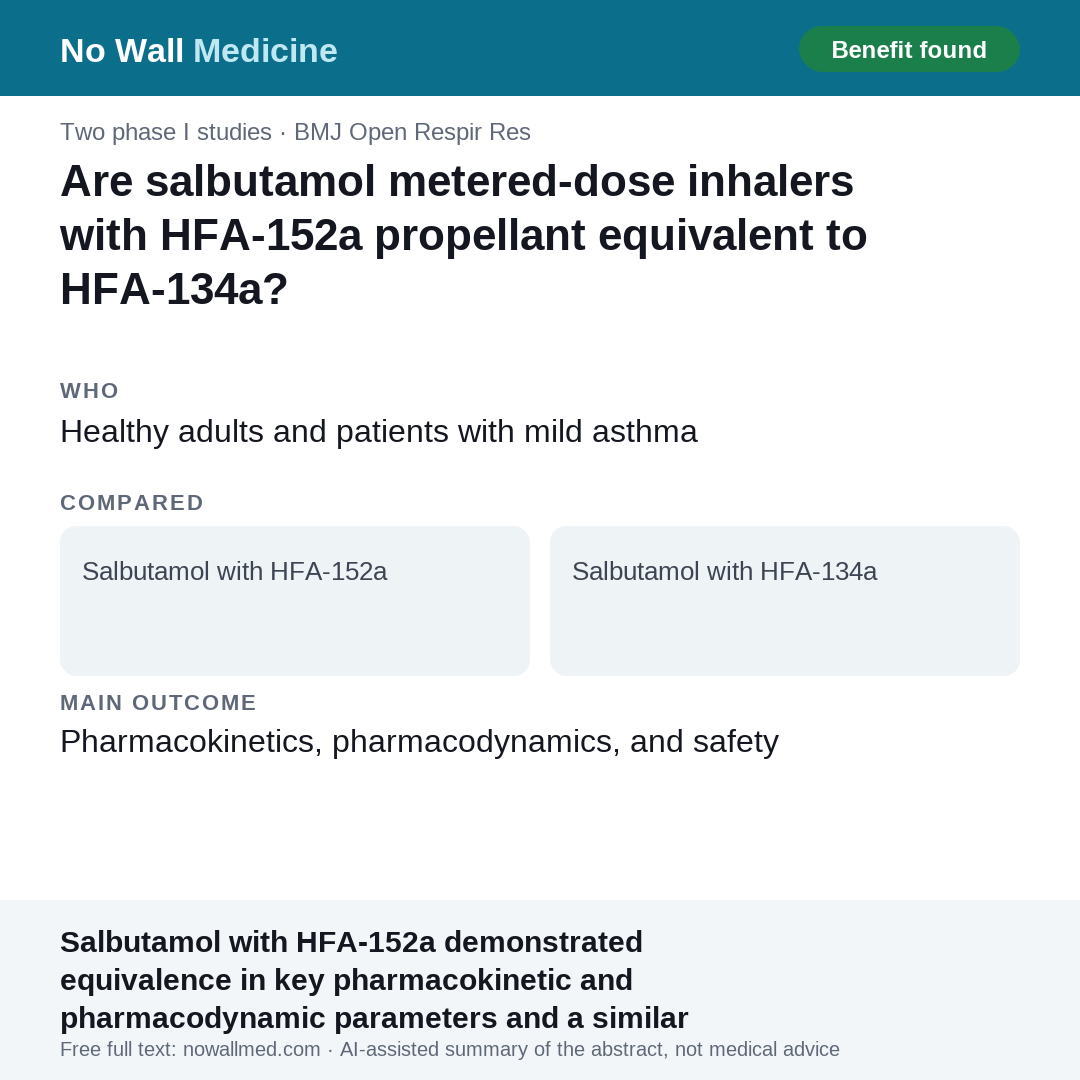
Clinical question: Are salbutamol metered-dose inhalers with HFA-152a propellant equivalent to HFA-134a?
Why it matters: Current metered-dose inhalers use HFA-134a propellant, which contributes to healthcare-related greenhouse gas emissions.
Key points
- Researchers compared salbutamol metered-dose inhalers using a new propellant in two studies involving 60 healthy adults and 21 patients with mild asthma.
- The new propellant HFA-152a showed equivalent drug absorption and lung response compared to HFA-134a across all tested doses.
- No serious treatment-related adverse events were reported, and all side effects were mild and occurred at similar frequencies for both propellants.
Headline and key points written with AI from the paper’s abstract, with every number checked against it. Read the paper before relying on them.
Was this summary helpful?
Abstract
Introduction
Climate change is a global threat. Propellant hydrofluoroalkane (HFA)-134a in metered-dose inhalers (MDIs) contributes to healthcare-related greenhouse gas emissions. HFA-152a is a new propellant with ~90% lower global warming potential than HFA-134a. Two phase I studies (NCT06433908/NCT06433921) compared the pharmacokinetics (PK), pharmacodynamics (PD) and safety of salbutamol MDI with HFA-152a or HFA-134a. Methods
Relative bioavailability (Study 1): healthy adults received single salbutamol doses (200/800 µg) via MDI with HFA-152a or HFA-134a. Primary PK endpoints were areas under the plasma concentration-time curve (0-30 min (AUC)0-30 min, zero to infinity (AUC0-∞) and maximum plasma concentration (Cmax)). Relative PD potency via methacholine challenge (Study 2): patients with mild asthma received MDI placebo and salbutamol doses (100/200/400 µg) with HFA-152a or HFA-134a. The primary PD endpoint was provocative methacholine concentration (PC) causing ≥20% (PC20) forced expiratory volume in 1 s reduction. Results
Study 1: 60 participants (30 per cohort) enrolled. In cohort 1 (200 µg), AUC0-30 min was within the predefined PK bioequivalence (BE) range (0.80-1.25); in cohort 2 (800 µg), AUC0-∞ and Cmax were within the BE range. Study 2: 21 participants enrolled. PD relative potency of HFA-152a was within the predefined BE range (0.67-1.50). No serious treatment-related adverse events (AEs) were reported; all AEs were mild and occurred at similar frequencies with both propellants. Conclusions
Salbutamol with HFA-152a demonstrated equivalence in key PK and PD parameters, as well as a similar safety profile to salbutamol with HFA-134a, supporting salbutamol MDI with HFA-152a as a therapeutically equivalent, low-carbon replacement.
Abstract reproduced under the article’s CC BY NC licence.
Subject terms
Cite this article
Moreira S, Clow L, Coles-Piper E, et al. Developing low-carbon salbutamol MDI: assessment of relative bioavailability and pharmacodynamic relative potency of salbutamol MDI with propellant HFA-152a. BMJ Open Respir Res. 2026. doi:10.1136/bmjresp-2025-004036
Spotted a mistake? Suggest a correction