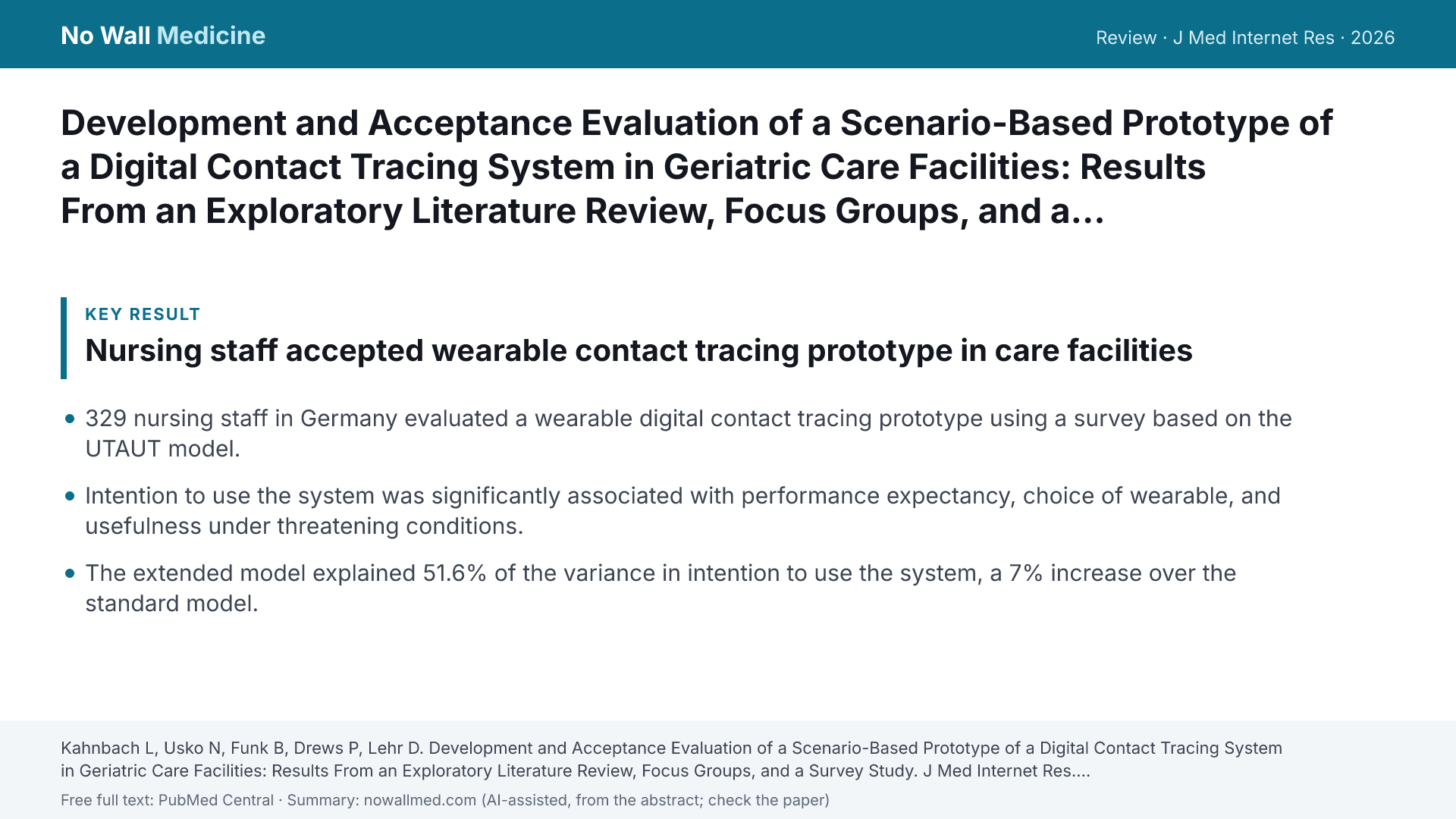
Development and Acceptance Evaluation of a Scenario-Based Prototype of a Digital Contact Tracing System in Geriatric Care Facilities: Results From an Exploratory Literature Review, Focus Groups, and a Survey Study
Key result: Nursing staff accepted wearable contact tracing prototype in care facilities
Key points
- 329 nursing staff in Germany evaluated a wearable digital contact tracing prototype using a survey based on the UTAUT model.
- Intention to use the system was significantly associated with performance expectancy, choice of wearable, and usefulness under threatening conditions.
- The extended model explained 51.6% of the variance in intention to use the system, a 7% increase over the standard model.
Why it matters: It is unclear whether nursing staff will accept wearable digital contact tracing systems needed to replace broad isolation in care homes.
Limitation the authors note: The study relied on a scenario-based prototype rather than a fully implemented system in real-world settings.
Discussion prompts
- Would these patients look like yours? Who was left out?
- Is the main outcome one that matters to patients?
- Is the difference large enough to change what you do?
Cite: Kahnbach L, Usko N, Funk B, Drews P, Lehr D. Development and Acceptance Evaluation of a Scenario-Based Prototype of a Digital Contact Tracing System in Geriatric Care Facilities: Results From an Exploratory Literature Review, Focus Groups, and a Survey Study. J Med Internet Res. 2026. doi:10.2196/84065
Free full text: PubMed Central · Summary and visual abstract: nowallmed.com/a/development-and-acceptance-evaluation-of-a-scenario-based-prototype-1isooca/ (AI-assisted from the abstract; check the paper before relying on it).