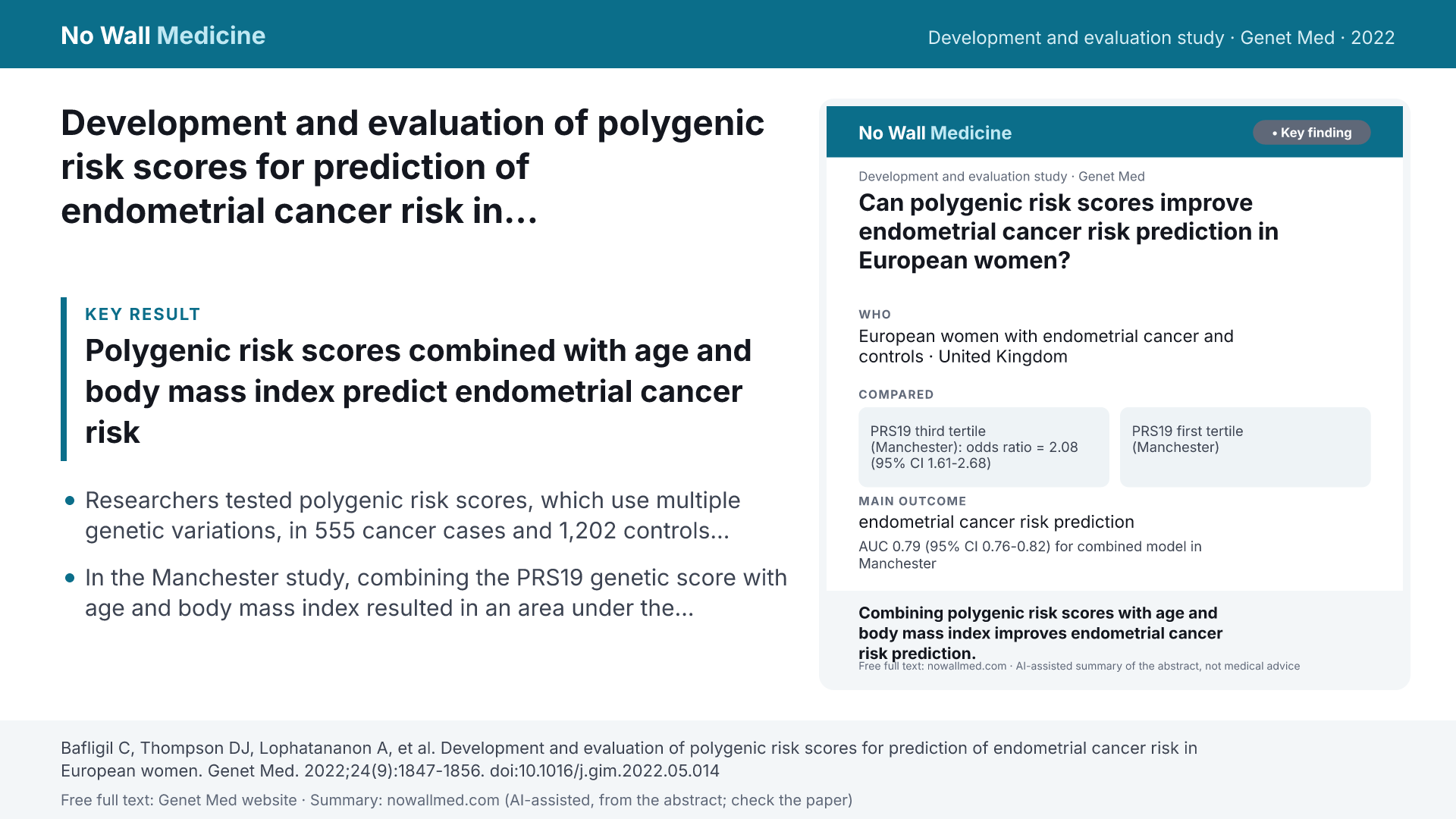
Polygenic risk scores combined with age and body mass index predict endometrial cancer risk
Development and evaluation of polygenic risk scores for prediction of endometrial cancer risk in European women
Development and evaluation studyKey finding
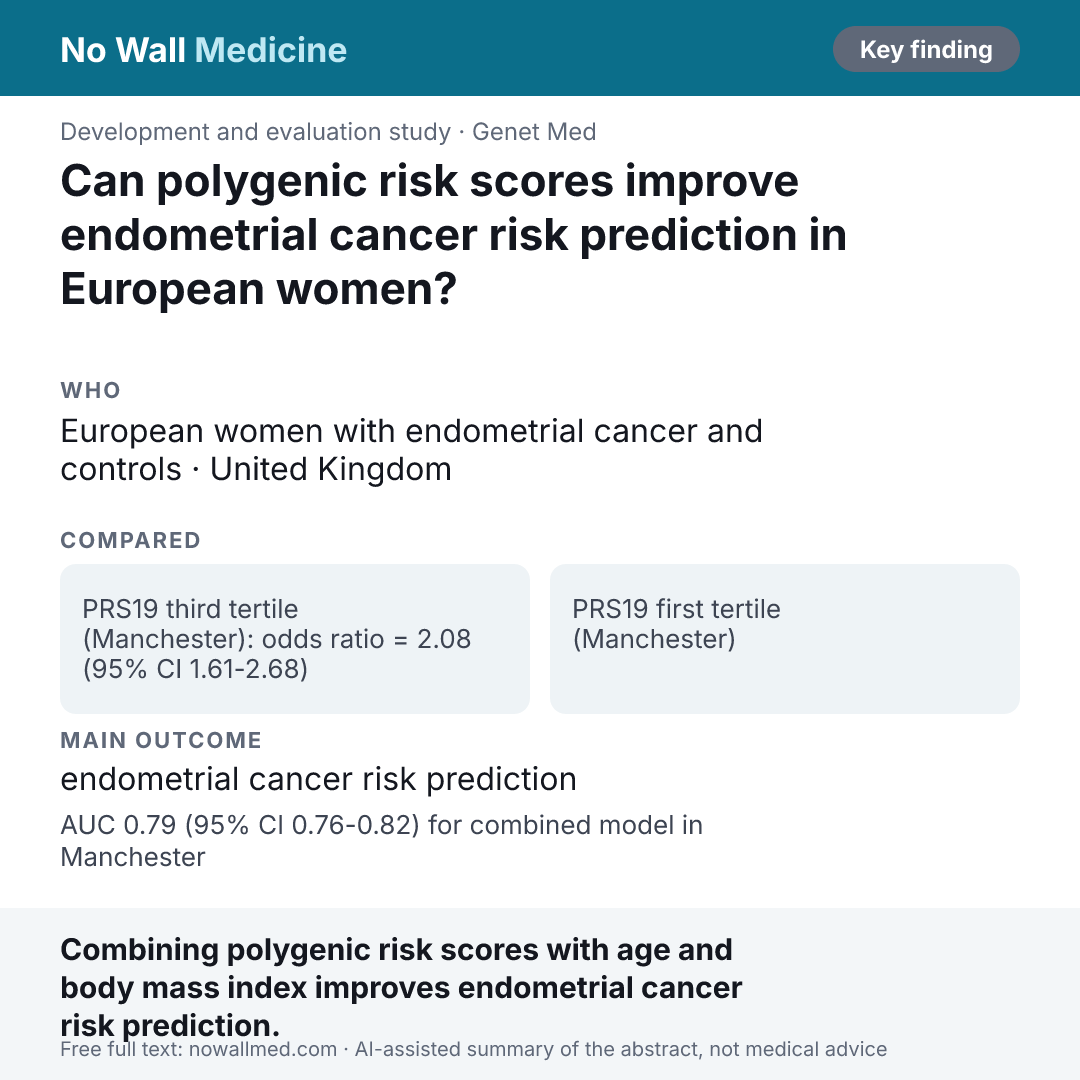
Can polygenic risk scores improve endometrial cancer risk prediction in European women?
Who
European women with endometrial cancer and controls · United Kingdom
Compared
PRS19 third tertile (Manchester): odds ratio = 2.08 (95% CI 1.61-2.68)
PRS19 first tertile (Manchester)
Main outcome
endometrial cancer risk prediction
Result: AUC 0.79 (95% CI 0.76-0.82) for combined model in Manchester
Bottom line: Combining polygenic risk scores with age and body mass index improves endometrial cancer risk prediction.
Genet Med · 2022-06-15 · Save PNG
Clinical question: Can polygenic risk scores improve endometrial cancer risk prediction in European women?
Key points
- Researchers tested polygenic risk scores, which use multiple genetic variations, in 555 cancer cases and 1,202 controls in Manchester and 1,676 cases and 116,960 controls in the UK Biobank.
- In the Manchester study, combining the PRS19 genetic score with age and body mass index resulted in an area under the receiver operator curve of 0.79.
- Women in the highest third of the PRS19 score in the Manchester study had a 2.1-fold increased risk of endometrial cancer compared to those in the lowest third.
Headline and key points written with AI from the paper’s abstract, with every number checked against it. Read the paper before relying on them.
Was this summary helpful?
Subject terms
Headline, design, result, key points, caveat and citation as plain text.
Cite this article
Bafligil C, Thompson DJ, Lophatananon A, et al. Development and evaluation of polygenic risk scores for prediction of endometrial cancer risk in European women. Genet Med. 2022;24(9):1847-1856. doi:10.1016/j.gim.2022.05.014
Spotted a mistake? Suggest a correction